The Jakarta Post
Please Update your browser
Your browser is out of date, and may not be compatible with our website. A list of the most popular web browsers can be found below.
Just click on the icons to get to the download page.


Popular Reads
Top Results
No results found. Please check your search term and try again
Can't find what you're looking for?
View all search results
Popular Reads
Top Results
No results found. Please check your search term and try again
Can't find what you're looking for?
View all search resultsWhy a just land transition needs real funding
Up to 40 percent of our planet’s lands are degraded and deteriorating, jeopardizing the health and livelihoods of more than 3 billion people.
Change text size
Gift Premium Articles
to Anyone
Share the best of The Jakarta Post with friends, family, or colleagues. As a subscriber, you can gift 3 to 5 articles each month that anyone can read—no subscription needed!
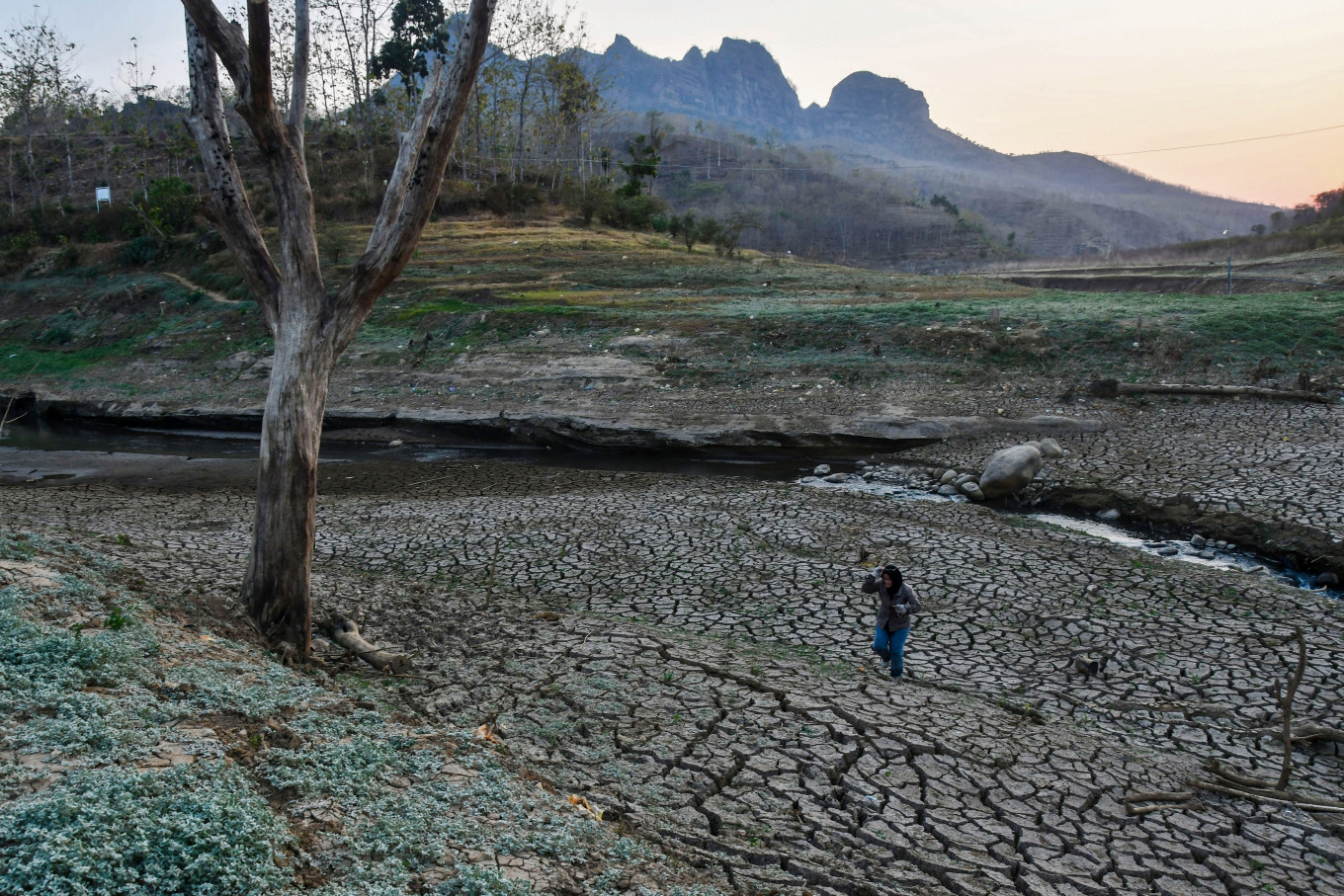 A woman walks on Sept. 20, 2024 across the dried-up bed of the Bendo Reservoir in Ponorogo, East Java, which has been hit by severe drought. (Antara/Siswowidodo)
W
ith the United Nations Climate Change Conference (COP30) and the Group of 20 (G20) Leaders’ Summit now concluded, attention turns to this week’s gathering of the UN Convention to Combat Desertification (UNCCD) in Panama. Whether the event delivers progress on sustainable land management and drought resilience in a just and equitable manner hinges largely on one familiar factor: finance.
Insufficient funding has emerged as a stumbling block in advancing multiple Sustainable Development Goals (SDGs), with SDG 15, focused on the protection, restoration and sustainable use of land and terrestrial ecosystems, receiving some of the lowest levels of finance. But human well-being, and progress toward many other SDGs, depends directly on healthy soil, water and terrestrial biodiversity.
Already, up to 40 percent of our planet’s lands are degraded and deteriorating, jeopardizing the health and livelihoods of more than 3 billion people, especially poor rural communities, small-scale farmers, women, youth, indigenous peoples and other at-risk groups. Annual economic losses linked to desertification, land degradation and drought amount to US$878 billion, far more than the investments needed to address them. A just transition from an exploitative land economy to one that is restorative, inclusive and resilient is urgently needed.
The concept of a just transition has become central to discussions on climate action, in particular, the energy transition. For example, it is understood that European communities dependent on coal production need support, so that they can secure good jobs in emerging clean industries. Globally, numerous initiatives have been created to support a just energy transition. But no equivalent exists for the land sector (which includes agriculture, forestry and other land use), even though the need for a “just land transition” to support interconnected climate, nature and human-development imperatives is at least as great.
Land-related activities account for nearly a quarter of greenhouse-gas emissions and employ over 20 times more workers than the energy sector globally. Moreover, unlike energy-sector workers, who tend to be formally employed, with regular, reasonably strong wages, many land workers are self-employed or seasonal, meaning that they have minimal safety nets and low financial resilience. In fact, extreme poverty is typically concentrated in degraded rural communities, which are often among the most exposed to climate and non-climate shocks.
Now, these communities are being forced to pursue their own transitions, with minimal support from the international community, including the countries that are most responsible for climate change. For example, climate change has left nomadic pastoralists in the Horn of Africa, whose own carbon footprint is negligible, with no choice but to alter millennia-old migration routes, owing to water scarcity and land degradation. Such unstructured and risky transitions exacerbate poverty, inequality and marginalization, increasing the risk of instability, out-migration and conflict, and underscoring the need to support vulnerable communities and ecosystems on the frontline of climate change, nature loss and land degradation.

But the news is not all bad. Momentum is gathering around land and soil restoration. China has long been a land-restoration pioneer, exemplified by the Three-North Shelterbelt Forest Program that began in 1978. And a growing number of countries are emulating such initiatives with local efforts to strengthen resilience increasingly complemented by national plans for halting and reversing land degradation and improving drought management.