The Jakarta Post
Please Update your browser
Your browser is out of date, and may not be compatible with our website. A list of the most popular web browsers can be found below.
Just click on the icons to get to the download page.


Popular Reads
Top Results
No results found. Please check your search term and try again
Can't find what you're looking for?
View all search results
Popular Reads
Top Results
No results found. Please check your search term and try again
Can't find what you're looking for?
View all search resultsWhy Malaysia must reform its Islamic home financing
Islamic home financing in Malaysia needs urgent form, as in its current iteration, it is failing too many buyers when projects stall or collapse.
Change text size
Gift Premium Articles
to Anyone
Share the best of The Jakarta Post with friends, family, or colleagues. As a subscriber, you can gift 3 to 5 articles each month that anyone can read—no subscription needed!
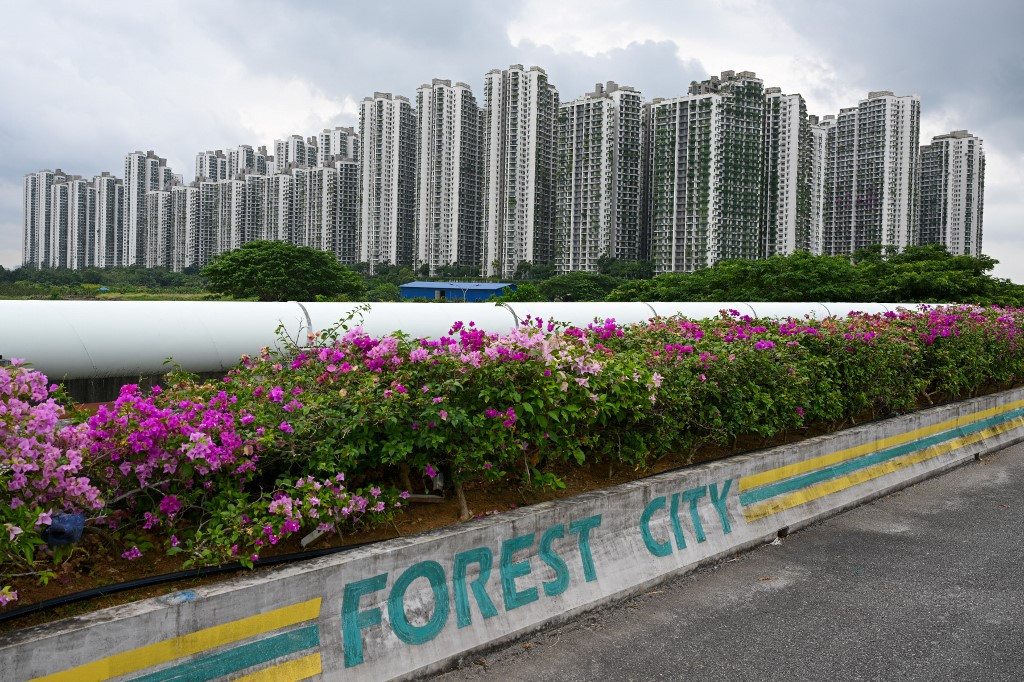 The logo of Forest City, a Malaysian development project in Johor state’s Gelang Patah launched under China's Belt and Road Initiative, marks a curb along an access road leading to a crop of towering condominiums on Sept. 1, 2023. (AFP/Mohd Rasfan)
I
slamic home finance in Malaysia was introduced in the 1980s with high expectations. It promised to create a system free from riba (usury), gharar (harmful uncertainty) and ẓulm (injustice) for 20.6 million Malaysian Muslims.
Four decades on, the original vision of Islamic home finance as an ethical, risk sharing alternative compliant to sharia is now being put to the test.
Ironically, sharia-compliant home financing has been implicated in the government’s recent findings as of Sept. 30, which identified 15,553 homebuyers affected by 107 abandoned housing projects comprising 29,587 units.
Some sharia-labeled home financing products closely resemble conventional loans, highlighting the need for clearer and more substantive differentiation to better guide and protect consumers, a concern that has already prompted calls for reform. Consequently, many families continue to make monthly payments for homes that remain unfinished, are delivered long past their promised dates or, in some cases, never materialize at all.
These perceptions have eroded public trust and confidence in Islamic home financing instruments, but reforms aimed at enhancing fairness, transparency and shared responsibility are gaining momentum.
The most common Islamic home financing structures in Malaysia are Bayʿ Bithaman al-Ājil (BBA; deferred payment sale) and tawarruq (deferred purchase, followed by quick resale for cash). Both are designed to avoid the direct payment of interest, yet their financial outcomes often resemble those of conventional loans.

In a typical BBA arrangement, for instance, the bank purchases the property and resells it to the buyer at a marked-up price to be paid in installments. While this structure formally avoids charging interest, its economics are almost identical. Banks lock in fixed returns while buyers bear the risks of nondelivery, delays or even project abandonment. This goes against the principle of al-ghunm bi al-ghurm: that profit should come hand in hand with risk.
Prominent scholars, including Justice Taqi Usmani, have warned that such contractual maneuvers risk undermining the ethical foundations of Islamic finance.
Many homebuyers continue to service loans for projects that are severely delayed, partially abandoned or unlikely to be completed. Such financial and emotional burdens run counter to maqāṣid al-sharīʿah, the higher objectives of sharia that uphold justice, welfare and the protection of wealth.
Islamic banks are under growing pressure from global regulations and investor expectations. The Basel Accord enforces stringent capital, liquidity and risk weight requirements to maintain financial stability.
These regulations, however, make debt-based contracts such as BBA, murabaḥah (a cost-plus resale on deferred payment) and tawarruq more capital efficient, and therefore more appealing to banks.
By contrast, genuine risk sharing models such as mushārakah mutanāqiṣah (diminishing partnership) and ijārah (Islamic leasing contract) typically demand more capital and appear less profitable on paper.
This dynamic forces banks to prioritize balance sheet “safety”, often shifting delivery risks onto homebuyers. In doing so, Basel inadvertently reinforces the “form over substance” dilemma that continues to shadow Islamic finance.
At the national level, neither the Shariah Advisory Council (SAC) of Bank Negara Malaysia nor the Shariah Committees (SCs) of individual Islamic banks are legally required to include consumer representatives.
To enhance fairness, Malaysia’s Islamic finance sector should ensure that SCs are appointed and remunerated independently, a move that would reduce potential conflicts of interest and strengthen public trust.
As a result, borrowers’ hardships, such as paying installments for homes that are delayed or abandoned, often go unheard. Dispute mechanisms meanwhile tend to favor financiers, leaving affected families with little meaningful recourse.
The Gulf Cooperation Council (GCC) countries face similar challenges, and have taken steps to guard against them.
In Dubai, the United Arab Emirates, a 2007 law mandates all buyer payments be placed in regulated escrow accounts to safeguard funds and ensure transparency. Funds can only be released in line with verified construction progress. If a project stalls, the Dubai Land Department or a special tribunal may order refunds or transfer the project to another developer.
In Bahrain, the Stalled Property Committee is empowered under a 2014 decree to replace failing developers, merge projects or liquidate assets to protect homebuyers. In Saudi Arabia, the Wafi off-plan sales program and SAMA’s escrow regulations ensure that buyer payments are ring-fenced, with any liquidation handled through the Infath Centre.
Nonetheless, property development oversight and consumer protection in these GCC countries still require stronger safeguards and more consistent enforcement.
To restore public trust and uphold sharia principles, Malaysia’s Islamic home financing should prioritize the Build-Then-Sell (BTS) model offering financing only for completed homes, thereby eliminating abandonment risks and avoiding gharar. Where the Sell-Then-Build (STB) model remains in use, developers should be required to provide insurance coverage and a clear rehabilitation plan within financing contracts.
Sharia governance should also be strengthened through an independent consumer ombudsperson, third-party sharia audits and consumer representation on the country’s SAC and sharia committees.
Malaysia should also reform the Housing Development (Control and Licensing) Act 1966 (Act 118) to make financiers partially accountable when projects fail, creating a fairer balance of responsibility among banks, developers and homebuyers.
To advance its goal of fully embedding Islamic principles in banking and finance, Malaysia could expand sukuk-funded housing programs and create a dedicated rehabilitation fund to revive distressed or abandoned projects.
A National Islamic Housing Fund could adopt the BTS model and the profit and risk sharing principle of al-ghunm bi al-ghurm, offering stronger protection for homebuyers.
Capital could be drawn from Khazanah Nasional Berhad, the Employees Provident Fund (EPF), the Retirement Fund (KWAP), Permodalan Nasional Berhad (PNB) and Tabung Haji. This could be reinforced through government guarantees, musharakah-based sukuk and targeted contributions from waqf, zakat and corporate social responsibility programs.
If Malaysia and the GCC fail to reform Islamic home financing to make it more equitable and aligned with the principles of maqāṣid al-sharīʿah, the consequences could be severe.
Public trust in Islamic finance may likely keep eroding without concrete action. Malaysia’s goal of addressing its deficit of 1 million homes by 2026, through a mix of financing instruments including Islamic options, could also be at risk.
---
The writer is a law lecturer at Universiti Utara Malaysia. This article is republished under a Creative Commons license.