TheJakartaPost
Please Update your browser
Your browser is out of date, and may not be compatible with our website. A list of the most popular web browsers can be found below.
Just click on the icons to get to the download page.


Popular Reads
Top Results
No results found. Please check your search term and try again
Can't find what you're looking for?
View all search results
Popular Reads
Top Results
No results found. Please check your search term and try again
Can't find what you're looking for?
View all search resultsThe sea of discrimination: Migrant fishers are denied justice
Migrant fishers holding transit visas cannot report their grievances to authorities without fear of deportation and criminalization.
Change text size
Gift Premium Articles
to Anyone
Share the best of The Jakarta Post with friends, family, or colleagues. As a subscriber, you can gift 3 to 5 articles each month that anyone can read—no subscription needed!
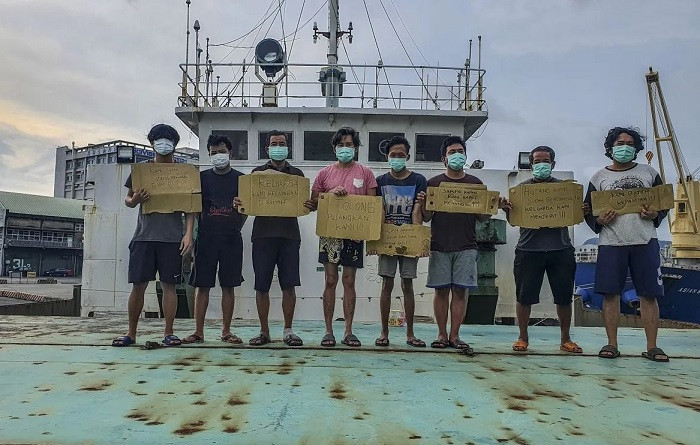 Calling home: Indonesian fishers hold posters on Aug. 11, 2022, aboard a vessel as it docks at Kaohsiung Port in Taiwan, asking for the government’s help to repatriate them. The fishermen were reportedly stuck on the boat, believed to belong to a Hong Kong company, since February 2022 without pay. (Antara/Fahmi Fahmal Sukardi)
A
s the world celebrated Human Rights Day last week, many remain without basic rights, especially those working on fishing vessels. This is commonly reported in the global fishing industry, even in Europe.
Earlier this year, six Indonesian migrant fishers were abandoned for eight months while employed on a Portuguese-flagged fishing fleet, left without adequate pay, repatriation and remedy. Meanwhile, on vessels flagged to the United Kingdom and Ireland, Indonesian and Filipino migrant fishers continue to face discrimination in terms of salary, working hours and social protection vis-à-vis European fishers.
The dire human rights situation is not because of the absence of human rights and labor legislation. In fact, the UK and Portugal have ratified ILO Convention 188 on Work in Fishing C-188 (C-188), the international agreement addressing decent work in fishing vessels. In addition to weak monitoring and enforcement, insecure immigration status contributes to the heightened vulnerability of migrant fishers.
In terms of immigration status, migrant fishers are issued different types of visas depending on the fishing grounds in which they work. Those employed on fishing vessels operating in territorial waters typically receive work visas. Meanwhile, migrant fishers working on board distant-water fleets operating beyond territorial waters are issued transit visas. This practice is evident in Taiwan, South Korea and the UK.
Those differences determine the rights and treatments that migrant fishers are entitled to. A work visa provides legal recognition to fishers as workers and gives them access to basic protections such as social security, healthcare, legal aid, fair wages, safer mobility and reduced risks of deportation or retaliation.
However, a transit visa gives fishers an insecure immigration status because they are not recognized as workers within this scheme. They are, thus, excluded from the labor standards in the national legal framework. Furthermore, their mobility is far more restricted than workers under the working visa scheme.

A transit visa only allows fishers to enter the port and remain within this area while waiting for their departure to the international waters. They cannot access areas outside of the port absent vessel owners’ permission.