The Jakarta Post
Please Update your browser
Your browser is out of date, and may not be compatible with our website. A list of the most popular web browsers can be found below.
Just click on the icons to get to the download page.


Popular Reads
Top Results
No results found. Please check your search term and try again
Can't find what you're looking for?
View all search results
Popular Reads
Top Results
No results found. Please check your search term and try again
Can't find what you're looking for?
View all search resultsBetting Indonesia's future, years and lungs on coal
Rapid industrial expansion in Java and Sulawesi, driven by the government’s downstreaming strategy, is being used to justify a surge in new coal capacity.
Change text size
Gift Premium Articles
to Anyone
Share the best of The Jakarta Post with friends, family, or colleagues. As a subscriber, you can gift 3 to 5 articles each month that anyone can read—no subscription needed!
 This photo taken on October 14, 2022 shows vessels carrying coal near Pha Lai thermal power plant in Hai Duong province, Vietnam. Solar power has boomed in Vietnam, its climate targets are ambitious, but the fast-growing economy is struggling to quit dirty energy, leaving one of the biggest coal power development programs in the world largely intact. (AFP/-)
D
espite a hopeful message at the recent climate conference (COP30) in Brazil promising to enhance Indonesia's national climate commitment and cooperate on global ambition, the country’s climate envoy and President Prabowo Subianto’s brother, Hashim Djojohadikusumo, has instead doubled down on rejecting a coal phase-out, emphasizing a “phase-down” instead.
This announcement comes at a troubling time. Recent climate-fueled extreme weather events have killed more than 1,600 people and displaced hundreds of thousands across South and Southeast Asia. In Indonesia, devastating flooding and landslides in Aceh, North Sumatra and West Sumatra have recently claimed over 1,000 lives.
Currently, coal fuels 62 percent of Indonesia’s power generation. Further, the country still plans to add sizable fossil power capacity in the next 10 years, the equivalent of 30 large coal and gas power plants.
In light of climate commitments, specifically the need to decarbonize energy systems, the government has outlined an eventual ramp up of renewables to reach 50 percent of the mix, but only in 2044. The pace is out of touch with reality. Indonesia aims to achieve 350 gigawatts (GW) of renewables capacity by 2060; meanwhile China installed 360 GW of solar and wind power in 2024 alone.
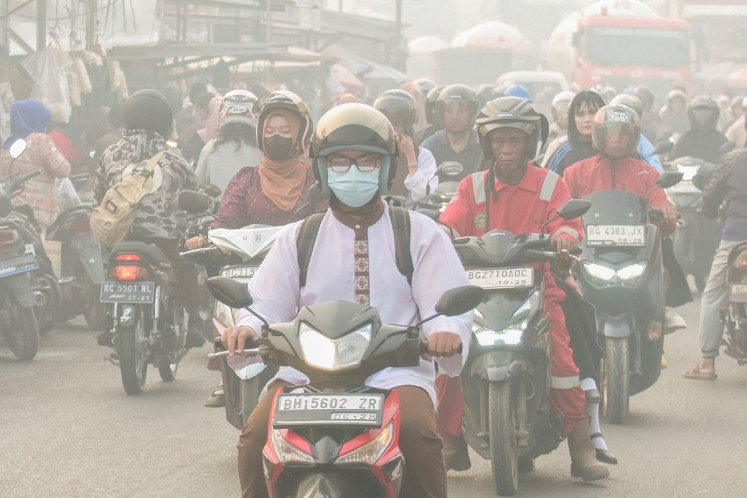
Consequently, Indonesia stands as the most polluted country in Southeast Asia. This crisis is driven by a complex mix of sources: a massive fleet of coal-fired power plants, millions of older vehicles saturating urban air and large-scale forest and peat fires causing transboundary haze.
Recently, the situation has worsened. Rapid industrial expansion in Java and Sulawesi, driven by the government’s downstreaming strategy, is being used to justify a surge in new coal capacity. This policy may fuel economic growth, but it locks in severe air pollution for decades. The nation still does not have a national clean air action plan.

The human and economic toll will be staggering. Over the lifetime of the coal plants alone, air pollution-related deaths are projected to exceed 300,000. This will cost the economy an estimated US$210 billion, well above the state budget for 2026.