TheJakartaPost
Please Update your browser
Your browser is out of date, and may not be compatible with our website. A list of the most popular web browsers can be found below.
Just click on the icons to get to the download page.


Popular Reads
Top Results
No results found. Please check your search term and try again
Can't find what you're looking for?
View all search results
Popular Reads
Top Results
No results found. Please check your search term and try again
Can't find what you're looking for?
View all search resultsExtended responsibility
Plastic waste remains a common sight on our streets, waterways and beaches, even as the government moves to phase out disposable polymers by 2030.
Change text size
Gift Premium Articles
to Anyone
Share the best of The Jakarta Post with friends, family, or colleagues. As a subscriber, you can gift 3 to 5 articles each month that anyone can read—no subscription needed!
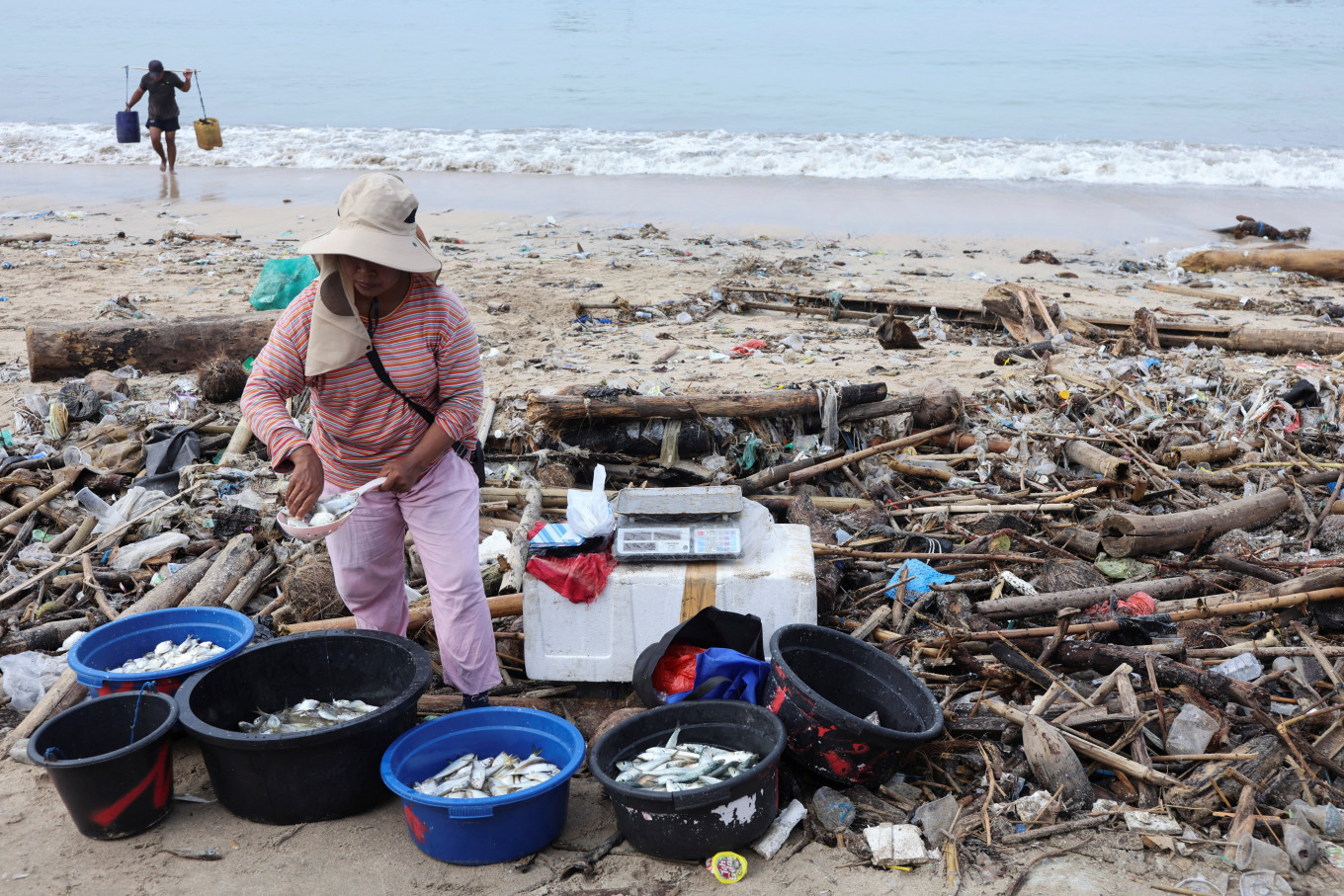 Never-ending: A fish vendor stands near trash on Dec. 19, 2025, during an emergency cleanup at Kedonganan Beach, Badung, Bali. The trash is swept on to the beach by the sea and originates from various area across the resort island. (REUTERS/Johannes P. Christo)
P
lastic pollution is still a pervasive sight across our landscapes and oceans, with only four years remaining until the national deadline to phase out disposable polymers. While plastics, invented some 150 years ago, have undeniably made our lives easier and transformed how we shop, eat and live, this convenience comes at a heavy cost.
Our dependence on disposability carries a steep environmental price. Roughly 13,000 tonnes of plastic waste was tossed nationwide every day last year, much of which either ended up in the ocean, choking our waterways, or bloating landfills, as these materials often take centuries to decompose.
A recent report from the non-profit Dietplastik Indonesia, formerly the Plastic Bag Diet movement, found that most Indonesian cities and regencies are failing to restrict throwaway plastics like shopping bags, food containers and bottles. Of more than 500 regions across the country, only about 100 have issued restrictions to date, less than four years before the 2030 national target.
The study analyzed 101 regulations issued across 27 provinces since 2018, uncovering a low level of enforcement and a significant lack of oversight. Furthermore, surveys of consumers and businesses in Jakarta, Bali, Bogor and Kediri revealed that while 55 to 70 percent of businesses complied with local rules, public participation lagged behind at only 40 to 65 percent.
In Bali, the report noted that traditional market vendors still offer disposable bags, though regulations successfully halved plastic use in modern retail outlets. In Jakarta, initial restrictions reduced bag use by 80 percent in 2020, but progress ultimately faltered due to poor monitoring.
To bridge this gap, the government has recently pivoted toward more visible, nationwide mobilization. The President recently launched ASRI, an acronym for Aman, Sehat, Resik, Indah (Safe, Healthy, Clean and Beautiful), a flagship initiative designed to harmonize national policy with local execution. ASRI aims to move beyond mere regulation, fostering a culture where plastic reduction is a shared national responsibility rather than a bureaucratic burden.

However, the persistent distribution of polymers remains a symptom of a deeper issue: the government’s failure to fully enforce the Extended Producer Responsibility (EPR) policy. This policy is a core part of the waste reduction roadmap for manufacturers, the food and beverage industry and retailers.