The Jakarta Post
Please Update your browser
Your browser is out of date, and may not be compatible with our website. A list of the most popular web browsers can be found below.
Just click on the icons to get to the download page.


Popular Reads
Top Results
No results found. Please check your search term and try again
Can't find what you're looking for?
View all search results
Popular Reads
Top Results
No results found. Please check your search term and try again
Can't find what you're looking for?
View all search resultsAnalysis: Strait of Hormuz blockade exposes Indonesia’s energy vulnerabilities
Change text size
Gift Premium Articles
to Anyone
Share the best of The Jakarta Post with friends, family, or colleagues. As a subscriber, you can gift 3 to 5 articles each month that anyone can read—no subscription needed!
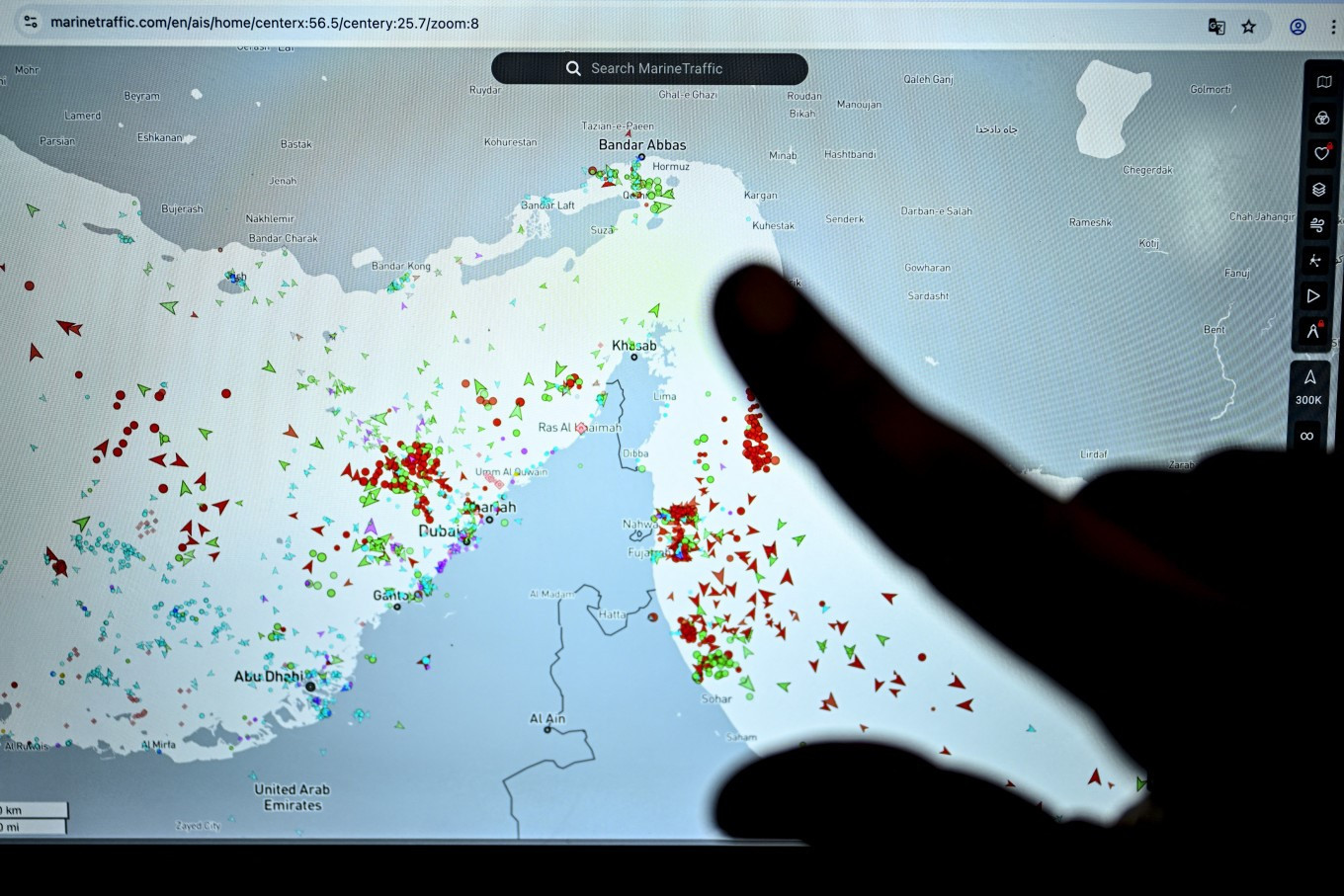 A person points at a page on the Marinetraffic website that shows commercial shipping traffic on the edge of the Strait of Hormuz near the Iranian coast, on March 4 in Paris. (AFP/Julien De Rosa)
T
he closure of the Strait of Hormuz amid the escalating Middle East war has disrupted global oil and gas shipments, driving up prices and exposing Indonesia to serious energy and financial risks. Around 25 percent of the country's oil imports originate from the Middle East and pass through the strait, while domestic fuel reserves can only last for around 20 days. With oil prices recently surpassing US$100 per barrel and the rupiah weakening to around Rp 17,000 per United States dollar, Indonesia now faces an additional layer of economic and energy security risk. The administration of President Prabowo Subianto is therefore under pressure to secure alternative supplies and stabilize domestic markets.
The Energy and Mineral Resources Ministry revealed that the current fuel stockpile provides a consumption buffer of only between 20 and 25 days, far below the 90-day net import reserve recommended for members of the International Energy Agency (IEA). Official data show that domestic fuel consumption totaled 82.9 million kiloliters (kL) in 2024, or roughly 227,136 kL per day. The ministry has noted that existing reserves are mainly intended to meet daily operational needs, while limited storage capacity constrains the country’s ability to maintain strategic petroleum reserves. According to the National Energy Council (DEN), state-owned oil and gas holding company Pertamina holds the majority of national energy reserves.
Several key fuel products have a buffer period of less than a month. Liquefied petroleum gas (LPG) has only 15 days of reserves, while most diesel products have around an 18-day buffer period. The subsidized high-octane gasoline product Pertalite, which is rated research octane number (RON) 90, has a buffer period of 19 days, RON 92 gasoline 26 days and both RON 98 gasoline and jet fuel around 29 days. Other fuels have slightly longer buffer periods: marine fuel oil (33 days), kerosene (38 days) and cetane number (CN) 53 diesel fuel (39 days).
The Strait of Hormuz remains one of the world’s most critical energy choke points. In 2024, around 20.3 million barrels per day (mbpd) of oil passed through the strait, or nearly one-fifth of global oil consumption of around 102.7 mbpd, according to the US Energy Information Administration. LNG shipments through the strait reached approximately 291.49 million cubic meters. At its narrowest point, the waterway is only around 33 kilometers wide, making it particularly vulnerable to disruption during a regional conflict.
The US-Israeli war with Iran has caused oil prices to surge. On March 9, 2026, both the Brent and West Texas Intermediate (WTI) crude oil futures briefly jumped to $119.5 and $119.48 per barrel, respectively, after several Arab Gulf states reduced oil and gas production. Prices later eased slightly but remained elevated after US President Donald Trump vowed to seize control of the Strait of Hormuz. Brent crude futures eventually closed down 4.6 percent at $88.43 per barrel, while WTI settled 6.19 percent lower at $85.27.
Rising oil prices present a direct fiscal risk for Indonesia. The 2026 state budget assumes an average crude oil price of $70 per barrel. State-owned Bank Mandiri estimates that every $1 increase in crude prices will add approximately Rp 10.3 trillion ($608 million) in energy subsidies and compensation costs, while added tax and royalty revenues will reach only around Rp 3.5 trillion. Inflationary pressure would also rise: Every 10 percent increase in Pertalite price could push up inflation by 0.27 percentage points, while a similar price increase for subsidized diesel product Solar would raise inflation by around 0.05 percentage points.

Public awareness of the potential disruption to fuel supplies, combined with official acknowledgement of limited national reserves, has triggered panic buying in several regions. This has worsened fuel supply disruptions that have been affecting Aceh, North Sumatra and Riau since early March. The demand surge has added further strain to supply chains, particularly as fuel consumption typically rises ahead of Idul Fitri. Pertamina had previously projected gasoline demand during the holiday season to increase around 12 percent compared with normal levels.