The Jakarta Post
Please Update your browser
Your browser is out of date, and may not be compatible with our website. A list of the most popular web browsers can be found below.
Just click on the icons to get to the download page.


Popular Reads
Top Results
No results found. Please check your search term and try again
Can't find what you're looking for?
View all search results
Popular Reads
Top Results
No results found. Please check your search term and try again
Can't find what you're looking for?
View all search resultsAmong competing powers, Indonesia charts a quiet path
Indonesia is practicing a balancing strategy, engaging multiple major powers simultaneously, not to hedge passively, but to actively expand its room for maneuver.
Change text size
Gift Premium Articles
to Anyone
Share the best of The Jakarta Post with friends, family, or colleagues. As a subscriber, you can gift 3 to 5 articles each month that anyone can read—no subscription needed!
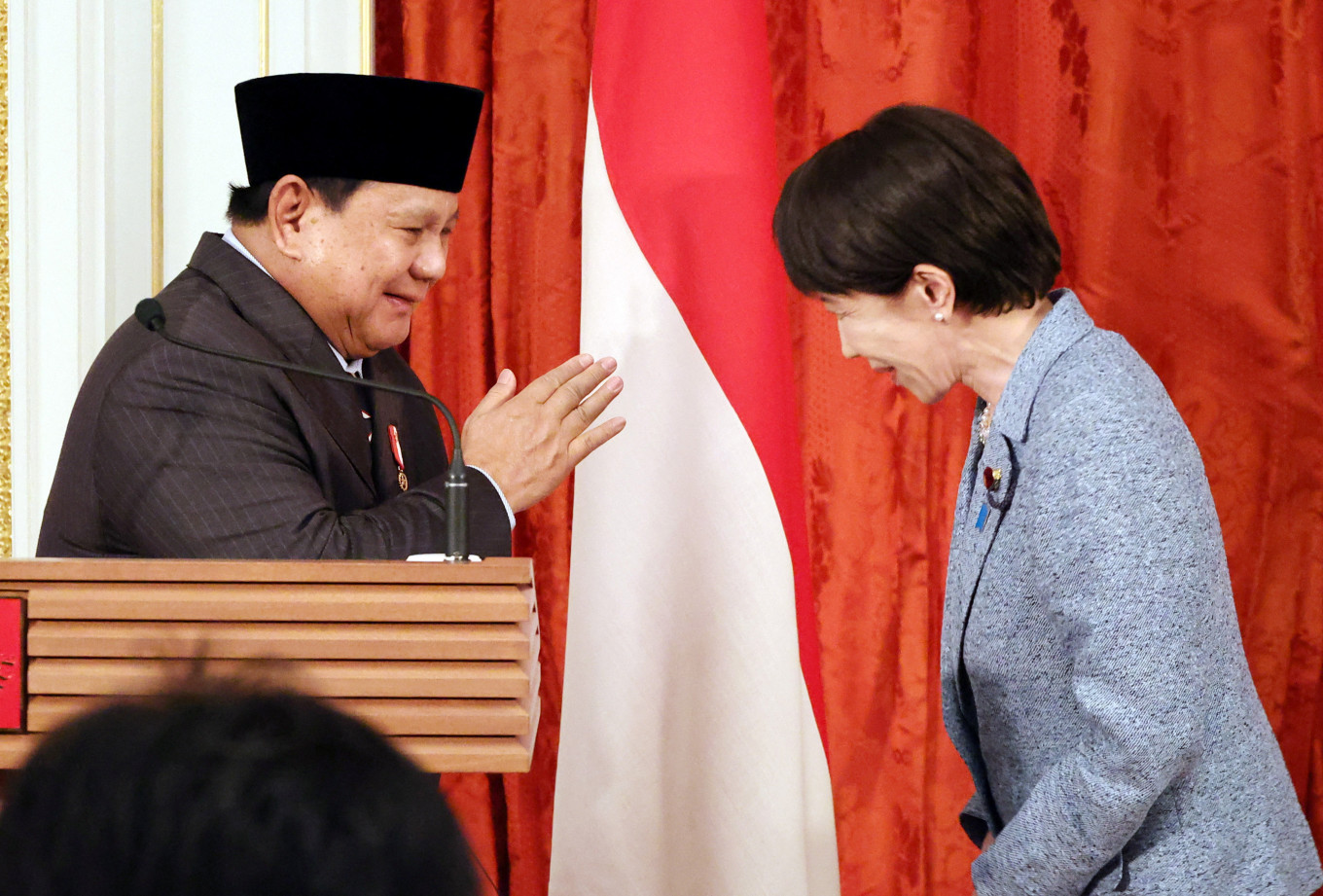 President Prabowo Subianto (left) and Japanese Prime Minister Sanae Takaichi exchange bows after they announced their joint statements on March 31 at the Akasaka Palace in Tokyo. (Reuters/Pool/Yoshikazu Tsuno)
T
he recent state visit of President Prabowo Subianto to Japan may appear, at first glance, to be routine state diplomacy. Yet, through the lens of Japanese media and academia, it reveals something far more consequential: Indonesia’s deliberate positioning within the evolving landscape of kokusai seiji, or international politics.
The Indo-Pacific today is increasingly shaped by structural tensions between the United States and China, a rivalry that is not merely strategic, but systemic. It is redefining the contours of the international order itself. Japan, firmly anchored within the US alliance system, continues to promote its vision of a Free and Open Indo-Pacific (FOIP), while China expands its influence through capital, infrastructure and industrial integration.
Within this contested space, Indonesia’s posture stands out not for its alignment, but for its restraint. As observed in Japanese discourse, Jakarta’s approach reflects a modern reinterpretation of jishu gaiko, or autonomous diplomacy, not as ideological neutrality, but as calculated flexibility. This is not indecision. It is design.
Indonesia is, in effect, practicing a balancing strategy, engaging multiple major powers simultaneously, not to hedge passively, but to actively expand its room for maneuver. At the core of this approach lies a clear objective: the maximization of national interest.
From a Japanese analytical standpoint, such a strategy reflects a high degree of rationality within gaiko senryaku, or foreign policy strategy. Indonesia appears to recognize that dependence, even when economically beneficial, ultimately narrows strategic autonomy.
Balance, therefore, is not simply a diplomatic posture; it is a mechanism for preserving national sovereignty.

What makes this approach particularly notable is its functional clarity. China remains indispensable in areas requiring scale and speed, especially infrastructure and resource-driven industrialization. Japan, by contrast, represents technological depth, institutional reliability and a pathway toward industrial upgrading. Meanwhile, the US continues to underpin the broader architecture of security and global strategic equilibrium. Rather than choosing between these actors, Indonesia assigns them distinct roles.