The Jakarta Post
Please Update your browser
Your browser is out of date, and may not be compatible with our website. A list of the most popular web browsers can be found below.
Just click on the icons to get to the download page.


Popular Reads
Top Results
No results found. Please check your search term and try again
Can't find what you're looking for?
View all search results
Popular Reads
Top Results
No results found. Please check your search term and try again
Can't find what you're looking for?
View all search resultsA lesson from Doha: Why Middle East wars are never distant
The Middle East war affecting Doha and the Gulf in general proves that education also depends on peace, stability and institutions capable of protecting learning from violence.
Change text size
Gift Premium Articles
to Anyone
Share the best of The Jakarta Post with friends, family, or colleagues. As a subscriber, you can gift 3 to 5 articles each month that anyone can read—no subscription needed!
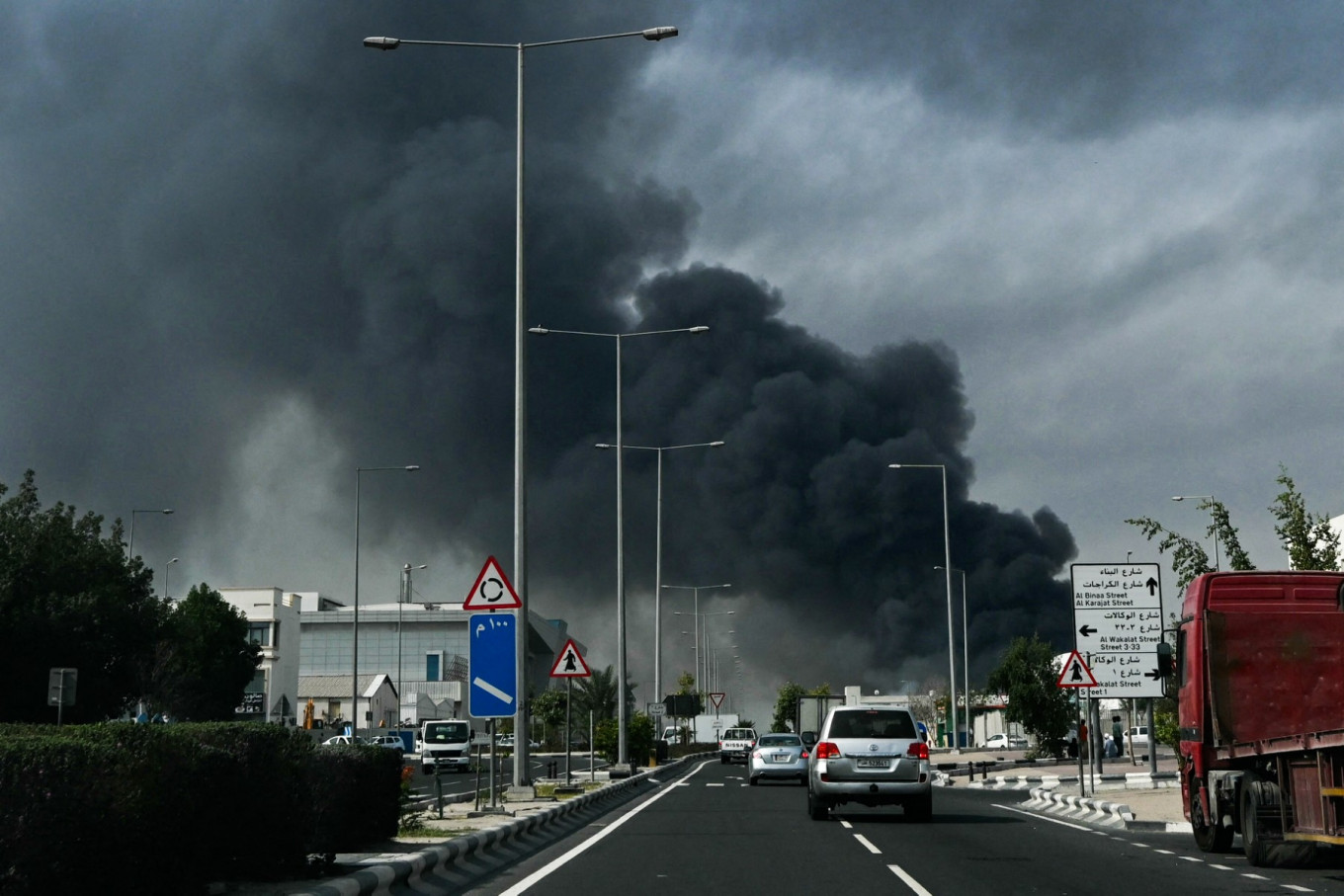 Motorists drive past a plume of smoke rising from a reported Iranian strike in the industrial district of Doha on March 1, 2026. (AFP/Mahmud Hams)
On Feb. 28, the United States-Israeli war on Iran stopped being a distant headline for those of us studying in Qatar.
Within hours, the Qatari government announced that all schools, universities and educational centers would shift to distance learning starting March 1 as a precautionary measure.
What had begun as breaking news quickly entered our daily routines. Lecture schedules changed overnight. Families back home began calling more often. Suddenly, the question of what tomorrow might look like no longer felt predictable.
For six weeks now, this conflict has taught me something I did not expect to learn as a student in the Middle East: Here, war does not stay on television. It spills into classrooms, dormitories and the rhythms of ordinary life. From Doha, distance increasingly feels like an illusion.
Weeks after the conflict began, authorities announced a phased return to normal activities. Universities were allowed to resume in-person classes on March 23. But “normal” never fully returned.
Those of us living in Education City, Doha’s international academic hub, were evacuated twice to hotels across the city during the war. Packed bags and emergency instructions replaced the usual conversations about assignments and research deadlines. When renewed Iranian threats against US-affiliated universities in the region emerged at the end of March, several campuses again suspended in-person activities and closed buildings.

In those moments, the war stopped being abstract geopolitics. It became the uneasy experience of waiting for the next alert.