The Jakarta Post
Please Update your browser
Your browser is out of date, and may not be compatible with our website. A list of the most popular web browsers can be found below.
Just click on the icons to get to the download page.


Popular Reads
Top Results
No results found. Please check your search term and try again
Can't find what you're looking for?
View all search results
Popular Reads
Top Results
No results found. Please check your search term and try again
Can't find what you're looking for?
View all search resultsAnalysis: BI tightens USD access as rupiah pressures mount
Change text size
Gift Premium Articles
to Anyone
Share the best of The Jakarta Post with friends, family, or colleagues. As a subscriber, you can gift 3 to 5 articles each month that anyone can read—no subscription needed!
 Set as preferred source
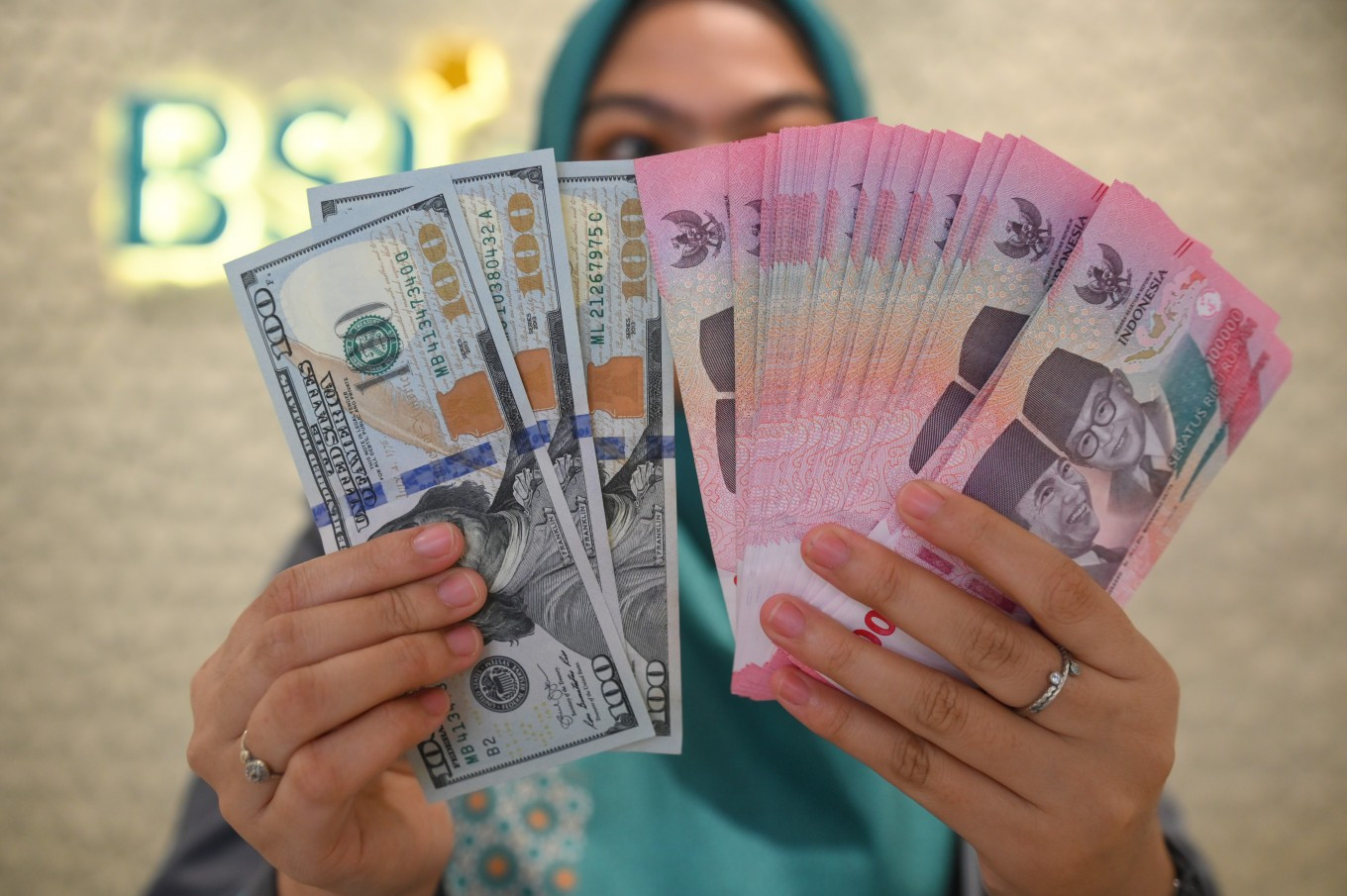 An employee displays Indonesian rupiah and United States dollar banknotes at Bank Syariah Indonesia in South Tangerang, Banten, on Jan. 21, 2026. (Antara/Hafidz Mubarak A)
W
ith the rupiah continuing to weaken amid an oil and gas shock linked to the United States-Israeli war on Iran, Bank Indonesia (BI) has halved the threshold for monthly purchases of US dollars (USD) using rupiah. The move is intended to give the central bank more room to intervene in the currency market and safeguard foreign exchange reserves, particularly as pressures intensify from ongoing oil and gas supply disruptions. However, the policy may carry unintended consequences for the real economy.
To curb currency speculation and ensure that forex purchases are used for real economic activity, BI issued Board of Governors (BoG) Regulation No. 7/2026 on Mar. 26 to maintain the stability of the rupiah’s exchange rate. The regulation lowers the threshold for USD purchases without supporting documents to US$50,000 from $100,000. At the same time, it raises the threshold for domestic non-deliverable forward (DNDF) and forex swap transactions from $5 million to $10 million per transaction. The policy took effect on April 1.
A second regulation, BI BoG Regulation No. 8/2026, issued on Mar. 30 as the third revision to Regulation No. 21/2019, introduces similar changes for outward transfers. It reduces the threshold for international transfers requiring Supporting Document for Outgoing Fund Transfers from $100,000 to $50,000. For transfers between $50,000 and $100,000 in April 2026, a client-issued letter containing the required information may serve as sufficient documentation. This regulation also came into effect on April 1.
The monetary measures came about amid the continued trend of the rupiah’s exchange rate against the USD hovering around the psychological level of Rp 17,000 per $1 throughout March 2026. The rupiah’s spot market exchange rate appreciated 0.34 percent from its historic low of Rp 17,041 per $1 to Rp 16,893 per $1. The Jakarta Interbank Spot Dollar Rate (JISDOR) reached Rp 17,002 per US$1 of Apr. 1, while BI’s reference purchase and selling prices for USD were Rp 17,083.99 per $1 and Rp 16,914.01 per $1, respectively.
Indonesia’s foreign exchange reserves had recovered from $148.74 billion in September 2025 to $156.47 billion in December. However, continued intervention to support the rupiah has reduced reserves to $151.9 billion as of February 2026, equivalent to 6.1 months of import financing or 5.9 months of imports and sovereign debt servicing. While still above the three-month adequacy threshold, external buffers are showing signs of strain. At the same time, the trade surplus narrowed to $950 million in January 2026, with import growth outpacing exports.
The Indonesian Importers Association (GINSI) expects the new policy to have limited impact on import activity, noting that several trading partners, including China, increasingly accept local currency settlement. However, some analysts warn that tighter administrative controls could trigger front-loading of forex demand, as businesses rush to secure USD ahead of potential further restrictions. Others see the policy as effective only in easing short-term depreciation pressures.

Front-loading behavior could also strain firms that rely on gradual USD purchases for operational needs, potentially disrupting real economic activity. More broadly, the policy suggests that BI is encouraging a shift toward longer-term hedging instruments such as DNDF. At the same time, it may reinforce perceptions that the rupiah is becoming more dependent on central bank intervention rather than market-driven adjustment, raising concerns about a more tightly managed exchange rate regime.