The Jakarta Post
Please Update your browser
Your browser is out of date, and may not be compatible with our website. A list of the most popular web browsers can be found below.
Just click on the icons to get to the download page.


Popular Reads
Top Results
No results found. Please check your search term and try again
Can't find what you're looking for?
View all search results
Popular Reads
Top Results
No results found. Please check your search term and try again
Can't find what you're looking for?
View all search resultsASEAN must learn from China's energy foresight
As recent reporting makes clear, Beijing's long-running emphasis on energy security has given it a stronger buffer against external shocks.
Change text size
Gift Premium Articles
to Anyone
Share the best of The Jakarta Post with friends, family, or colleagues. As a subscriber, you can gift 3 to 5 articles each month that anyone can read—no subscription needed!
 Set as preferred source
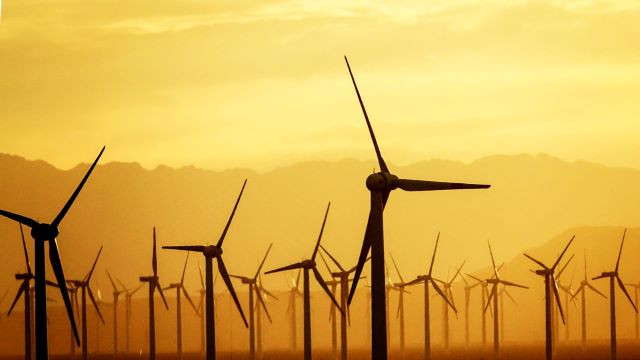 The Dabancheng wind power plant in Urumqi in China's western Xinjiang region operates amid haze on July 14, 2021. (AFP)
The world is learning, once again, that energy security is never an afterthought.
It is not something a country improvises when war erupts, shipping lanes tighten or oil traders panic.
It is something prepared over many years, often quietly, patiently and with a discipline that only serious states can sustain.
China is now showing the results of that discipline.
As recent reporting makes clear, Beijing’s long-running emphasis on energy security has given it a stronger buffer against external shocks.
Chinese leaders have spent years building reserves, expanding storage, maintaining domestic production and diversifying the overall energy mix.

In March, China’s new five-year energy plan explicitly pledged to expand its strategic oil reserves, which analysts estimate at around 900 million barrels, or just under three months of imports.
This matters because the current global energy crisis is not merely about price. It is about endurance.
Many countries still think of energy security in narrowly commercial terms.
They assume that as long as oil can be bought on the market, national security is protected. That assumption is now badly outdated.
In a world shaped by war, sanctions, maritime disruption, strategic chokepoints and weaponized supply chains, energy must be understood as part of statecraft itself.
China understood that earlier than most.
President Xi Jinping said on April 6 that China must accelerate the planning and construction of a “new energy system” to safeguard national energy security.
Reuters noted that analysts see China as relatively better positioned to absorb oil price shocks because coal still accounts for more than half of its energy mix, it has ample oil stockpiles and imports via the Strait of Hormuz amount to only around 5 percent of total energy consumption.
That is the real lesson. China did not place all its hopes in one fuel, one region or one shipping corridor. It built redundancy.
It kept coal as a reliability backbone, even while scaling wind and solar.
It expanded hydropower. It pushed nuclear power in a safe and orderly manner. It kept domestic oil production high even as electrification accelerated.
And just as important, it institutionalized reserve holding more firmly.
An Oxford Institute for Energy Studies paper published in February noted that China’s revised Energy Law made crude stockholding a legal requirement for both state-owned and private companies, not merely a regulatory preference.
That is strategic foresight in concrete form.
Too often, countries wait until a crisis to hold emergency meetings, issue statements and blame markets.
China did the hard thing. It was prepared before the crisis fully arrived.
This does not mean China is invulnerable. No country is.
Reuters reported that China’s seaborne crude imports in March still fell from February levels, and China remains exposed to turbulence in West Asia and global oil pricing.
But resilience is not the same as immunity. The point is that Beijing has created cushions where many others have only hopes.
The wider world should respect this, even if it does not wish to imitate every feature of China’s system.
Respect does not mean submission. It means acknowledging competence where competence exists.
For Southeast Asia, the message is especially urgent.
We cannot continue assuming that open sea lanes alone will protect us. We cannot rely on spot markets without serious reserves, diversified power generation or stronger long-term planning.
Energy security must be tied to storage, logistics, refining, renewables, interconnection and the political will to think beyond one electoral cycle.
China has shown that future planning is not abstract theory. It is national survival made operational.
The uncomfortable truth is simple. Many states talk about resilience. China has been building it. That is why, in moments of systemic shock, Beijing appears ahead of the pack. And that is why the world needs to respect not just China’s size, but its strategic future planning.
Whether one is speaking of the ASEAN Power Grid, ASEAN Connectivity, indeed the Kuala Lumpur Vision 2045, there is a need for ASEAN, beginning with the International Institute of Future Studies (IIFS) led by Ziauddin Sardar and Scott Jordan in Kuala Lumpur, to think forward systematically on the future to come.
One that will be beset with multiple crises. Their books on future studies, the Islamic future and post normal times theory are all important works of scholarship.
---
The writer is a professor of ASEAN Studies and director of the Institute of International and ASEAN Studies at the International Islamic University of Malaysia.