TheJakartaPost
Please Update your browser
Your browser is out of date, and may not be compatible with our website. A list of the most popular web browsers can be found below.
Just click on the icons to get to the download page.


Popular Reads
Top Results
No results found. Please check your search term and try again
Can't find what you're looking for?
View all search results
Popular Reads
Top Results
No results found. Please check your search term and try again
Can't find what you're looking for?
View all search resultsPolitical reform 2.0: Restoring the state to its foundational principles
Public policy ceases to be guided primarily by considerations of efficiency or long-term national interest; instead, it often becomes the outcome of negotiated distributions of power.
Change text size
Gift Premium Articles
to Anyone
Share the best of The Jakarta Post with friends, family, or colleagues. As a subscriber, you can gift 3 to 5 articles each month that anyone can read—no subscription needed!
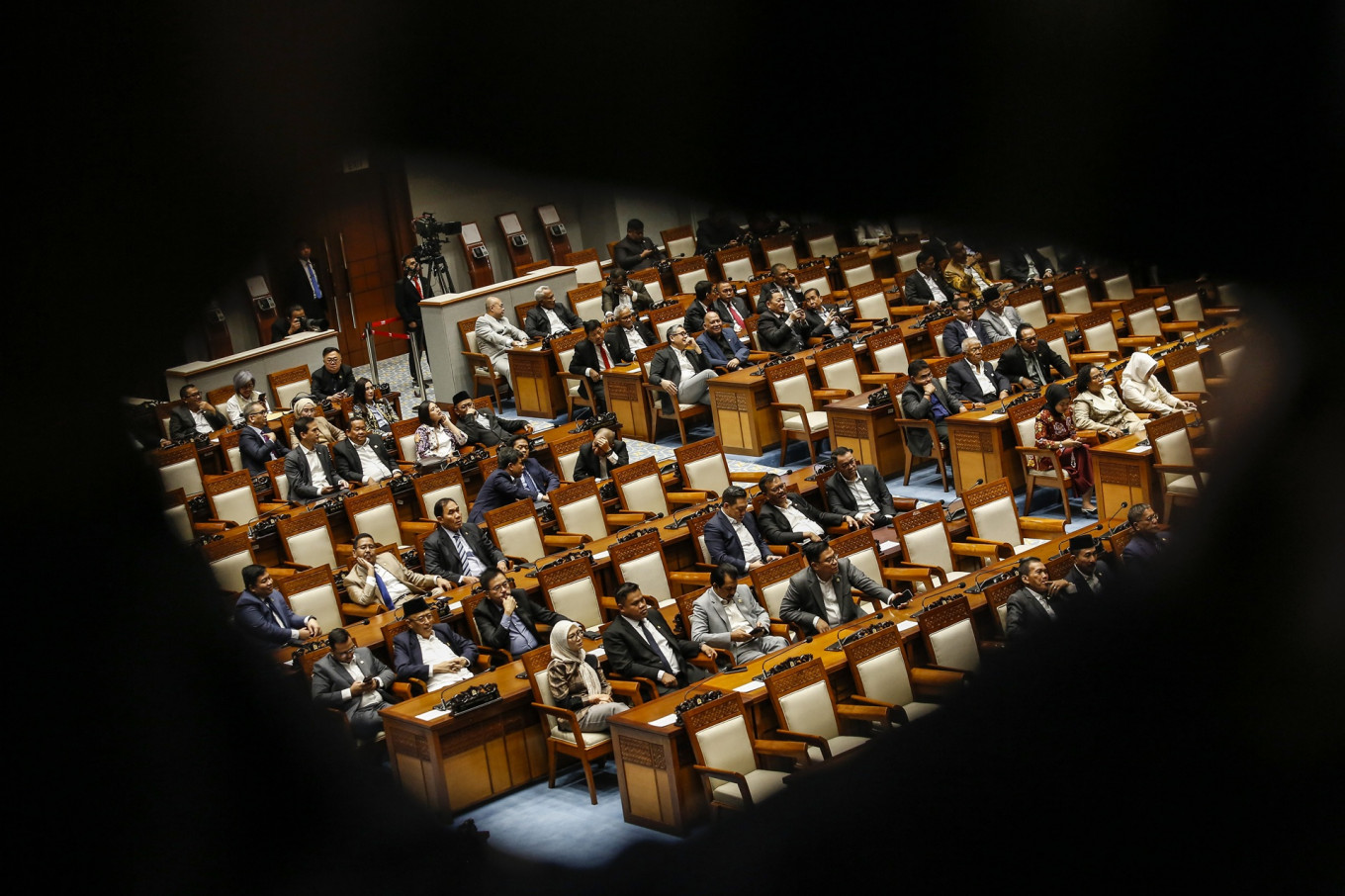 House of Representatives lawmakers attend a plenary session at the Senayan Legislative Complex in Central Jakarta on March 10, 2026. (Antara/Asprilla Dwi Adha)
A
profound paradox lies at the heart of Indonesia’s democratic trajectory, one that is becoming increasingly difficult to ignore. On the surface, the institutional architecture of democracy appears complete: elections are regularly conducted, the House of Representatives remains formally active and the full array of high state institutions is in place.
Yet beneath this procedural completeness, the substantive vitality of democracy is steadily eroding. The mechanisms endure, but their functional integrity is weakening. Democracy persists, but it no longer operates in full alignment with the aspirations of the citizenry.
At the core of this paradox is a configuration of power that is excessively concentrated within political parties. In practice, political parties do not merely compete within the democratic arena; they also define its rules. The laws governing elections and party systems are crafted by actors who stand to benefit directly from their design. In political theory, this condition reflects what Jeffrey Winters characterizes as a self-reinforcing oligarchy, a system that continuously reproduces and entrenches the dominance of a narrow elite.
This dynamic resonates with Acemoglu and Robinson’s concept of elite capture, wherein formal institutions are appropriated by dominant groups to preserve control over resources and decision-making processes. Consequently, democracy, rather than expanding the space of political contestation, becomes progressively constricted, while opposition forces are rendered structurally ineffective as instruments of accountability.
The consequences of such dominance extend well beyond the electoral sphere, permeating institutions that are normatively designed to operate independently of political power. The Constitutional Court, for instance, is conceived within constitutional theory as a counter-majoritarian institution, tasked with constraining majority excesses in order to safeguard the constitutional order. However, when its composition is shaped by politically mediated appointments, its capacity to function as an impartial guardian of the Constitution is inevitably compromised.
A comparable erosion is evident in institutions tasked with overseeing public finance. In the absence of a robust foundation of professionalism, the audit function risks devolving from a substantive mechanism of control into a mere procedural formality. From the standpoint of public finance accountability, institutional independence is not ancillary but foundational to ensuring governmental responsibility. Its erosion, therefore, directly weakens the state’s capacity for self-regulation.

In the realm of law enforcement, the challenges are equally profound. The principle of the rule of law presupposes consistency, impartiality and universality in legal application. Yet where the processes governing the selection and oversight of legal institutions remain embedded within political structures, there emerges a well-documented risk: the weaponization of law. Under such conditions, law risks transformation from an instrument of justice into a selective tool of power.