TheJakartaPost
Please Update your browser
Your browser is out of date, and may not be compatible with our website. A list of the most popular web browsers can be found below.
Just click on the icons to get to the download page.


Popular Reads
Top Results
No results found. Please check your search term and try again
Can't find what you're looking for?
View all search results
Popular Reads
Top Results
No results found. Please check your search term and try again
Can't find what you're looking for?
View all search resultsThe Lion’s grip: Civil liberties and the cost of dissent
Singapore’s glittering skyline hides a tightening legal knot where dissent is labeled a "falsehood" and conscience is treated as a crime. As activists face prison for questioning the state, one must ask: can a nation truly be great if its prosperity depends on the silence of its citizens?
Change text size
Gift Premium Articles
to Anyone
Share the best of The Jakarta Post with friends, family, or colleagues. As a subscriber, you can gift 3 to 5 articles each month that anyone can read—no subscription needed!
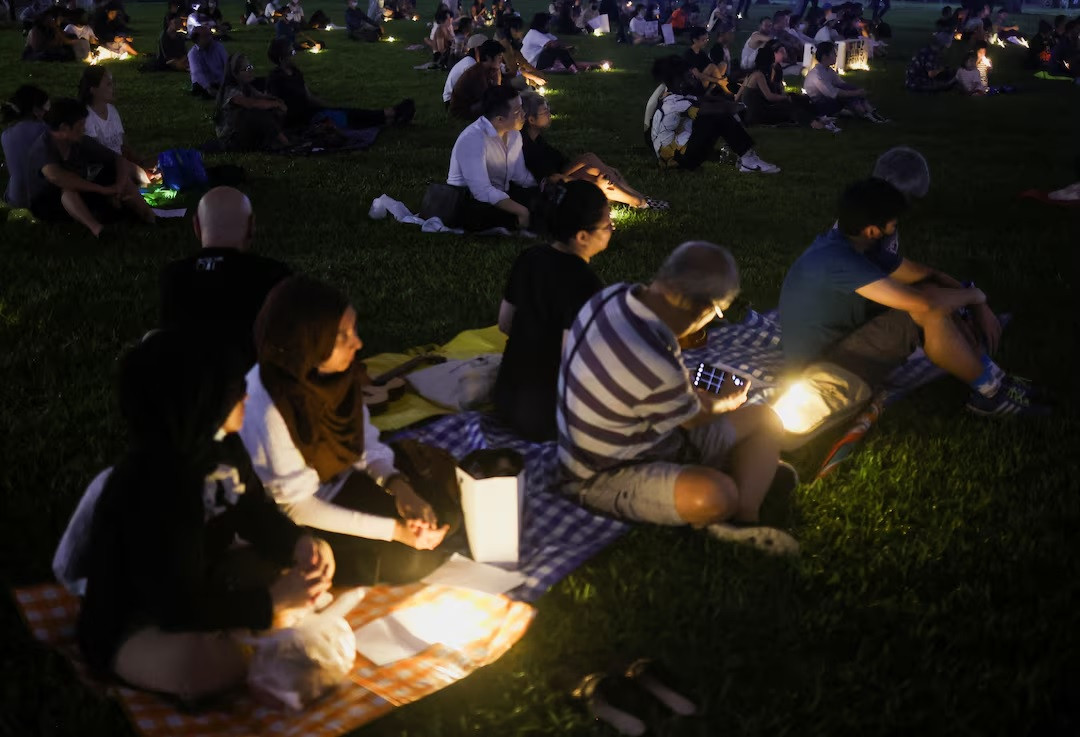 People take part in a vigil on April 25, 2022, ahead of the planned executions of Malaysian nationals Nagaenthran Dharmalingam and Datchinamurthy Kataiah at Hong Lim Park in Singapore. Datchinamurthy, convicted of smuggling drugs, was executed on Sept. 25, 2025. (Reuters/Edgar Su)
I
have always believed that Singapore, with its stunning achievements on the world stage, could one day become a beacon of freedom and civil liberties. It is a pity that, once again, this nation, admired by so many, is showing its worst side to the world through repressive policies and legislation targeting freedom of expression.
To understand the gravity of the situation, one must look at the legal boundaries of state power. One does not need to be a luminary in law to recognize when a state exceeds its legitimate prerogatives under the guise of stemming the plague of misinformation and "outright falsehoods". While social media presents a challenge to society, especially when leveraged by actors with malign intent, a government’s role should be to safeguard the "common good" by ensuring the free flow of ideas while remaining vigilant against deliberate lies.
It is a delicate equilibrium to maintain: protecting freedom of expression while establishing guardrails against distortions. However, the Lion City has continuously failed this complex test through the draconian Protection from Online Falsehoods and Manipulation Act (POFMA).
This legislation curtails the rights of citizens to hold opinions on facts where the government maintains a different view. If your interpretation of a certain fact happens to collide with the official position, you face significant trouble, especially if you choose not to comply with a correction order. For those who refuse to surrender their inalienable rights, defiance becomes almost the only tool at their disposal.
I say "almost" because appealing a POFMA order is a daunting, narrow path. The burden of proof rests entirely on the applicant, and the timeline is incredibly stringent. In practice, life is much simpler if you surrender and publish a "correction direction" on your platform. If you decide otherwise, you face up to 12 months in jail, a fine of up to S$20,000 (US$15,575), or both. As of mid-2024, only two POFMA orders have been set aside by the High Court out of 163 cases issued since the law’s inception in 2019.
This radical rigidity is hard to comprehend, even within the city-state’s unique application of the rule of law. The government has relentlessly applied this legislation not only to its own citizens but to academics and international news outlets as well.

I feel compelled to write about this now because, on April 23, anti-death penalty activist Kokila Annamalai was charged with failing to comply with a POFMA order. The authorities took issue with her statement that the government "schedules and stays executions arbitrarily without regard for due legal process". For the state, this statement was a falsehood; for Annamalai, it was a reflected opinion, and she chose not to comply.