TheJakartaPost
Please Update your browser
Your browser is out of date, and may not be compatible with our website. A list of the most popular web browsers can be found below.
Just click on the icons to get to the download page.


Popular Reads
Top Results
No results found. Please check your search term and try again
Can't find what you're looking for?
View all search results
Popular Reads
Top Results
No results found. Please check your search term and try again
Can't find what you're looking for?
View all search resultsAnalysis: Toll road VAT, EV disincentive: Short-term revenue, long-term losses
Change text size
Gift Premium Articles
to Anyone
Share the best of The Jakarta Post with friends, family, or colleagues. As a subscriber, you can gift 3 to 5 articles each month that anyone can read—no subscription needed!
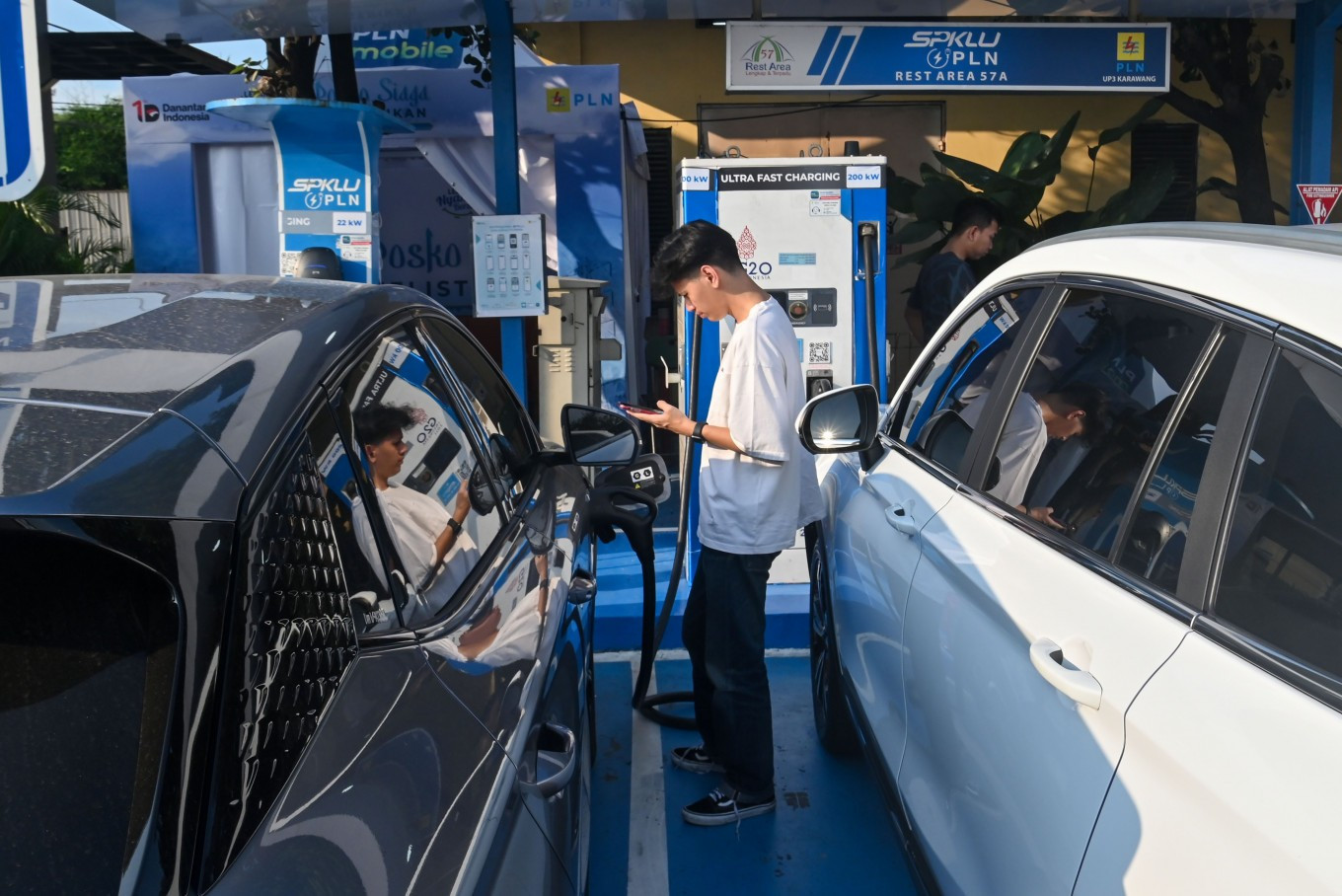 Powering up: A traveler charges an electric vehicle on March 15, 2026, at a public EV charging station operated by energy giant PT PLN at a rest area on the Jakarta-Cikampek toll road in Karawang Regency, West Java. The transition to transportation electrification requires political will, as well as subsidies and a clear long-term strategy (Antara/Fakhri Hermansyah)
A
s the government seeks to shore up fiscal stability amid slowing tax revenue and rising spending pressures, it is turning to controversial new revenue measures, including imposing VAT on toll roads and removing tax exemptions for EV. These policies could slow adoption even as the country pushes electrification to reduce reliance on costly fuel imports.
The urgency behind these measures is understandable. Indonesia’s 2026 tax revenue target stands at Rp 2.358 quadrillion (US$136 billion), while collections have continued to underperform. In response, the government is expanding the tax base by targeting sectors with strong revenue potential.
The plan to impose VAT on toll roads, as outlined in the 2025-2029 Strategic Plan of the Directorate General of Taxes’ (DJP’s), is backed by legal provisions under the Tax Harmonization Law and has emerged as an obvious candidate. Likewise, regional administrations argue that maintaining tax exemptions for EVs reduces the revenue needed to finance local roads and public infrastructure.
From a fiscal perspective, both policies appear rational. The problem is that fiscal policy does not operate in isolation. Taxing infrastructure designed to reduce costs and eliminating incentives meant to accelerate electrification could generate broader economic losses that outweigh immediate fiscal gains.
These broader risks are most visible in the proposed 11 percent VAT on toll roads. While the government expects the policy to generate an additional Rp 4-5 trillion in annual revenue, many economists argue that this gain is small relative to the wider economic costs. In the context of a budget deficit reaching hundreds of trillions of rupiah, the policy is far from a game changer.
What is more immediate is its impact on logistics costs and household spending. Toll roads are central to the movement of goods and people, particularly for the urban middle class. Higher toll rates are unlikely to be absorbed by operators or logistics firms and will instead be passed along supply chains. This could raise the prices of food, basic goods and other daily necessities, including for consumers who never use toll roads. For middle-income households already grappling with weakening purchasing power and rising costs of living, this is less a tax adjustment than a direct squeeze on affordability.

A similar contradiction appears in the EV disincentive policy. Indonesia has spent years trying to position itself as a regional hub for EV production and adoption, offering tax incentives to attract investment and encourage consumers to shift away from fossil fuel vehicles. Yet the removal of automatic tax exemptions under Home Ministry Regulation No. 11/2026 sends a conflicting signal at a critical stage of that transition.