The Jakarta Post
Please Update your browser
Your browser is out of date, and may not be compatible with our website. A list of the most popular web browsers can be found below.
Just click on the icons to get to the download page.


Popular Reads
Top Results
No results found. Please check your search term and try again
Can't find what you're looking for?
View all search results
Popular Reads
Top Results
No results found. Please check your search term and try again
Can't find what you're looking for?
View all search resultsRestoring people's rights to natural resources
It's time to stop the false solutions and return the power of natural resource management to the hands of the people.
Change text size
Gift Premium Articles
to Anyone
Share the best of The Jakarta Post with friends, family, or colleagues. As a subscriber, you can gift 3 to 5 articles each month that anyone can read—no subscription needed!
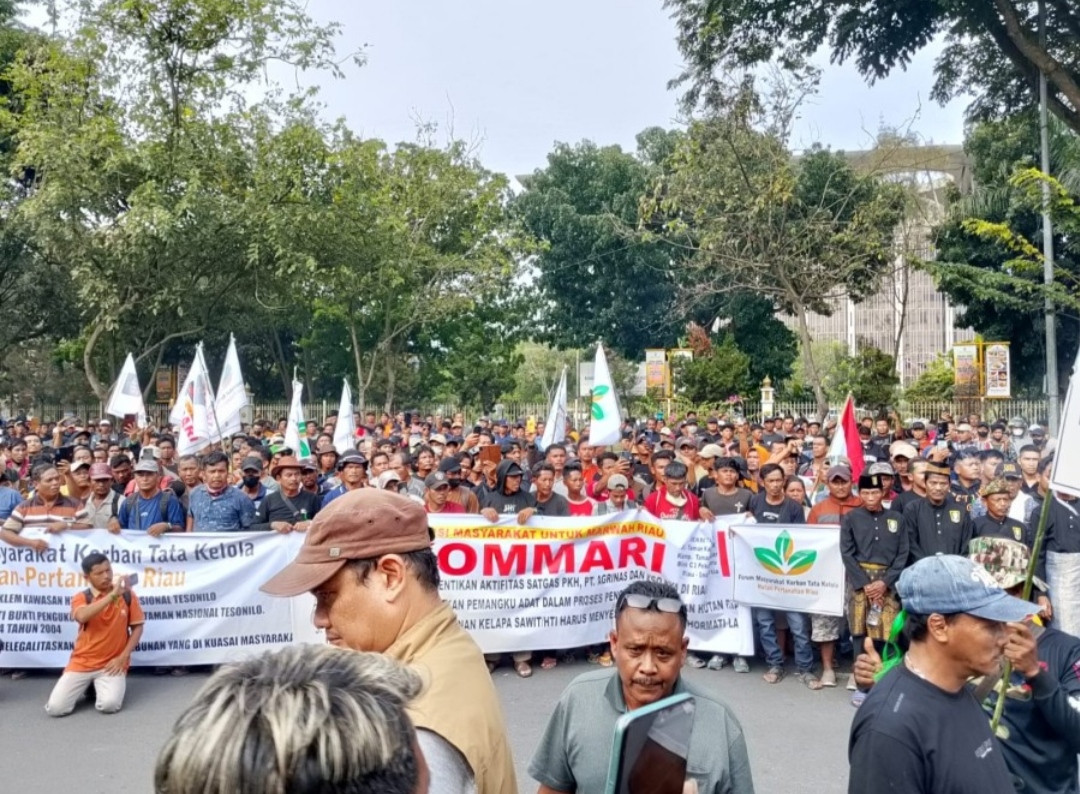 Protesters stage demonstration in front of the Riau Prosectuor's Office in Pekanbaru, Riau, on Nov. 20, 2025, rejecting the relocation of local communities residing within the Tesso Nilo National Park in the province to other areas as well as urging the government to allow the co-management of cultivation land within the national park between local communities and state-owned firm PT Agrinas Palma Nusantara. (JP/Rizal Harahap)
T
he narrative of energy and natural resource management in the country has almost always been trapped by the allure of mere economic achievement figures. We are busy pursuing an 8 percent economic growth target, for example, while neglecting the quality of life of the people living around mining areas or large-scale monoculture plantations. Some areas are simply considered giant sacrificial zones, areas that must be given up for exploitation.
While it is not too late, reversing the dogma of top-down development to a bottom-up movement is imperative. The bottom line is simple: restore the people's rights, so they are not merely spectators, but also manage and enjoy various resources without destroying them.
Take the energy transition, for example. Many coastal areas are threatened by an energy crisis because they still rely on expensive diesel generators. The solution should not be simply large, baseload-based projects from the center, but rather community-scale renewable energy, which is modular and can be implemented immediately.
Energy decentralization is key to resilience to crises and disasters, while also realizing a sense of justice. Solar panels and micro-hydro systems managed by local communities are among the possible technologies.
The problem in the practice of energy democratization is the bureaucratic wall of state utility company PLN, which monopolizes the provision of electricity for the public interest and carries out government assignments in the electricity sector. Total reform is needed in the electricity sector.
Local governments often stumble because all matters are shifted to the central government through the Job Creation Law. Yet, for the community, the energy transition must address daily needs and basic needs. This is the real problem they face. They do not care about complicated terms on paper.

Related to the same issue, it must also be acknowledged that land grabbing is now increasingly complex. Initially carried out under the guise of National Strategic Projects, the perpetrators now hide behind a "green" label called carbon trading. Indigenous territories are targeted for occupation. The perpetrators, called "carbon cowboys", appear to help indigenous communities enter the carbon system, but the greatest profits are reaped by a handful of elites.