The Jakarta Post
Please Update your browser
Your browser is out of date, and may not be compatible with our website. A list of the most popular web browsers can be found below.
Just click on the icons to get to the download page.


Popular Reads
Top Results
No results found. Please check your search term and try again
Can't find what you're looking for?
View all search results
Popular Reads
Top Results
No results found. Please check your search term and try again
Can't find what you're looking for?
View all search resultsA severe El Niño could shake the world's rice supply chain
The last El Niño in 2023–2024 threatened rice supplies. This one may be worse for farming, because climate change is adding extra heat on top of disrupted rainfall.
Change text size
Gift Premium Articles
to Anyone
Share the best of The Jakarta Post with friends, family, or colleagues. As a subscriber, you can gift 3 to 5 articles each month that anyone can read—no subscription needed!
 Set as preferred source
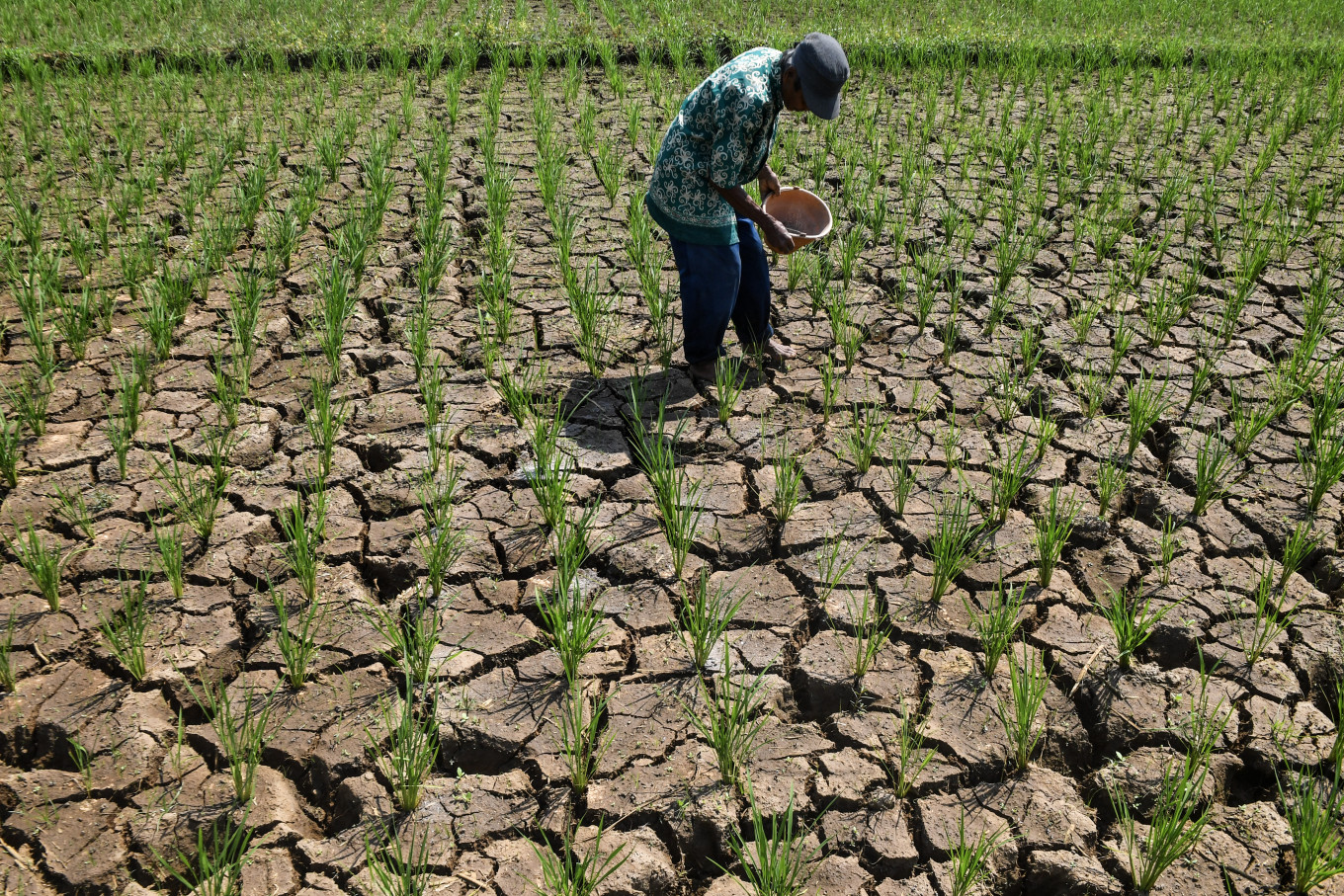 A farmer applies urea fertilizer to drought-affected rice plants in Handapherang village, Ciamis regency, West Java, on June 10, 2026. (Antara/Adeng Bustomi)
F
orecasters expect El Niño, which is now underway in the tropical Pacific, to strengthen into a strong or very strong climate driver later this year.
When El Niño arrives, it reorganizes rainfall patterns around the world. Parts of the Americas and east Africa tend to get heavier rain, while monsoonal rains in Asia get weaker and drier conditions settle over eastern Australia, Southeast Asia, India and southern Africa.
This mix of heat and disrupted water supplies could have real consequences for food supply, especially rice. El Niño does not tend to hit wheat as hard, because a bad season in one region is often offset elsewhere. But rice is different. Production is concentrated in Asia and only a small share is traded.
The last El Niño in 2023–2024 threatened rice supplies. This one may be worse for farming, because climate change is adding extra heat on top of disrupted rainfall.
Over half the world’s population relies on rice. India and China grow more than half of the world’s supply, and rice supplies more than half of all daily calories in countries such as Bangladesh, Vietnam and Cambodia.
Poorer households spend the largest share of income on food, so price spikes hit them first and hardest. In 2007–2008, rice prices roughly tripled, food riots broke out in dozens of countries, and in Haiti, the unrest helped bring down the prime minister. Securing rice is about more than food; it underpins public order.

Rice is also a thirsty crop. Most high-yielding varieties are bred for flooded paddies, where water suppresses weeds, supports flowering and grain development, and helps keep plants cool. Hardier upland rice can grow with less water but usually yields less. Hence, breeders want to move the drought-tolerance of upland rice into lowland varieties that most farmers actually grow.
If this year’s El Niño is severe, it could hit the water supplies of several major producers at once, so shortfalls compound rather than cancel out.
Fertilizer prices have also spiked in 2026 due to the Iran war and disruption to the Strait of Hormuz, making a hard season even harder.
Around three-quarters of the world’s rice comes from irrigated lowland paddies. Irrigation buffers rice against patchy rainfall in normal years, but it depends on water sources such as rivers, reservoirs and snowmelt, which El Niño can affect.
Australia shows this clearly. The Riverina region of New South Wales grows some of the most water-efficient rice in the world. But rice competes for water with permanent plantings such as almonds, which must be watered regularly.
In the worst droughts, Australia’s rice crop has fallen to a small fraction of normal production.
Rice is thinly traded. Most of what a country grows is eaten at home, and exports are often less than 10 percent of production. This means a disruption to a few big exporters can move prices fast.
In 2023, India clamped down on rice exports to protect domestic prices, resulting in global price surge. But the picture recently reversed. India now has record stocks and is exporting heavily after lifting its bans, easing prices.
This situation is not guaranteed to last. During the 2007–2008 rice crisis, export bans and panic buying were the major factors driving up prices. If this year’s El Niño is severe, it could hit several regions at once, triggering bans and panic buying on a larger scale. Worst hit would be poorer nations dependent on rice imports, such as the Philippines and West African countries.
Rice farmers in Indonesia are racing to plant their crop ahead of El Niño, and farmers elsewhere are trying to adapt too.
Researchers can play a key role. Before being domesticated, wild rice was a humble grass with much smaller grains and lower yields. Thousands of years of selective breeding have turned it into cultivated rice, with much larger yields.
Even more can be done to make rice stress resilient, climate adapted and water efficient.
Our recent work suggests some rice varieties can conserve water without an obvious yield or quality penalty even when water supplies are limited.
Farming methods can save water too: growers can let paddies dry between waterings, irrigate later in the season or grow rice more like a dryland crop. Standing water also shields the crop from temperature extremes, cooling it in heat and buffering it against cold, so cutting it back too far can expose flowers to damage at the most vulnerable stage.
Beyond the farm, preparation means better forecasting, sustained research investment and a shared resolve among rice-growing nations to keep trade open rather than hoard in a crisis.
We are not powerless against a strong El Niño. But this year’s rice supply faces a real test. The stakes are high, not just for food security, but also for global stability.
---
 The writer is a senior lecturer in biotechnology at the Swinburne University of Technology. This article is republished under a Creative Commons license.