The Jakarta Post
Please Update your browser
Your browser is out of date, and may not be compatible with our website. A list of the most popular web browsers can be found below.
Just click on the icons to get to the download page.


Popular Reads
Top Results
No results found. Please check your search term and try again
Can't find what you're looking for?
View all search results
Popular Reads
Top Results
No results found. Please check your search term and try again
Can't find what you're looking for?
View all search resultsBattery metals recovery runs into stop-start EV market
Some of the previous gloom has lifted from the market. The focus now turns to whether demand is strong enough to underpin higher price levels.
Change text size
Gift Premium Articles
to Anyone
Share the best of The Jakarta Post with friends, family, or colleagues. As a subscriber, you can gift 3 to 5 articles each month that anyone can read—no subscription needed!
 Set as preferred source
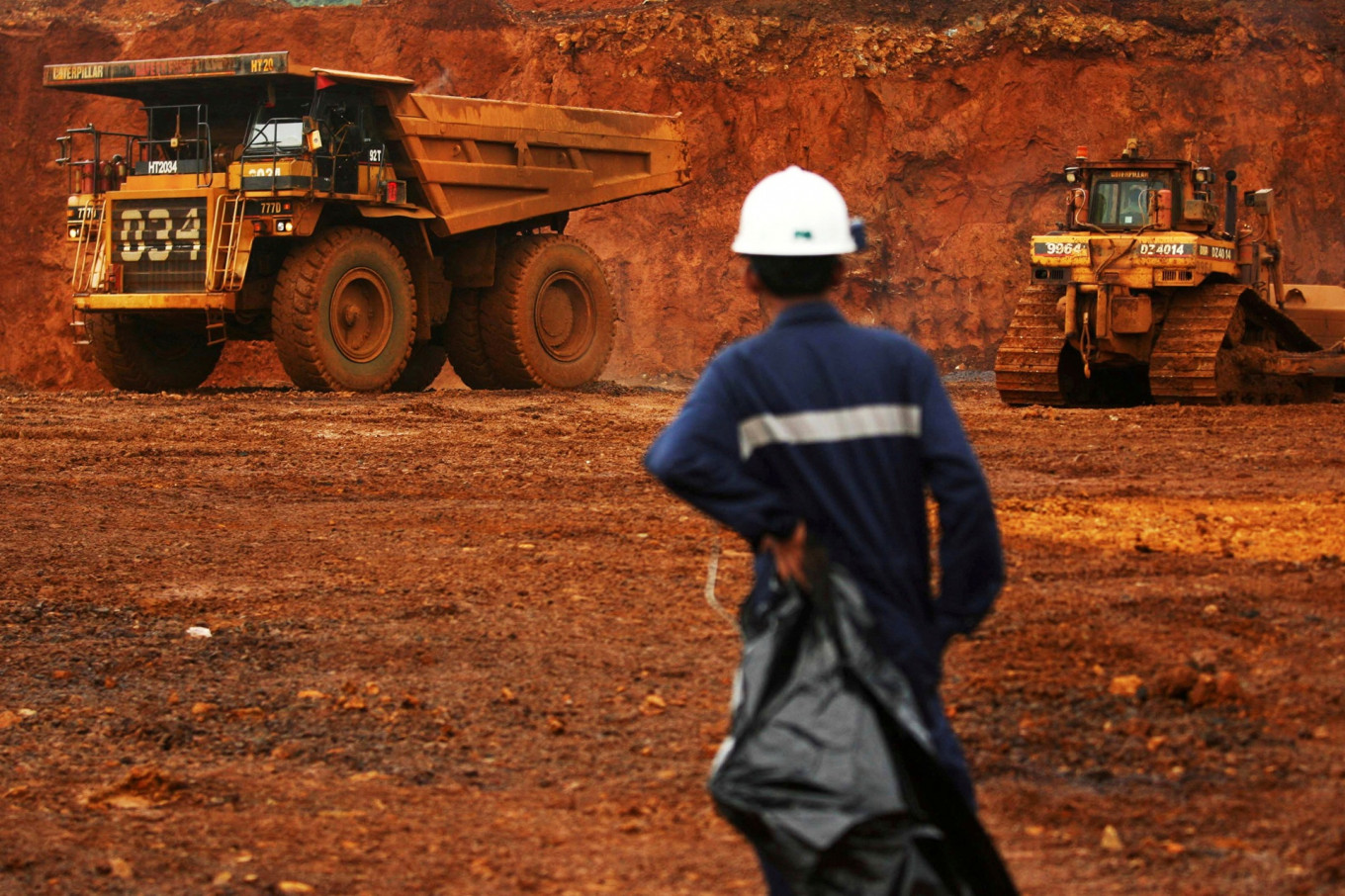 A worker watches as trucks load up raw nickel on Jan. 8, 2014, near Sorowako, South Sulawesi. (Reuters/Yusuf Ahmad)
The battery metals bust has run its course. Prices of lithium, cobalt and nickel have all recovered from their 2024-2025 lows.
This has largely been a story of supply restraint.
The world's dominant cobalt producer, the Democratic Republic of Congo, has restricted exports since February last year.
Indonesia, which exerts similar control over the nickel supply chain, has used quotas to rein in its runaway mining sector.
Lithium's recovery has been largely down to the market. Two years of super-low prices took a heavy toll on both incumbent producers and new projects. But Chinese authorities' suspension of the giant Jianxiawo lithium mine has helped.
This is still very much a work in progress, with immediate price evolution beholden to policy makers in Kinshasa, Jakarta and China's Jiangxi province.

But some of the previous gloom has lifted from these markets. The focus now turns to whether demand is strong enough to underpin higher price levels.
While changes in supply dynamics have shaped the most recent boom-and-bust cycle in battery metals, demand has not stopped growing.
Global lithium-ion battery deployment in 2025 was six times that of 2020, according to the International Energy Agency (IEA).
The driver has been the electric vehicle (EV) sector, which accounts for 70 percent of total lithium-ion battery deployment.
But after surging 20 percent year-on-year in 2025, EV sales have hit a bumpy patch this year.
Global sales growth was just 0.9 percent in January to May, according to consultancy Benchmark Mineral Intelligence (BMI).
The headline figure masks sharply divergent regional performance, however.
Sales in North America fell by 25 percent year-on-year, reflecting the removal of US tax credits in September.
China, the world's largest EV market, also saw sales contract by 15 percent in the first five months of 2026. The drag on battery demand has been partly cushioned by a shift to larger vehicles requiring larger batteries, BMI notes.
Europe, by contrast, registered 26 percent year-on-year growth and the rest of the world grew even faster at 89 percent, reflecting an acceleration of Chinese EV exports, particularly to the rest of Asia.
Grid-scale battery storage is rapidly emerging as an additional lithium demand driver.
Global installations have grown more than 20-fold in the last five years and the sector accounted for 15 percent of battery demand in 2025, according to the IEA.
The global roll-out of renewable energy systems means rising demand for batteries to improve grid reliability when the sun doesn't shine and the wind doesn't blow.
China is halfway through a three-year plan to more than double new energy storage capacity to 180 gigawatts by 2027. More installations will be required if Beijing is to meet a five-year target of generating half the nation's power from renewable energy by 2030.
Battery storage offers lithium some offset to the rise of sodium-ion batteries in the Chinese automotive market but does little to help either cobalt or nickel.
Grid storage batteries use lithium-iron-phosphate (LFP), which contains neither metal.
It's a reminder that not all battery metals are created equal in what is an ever-evolving arms race for cheaper, more efficient chemistries.
LFP is currently the winner of this race, both for energy storage and automotive batteries, where it has taken a 50 percent market share, according to the IEA.
But some Western automakers are understandably reluctant to commit to what is a Chinese-dominated chemistry.
Cobalt and nickel are, for now, holding their own.
Consultancy Adamas Intelligence provides a granular monthly snapshot of metals deployed in passenger EVs.
While the average amount of lithium used per battery was up by 7 percent year-on-year in April, reflecting the shift towards LFP and bigger batteries, average cobalt and nickel usage were both unchanged from a year earlier.
Higher battery metal prices mean higher battery prices, which can themselves act as a drag on demand.
Lithium carbonate prices may already be testing buyers' ability to absorb a near-threefold cost increase since the middle of last year.
Analysts at consultancy Project Blue estimate that current pricing has reached break-even levels for some grid storage projects. They go on to warn that "the risk of demand destruction grows if prices keep rising."
That's a strong reason to believe that the recent battery metal bust won't once again become a battery metal boom.
But market forces are now intertwined with policymaking, adding an extra layer of unpredictability to metals that have until now been defined by an inability to align supply and demand.
---
The writer is columnist for Reuters. The views expressed are personal.