The Jakarta Post
Please Update your browser
Your browser is out of date, and may not be compatible with our website. A list of the most popular web browsers can be found below.
Just click on the icons to get to the download page.


Popular Reads
Top Results
No results found. Please check your search term and try again
Can't find what you're looking for?
View all search results
Popular Reads
Top Results
No results found. Please check your search term and try again
Can't find what you're looking for?
View all search resultsMisreading China risks strategic failure
Every empire has its strengths and weaknesses. Perhaps the most important asset is understanding those of your adversaries.
Change text size
Gift Premium Articles
to Anyone
Share the best of The Jakarta Post with friends, family, or colleagues. As a subscriber, you can gift 3 to 5 articles each month that anyone can read—no subscription needed!
 Set as preferred source
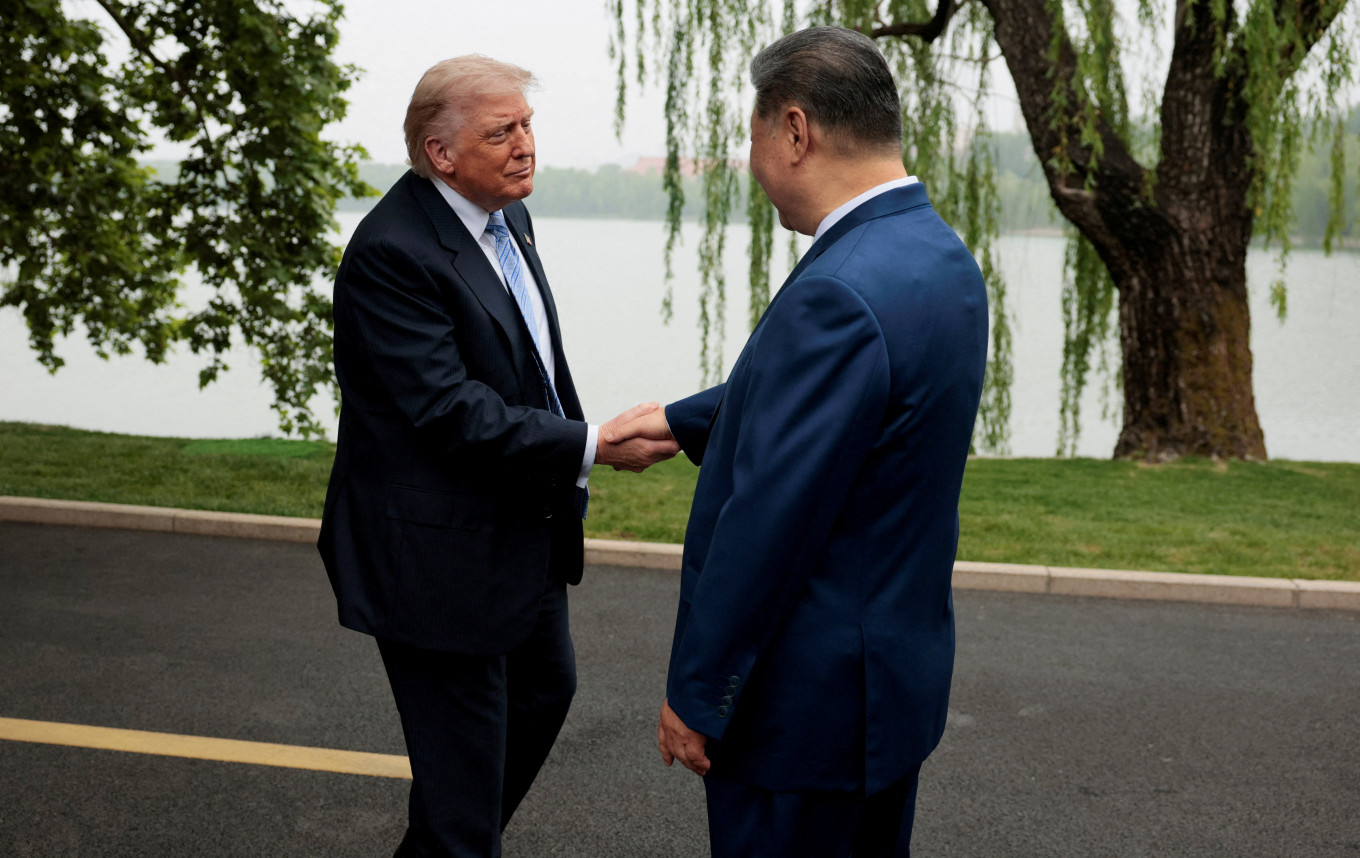 Chinese President Xi Jinping (right) welcomes United States President Donald Trump on May 15, 2026, at the Zhongnanhai garden in Beijing. (Reuters/Pool/Evan Vucci)
C
hina is such a giant player in the global economy that we must understand how the United States-China “contest of the century” for international primacy will evolve. Westerners, especially Americans, feel so threatened that protectionism, preparing for World War III and global fragmentation are already in the cards.
Kishore Mahbubani’s pathbreaking 2020 book, Has China Won?, articulated deep misunderstandings between China and the US, concluding with the paradox that a clash is both inevitable and avoidable.
However powerful America may be, it appears to be taking on four fronts simultaneously: China, the Middle East, Russia/Europe and its own fiscal dilemma of fighting for hegemony using borrowed money. Financial Times columnist Martin Wolf documents with great insight how, “on the eve of the 250th anniversary of her founding, America and the world order it created are in crisis”.
At the heart of America’s quandaries in dealing with China is the unfortunately shallow understanding of China’s complexity and its civilizational mindset, honed from 2,500 years of dealing with both severe internal and external stresses.
China has the oldest surviving bureaucracy in the world, which is too simplistic to classify as Stalin-Leninist or inflexible, centralized decision-making.
My own experience in working with Chinese agencies is that they can achieve something at speed, scale and scope that are not easily conceivable by Western public services, which cannot plan normally beyond electoral cycles.

On the other hand, some of the institutional reforms that Western bureaucracies achieve, such as a centralized pension system, are delayed due to Chinese divisions of power between central and local governments and fiscal traditions that hamper execution.
Every civilization has its strengths and weaknesses, but what Chinese civilization has excelled is the ability to survive the worst of natural calamities and external invasions, despite perennial, internal institutional decay.
Fund manager Ray Dalio, writing in the Financial Times, said of the Chinese tribute system: It “was informed by Confucian values, in particular the idea that order comes from having clearly defined hierarchical roles. Relations within it are not between equals but between superiors and subordinates that recognize their relative positions. The more powerful ones in the hierarchy should treat the less powerful well and the less powerful should treat the more powerful well, so that there is harmony.”
While it is true that China is informed by Confucian values, what most Westerners don’t get is that since the Han Dynasty, China’s essential values are “outwardly Confucian, inwardly legalist”, meaning that Chinese policy thinking has deeply ingrained legalist or ruthlessly realist strategies framed on action, not theory; whereas it must outwardly conform with a humanist, virtuous and traditionalist Confucian philosophy.
Han Dynasty grand chancellor Dong Zhongshu invented this dictum, to square the circle between the ruthless legalist methods that created the Qin Empire and the Confucian ethos that preserved family and state harmony and stability.
The tribute system first came to Western experience through the Macartney Mission to China in 1793, after Britain conquered India and ceded independence to the United States of America.
For Macartney, whether to kowtow was a matter of diplomatic face. With limited understanding of the rise of Western technology, Emperor Qian Long (1711-1799) compromised with Macartney, kneeling as he would to his sovereign but famously rejected opening trade with Britain.
This incident reflected China’s misreading of Western power and Britain’s accurate assessment of Qing’s insular weaknesses. By 1839, British steam-powered gunboats had thrashed Qing’s obsolete armies in the First Anglo-Chinese war, resulting in the ceding of Hong Kong and a century of humiliation.
Dalio’s understanding of the Chinese tributary system is another case of misreading nuances of Chinese statecraft.
American Chinese macro-historian Ray Huang, who actually fought as a nationalist general in World War II and meticulously studied Ming fiscal records, understood that traditional Chinese dynasties lacked the accounting tools, legal infrastructure and statistical monitoring or feedback systems to manage a massive empire.
Up to the 19th century, Chinese fiscal revenue was around 10 percent of gross domestic product, so it could not afford large standing armies to prevent constant invasions or harassment from neighboring nomads or tribes along its long borders. Maintaining a large standing army was not only expensive fiscally, but there was also a risk of coup d’etat from dissatisfied generals.
Hence, the cheaper option was to maintain a tribute system whereby neighboring tribes and dignitaries would come regularly to maintain formal relations and pay tribute (courtesy) to the emperor. China would then give the visitors sufficient gifts in terms of silk, porcelain or gold and silver and occasionally wed members from the royal household to maintain peace without resorting to arms.
This asymmetric tribute system, therefore, was one of subtle pragmatic diplomacy in which historically weak Chinese dynasties accepted nominal tributes from invading tribes, who acknowledged China as big brother to save imperial face but gave large gifts and trade concessions from the Chinese court in exchange for nonaggression. Strong dynasties used the regular tribute meetings to assess border conditions and tweak efforts to maintain peace through divide and rule ploys.
In essence, Huang highlighted that the tribute system was a loss-making concern of prioritizing prestige over reality. By maintaining the facade of being the "Middle Kingdom" (Tianxia), Chinese emperors "gave much and received little" in tributary exchanges with neighboring powers.
Eventually, by being defensive and protectionist, China’s market and technological evolution was stifled and left it ill-equipped to face the rise of Western industrial powers in the 19th century.
To paraphrase Sunzi, in misreading your enemy and misreading yourself, you will lose without knowings why.
---
The writer is a distinguished fellow at Asia Global Institute and chairman of the George Town Institute of Open and Advanced Studies at the Wawasan Open University. The views expressed are personal.