

 Set as preferred source





Enjoy This Gifted Article!
You're reading this thanks to a The Jakarta Post subscriber.
Access is available for 30 days. For unlimited access, consider subscribing.
Please Update your browser
Your browser is out of date, and may not be compatible with our website. A list of the most popular web browsers can be found below.
Just click on the icons to get to the download page.

Can't find what you're looking for?
View all search resultsCan't find what you're looking for?
View all search resultsClimate change and disaster management can no longer be treated separately.
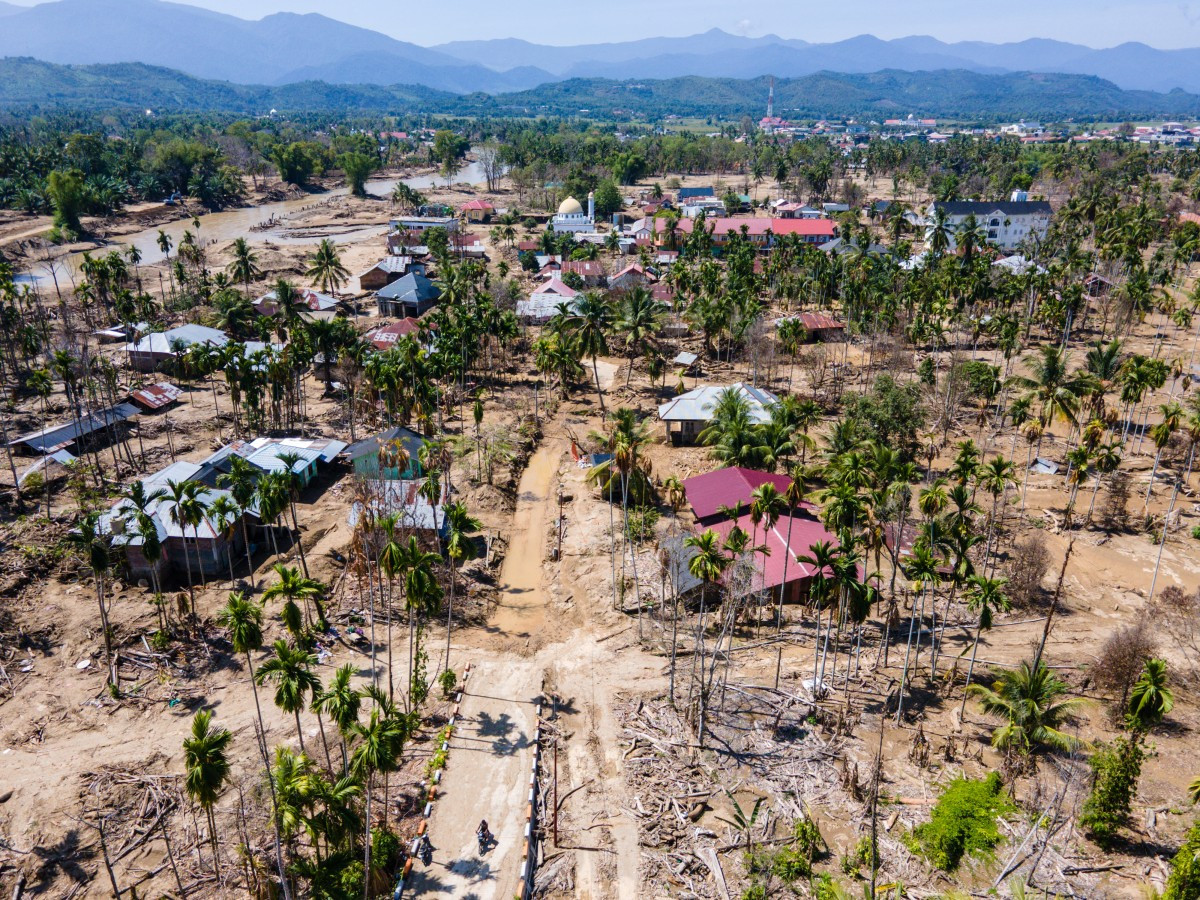 An aerial view shows flood damage to a residential area in Meurah Dua, Pidie Jaya regency, Aceh, on Feb. 22, 2026, after devastating cyclone-induced floods and landslides struck northern Sumatra in November 2025. (AFP/Chaideer Mahyuddin)
ndonesia has long understood that disasters are not only sudden events. They are shaped by where people live, how cities grow, how ecosystems are managed and how prepared institutions and communities are before hazards strike. But climate change is altering the scale and complexity of those risks.
The scale is already visible. In 2025, the National Disaster Mitigation Agency (BNPB) recorded 4,727 disaster events, with more than 12.1 million people affected and displaced, alongside 1,666 deaths and 214 people missing. Reducing these risks is therefore not only essential to protecting communities, but also to strengthening Indonesia’s long-term development, resilience and disaster management agenda. This aligns with Asta Cita, the National Long Term Development Plan (RPJPN) 2025–2045 vision for social, cultural and ecological resilience and the Sustainable Development Goals (SDGs) on resilient communities and climate action.
Within the broader reality, climate change is increasingly influencing disaster risks, from changing rainfall patterns and rising temperatures to sea-level rise, coastal erosion and ecosystem degradation.
Not all communities experience climate change impacts in the same way. The most vulnerable populations, including women, children, older persons, persons with disabilities and low-income households, often face disproportionate risks, underscoring the importance of locally led approaches that prioritize those most at risk.
These impacts include damage to homes and infrastructure, disruption of livelihoods and displacement. In this context, displacement is not separate from disasters, but one of their humanitarian consequences. The challenge extends beyond emergency response. It becomes a question of governance, development planning and national and local resilience.
For this reason, climate change and disaster management can no longer be treated separately.

These challenges are not unique to Indonesia. Across East Asia and the Pacific, disasters triggered 19.6 million internal displacements in 2025, about one-third of the global total, with powerful typhoons and end-of-year storms affecting densely populated countries including the Philippines, China and Indonesia. This underscores the need for stronger regional cooperation, shared learning and evidence-based approaches to disaster risk management and human mobility.
For the BNPB, this requires disaster management systems to evolve beyond reactive approaches. Disaster response remains critical, but preparedness, risk reduction and anticipatory action are becoming equally important.
Climate-related hazards do not only damage infrastructure. They affect livelihoods, social stability and long-term development pathways. A village repeatedly affected by coastal flooding may eventually face declining income, reduced access to education and health services, and gradual outmigration. Communities experiencing prolonged drought may face mounting economic pressures that drive mobility and weaken local resilience. Responding only after displacement occurs often results in higher recovery costs.
Recognizing these evolving risks, the BNPB continues to strengthen the integration of climate adaptation, disaster risk reduction and human mobility in Indonesia’s disaster risk agenda, with technical support from partners such as the International Organization for Migration (IOM).
Managing climate-related mobility requires coordination across disaster management agencies, local governments, climate actors, development planners and humanitarian partners. It also requires better understanding of how climate hazards interact with social vulnerability and mobility patterns at both national and local levels.
To strengthen this anticipatory approach, the BNPB is advancing efforts to better integrate climate displacement risk into disaster risk analysis and planning, with technical support from government counterparts, technical partners and the IOM. One initiative supporting this effort is the development of the Risk Index for Climate Displacement (RICD) in Indonesia. With generous support from the European Union, the RICD brings together data on hazards, population exposure and socioeconomic vulnerability to identify areas where climate-related hazards and vulnerabilities may increase future displacement risks.
Better data is only the starting point. The larger objective is to strengthen decision-making before crises escalate. This means integrating displacement considerations into spatial planning, contingency planning, climate adaptation strategies and social protection systems. It means improving coordination between data systems so that disaster information, climate projections, population trends and local vulnerabilities can inform policy more effectively. And it means recognizing that climate-induced mobility is not only a disaster management issue, but also a development and governance issue.
Most importantly, responses must remain grounded in local realities. National models may identify high-risk areas, but the decision to stay, evacuate or relocate is often shaped by practical conditions on the ground: whether livelihoods can recover, whether infrastructure remains accessible, whether people trust public information and whether communities have viable alternatives. This is why anticipatory planning must be informed by community experience, not only national-level data.
Indonesia already has strong foundations to advance this work. The country has decades of experience in disaster management, increasingly sophisticated risk analysis and institutional capacity at national and local levels. What climate change requires now is deeper integration across sectors and stronger anticipatory governance.
The lesson from recent disasters is not that Indonesia lacks response capacity. It is that climate risks are becoming increasingly interconnected with broader development challenges, from livelihoods to mobility and social resilience.
In a changing climate, protecting communities cannot begin only after disaster strikes. It must begin earlier, by anticipating risks, strengthening resilience and helping communities adapt before hazards lead to greater losses and more complex recovery challenges.
---
Udrekh disaster risk mapping and evaluation at the National Disaster Mitigation Agency (BNPB). Jeffrey Labovitz is the International Organization for Migration (IOM) chief of mission to Indonesia.
Share your experiences, suggestions, and any issues you've encountered on The Jakarta Post. We're here to listen.
Thank you for sharing your thoughts. We appreciate your feedback.
Quickly share this news with your network—keep everyone informed with just a single click!
Share the best of The Jakarta Post with friends, family, or colleagues. As a subscriber, you can gift 3 to 5 articles each month that anyone can read—no subscription needed!
Get the best experience—faster access, exclusive features, and a seamless way to stay updated.


