The Jakarta Post
Please Update your browser
Your browser is out of date, and may not be compatible with our website. A list of the most popular web browsers can be found below.
Just click on the icons to get to the download page.


Popular Reads
Top Results
No results found. Please check your search term and try again
Can't find what you're looking for?
View all search results
Popular Reads
Top Results
No results found. Please check your search term and try again
Can't find what you're looking for?
View all search resultsMyanmar is a litmus test of what ‘ASEAN way’ amounts to
As ASEAN races to normalize ties with Myanmar's brutal military junta for geopolitical gain, its quiet betrayal of human rights and its own charter lays bare the hollow core of the "ASEAN way."
Change text size
Gift Premium Articles
to Anyone
Share the best of The Jakarta Post with friends, family, or colleagues. As a subscriber, you can gift 3 to 5 articles each month that anyone can read—no subscription needed!
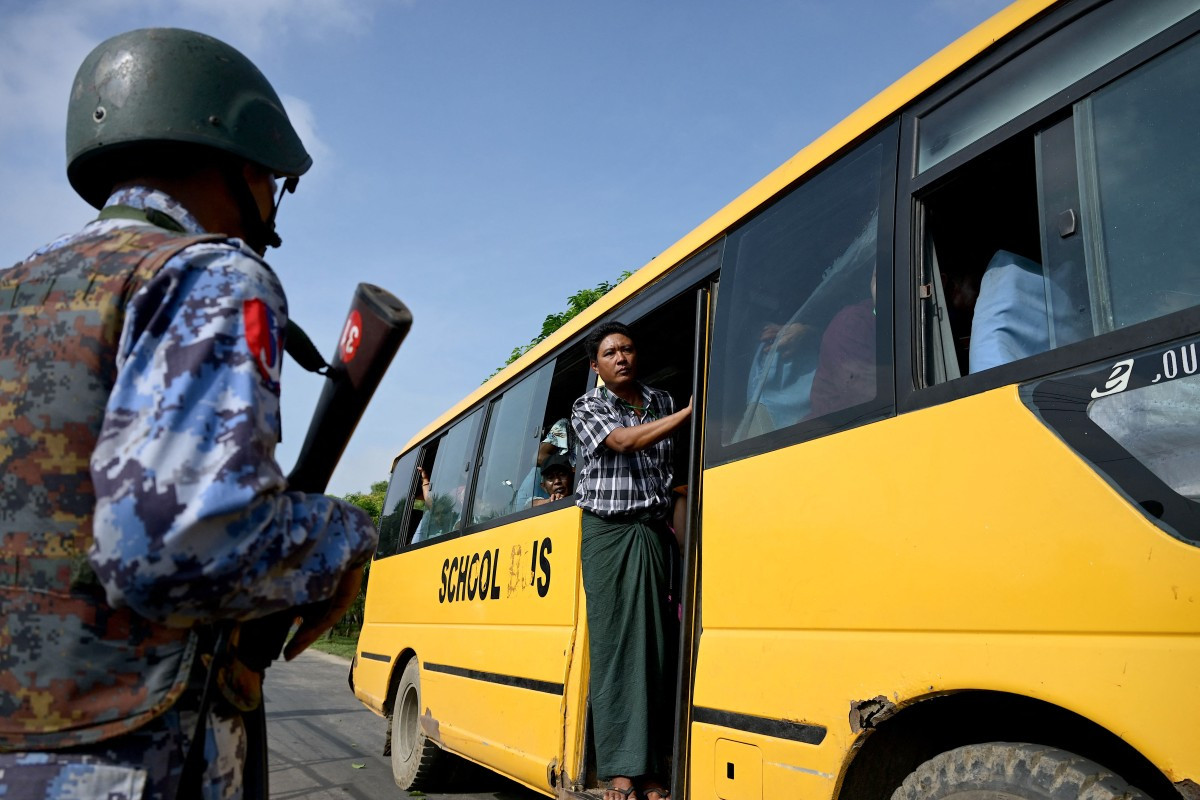 Migrants returning from Malaysia look out from a bus upon their arrival at the Myanmar Navy base in Thanlyin on Oct. 4, 2026. Nearly 1,500 Myanmar migrants from Malaysia arrived in their war-torn home country on Oct. 4, a Myanmar official said, returned under an opaque repatriation scheme that rights monitors say cannot assure their safety. (AFP/Sai Aung Main)
T
wo events on Sept. 29, 2026, were emblematic of the conflicting realities confronting ASEAN. The first was Malaysia’s deportation of 1,476 Myanmar refugees aboard Myanmar Navy vessels. This initial phase of a bilateral agreement covering 5,000 returnees in total, among them Rohingya, arguably violated the customary international law principle of non-refoulement, given the perilous conditions awaiting them upon arrival.
That Myanmar authorities supplied the list of approved returnees heightened concerns that it included political dissidents facing severe persecution, as well as young people targeted for forced conscription. Moreover, because these refugees were transferred directly from immigration detention centers, their consent was entirely nominal.
The plan’s architect, Prime Minister Anwar Ibrahim, once a staunch defender of the Rohingya, a vocal critic of the junta and a firm opponent of readmitting then-junta chief Min Aung Hlaing to the ASEAN fold, has executed an unapologetic reversal. He readily engaged the general, now a self-styled president following a discredited election, to facilitate the deportations in what many view as a nationalist ploy to bolster domestic support ahead of Malaysia’s next general election.
His invitation to Min Aung Hlaing for an official visit later this month reciprocates the arrangement, conferring much-craved legitimacy upon a disputed leader subject to an International Criminal Court (ICC) arrest warrant request for crimes against humanity perpetrated against the Rohingya.
On the very same day, the Myanmar military bombed a crowded market and the adjacent Kissapanadi Bridge in Kyauktaw Township, Rakhine State, killing 50 civilians, predominantly women and children, and critically wounding 60 more. This occurred in the exact state to which the deported Rohingya are expected to return.
Now largely under the control of the insurgent Arakan Army, Rakhine State has been subjected to an intensifying regime air campaign targeting civilians since April, flying directly in the face of Naypyidaw's professed transition to civilian rule.

This rush to engage a regime-ravaged country lays bare ASEAN's core duplicity. On one side, member states, driven by commercial and geopolitical calculus, are eager to consign the conflict to the past. On the other, it is impossible to overlook Myanmar’s outright refusal to honor even the baseline terms of the Five-Point Consensus.
Negotiated between ASEAN leaders and Min Aung Hlaing in April 2021, just months after the coup, the consensus stipulated an immediate cessation of violence, constructive all-party dialogue, the provision of humanitarian aid, and unimpeded access for an ASEAN special envoy. From the outset, the junta treated these commitments with such blatant disregard that by October 2021, ASEAN took the unprecedented step of barring Min Aung Hlaing and other junta officials from its leaders' summits.
Since then, the violence has only escalated. According to the United Nations Office of the High Commissioner for Human Rights (OHCHR), airstrikes have grown increasingly lethal, claiming at least 982 lives in 2025, including 232 children, a 52 percent surge compared to 2024. In aggregate, the Armed Conflict Location & Event Data project (ACLED) estimates the post-coup death toll exceeds 100,000.
Demands for the release of all political prisoners remain completely unaddressed, as does clearance for the special envoy to meet opposition leaders. Daw Aung San Suu Kyi remains incommunicado under house arrest; of the more than 32,000 people arrested since the coup, the Assistance Association for Political Prisoners (AAPP) confirms that nearly 15,000 remain behind bars, with almost 7,800 additional cases awaiting verification.
Yet ASEAN capitals are steadily drifting toward normalization. Laos was the first in the region to break Min Aung Hlaing’s isolation, receiving him for a state visit on July 3. Vientiane took its cues from New Delhi and, above all, Beijing, both of which feted the general following the junta-run election. China retains a clear interest in engineering the regime’s international rehabilitation, having underwritten it financially and militarily while attempting to rein in resistance forces along its border.
Thailand, however, signaled the region’s most decisive realignment by receiving Min Aung Hlaing with full state honors. The spectacle, complete with a red carpet and a formal guard of honor at Government House, transcended the "calibrated engagement" offered as its diplomatic pretext.
The neglected Five-Point Consensus was ignored, and Bangkok voiced no public reprimand over cross-border spillovers, including cyber-scam syndicates, narcotics networks, illicit migration, cross-border toxic runoff from mining or airspace incursions by Myanmar fighter jets. Instead, an elaborate banquet with Thailand’s leading corporate conglomerates telegraphed the real drivers: cross-border commerce, infrastructure deals and mineral extraction.
To date, only two maritime Southeast Asian states have resisted this momentum: Singapore, despite being one of Myanmar’s largest historical investors, continues to insist on verifiable benchmarks, including a durable ceasefire, prisoner releases and unhindered humanitarian corridors, before normalizing ties. Timor-Leste, the region’s youngest democracy, remains steadfast on accountability, pursuing legal action against the regime for war crimes under universal jurisdiction.
The rest of the bloc is faltering. Philippine Foreign Secretary and current ASEAN Special Envoy Theresa P. Lazaro, scheduled for a humanitarian mission to Myanmar this month, appears eager to manufacture diplomatic deliverables by advancing normalization at November’s ASEAN Summit in Metro Manila. She has already drawn sharp criticism for meeting Min Aung Hlaing in Naypyidaw in January 2026, and subsequently for hosting the informal ASEAN foreign ministers' retreat on July 12 in Bangkok, which included junta foreign minister Tin Maung Swe, the first such ministerial attendance since the coup.
Indonesia, while continuing to invoke the Five-Point Consensus in official communiqués, has quietly widened its engagement. Even prior to the announcement of the contested election results, a high-level delegation led by then-foreign minister Sugiono visited Naypyidaw on June 6, met with Min Aung Hlaing, and pledged deeper bilateral and multilateral cooperation.
This reversion to business as usual is fiercely challenged by regional civil society and prodemocracy networks, who stress that there is nothing remotely normal about an administration waging open war against its own populace. Such appeasement breeds a synthetic illusion of regional stability while leaving the structural roots of the crisis untouched.
Bestowing legitimacy upon the regime while ignoring sustained nationwide resistance will only entrench regional authoritarianism and cement ASEAN’s reputation as an institution indifferent to human rights.
As highlighted by Indonesian lawmaker Mercy Barends, ASEAN Intergovernmental Commission on Human Rights (AICHR) representative Anita Wahid, and Alternative ASEAN Network (ALTSEAN) director Debbie Stothard at the opening of The Coup Years exhibition in Jakarta, ASEAN has an explicit alternative embedded within its 2008 Charter.
The Charter explicitly anchors the regional order to the popular will, committing member states to democracy, the rule of law, good governance and fundamental human rights. Myanmar remains the litmus test of whether the "ASEAN way" possesses any real normative substance, or whether it simply serves as a convenient diplomatic cover for impunity.
***
The writer is director of Southeast Asia Junction and former Asia regional director of the International Development Research Center (IDRC) and the Rockefeller Foundation. The exhibition titled The Coup Years: A Visual Chronicle of Resistance in Myanmar takes place at the Dia.lo.gue Artspace gallery on Jl. Kemang Selatan 99A, South Jakarta to Oct. 11. More film screenings and book discussions are scheduled on Oct. 10 on Oct. 11 (www.seajunction.org).Organizers include SEA Junction (Southeast Asia Junction, Bangkok, Humanis Foundation, Migrant Care and AJAR (Asia Justice and Rights, Jakarta).