The Jakarta Post
Please Update your browser
Your browser is out of date, and may not be compatible with our website. A list of the most popular web browsers can be found below.
Just click on the icons to get to the download page.


Popular Reads
Top Results
No results found. Please check your search term and try again
Can't find what you're looking for?
View all search results
Popular Reads
Top Results
No results found. Please check your search term and try again
Can't find what you're looking for?
View all search resultsCan Central Java afford the water cost of AI?
Java’s northern coast faces severe water-catchment degradation, yet an AI center requiring massive amounts of water is planned there.
Change text size
Gift Premium Articles
to Anyone
Share the best of The Jakarta Post with friends, family, or colleagues. As a subscriber, you can gift 3 to 5 articles each month that anyone can read—no subscription needed!
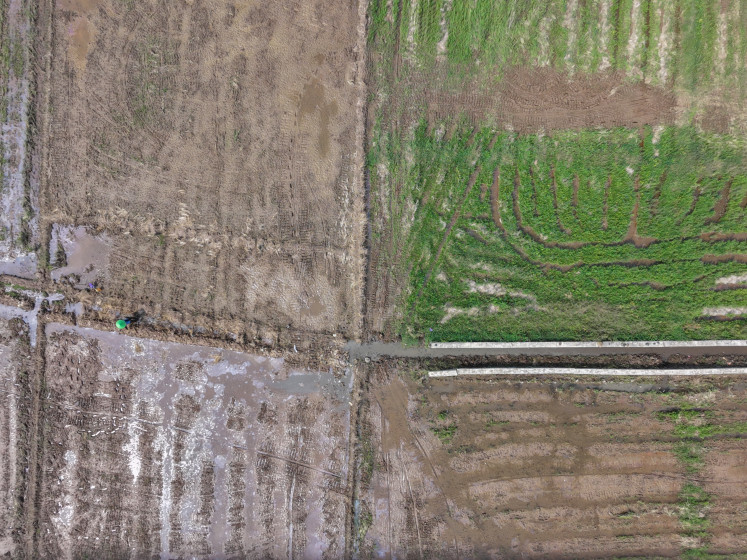
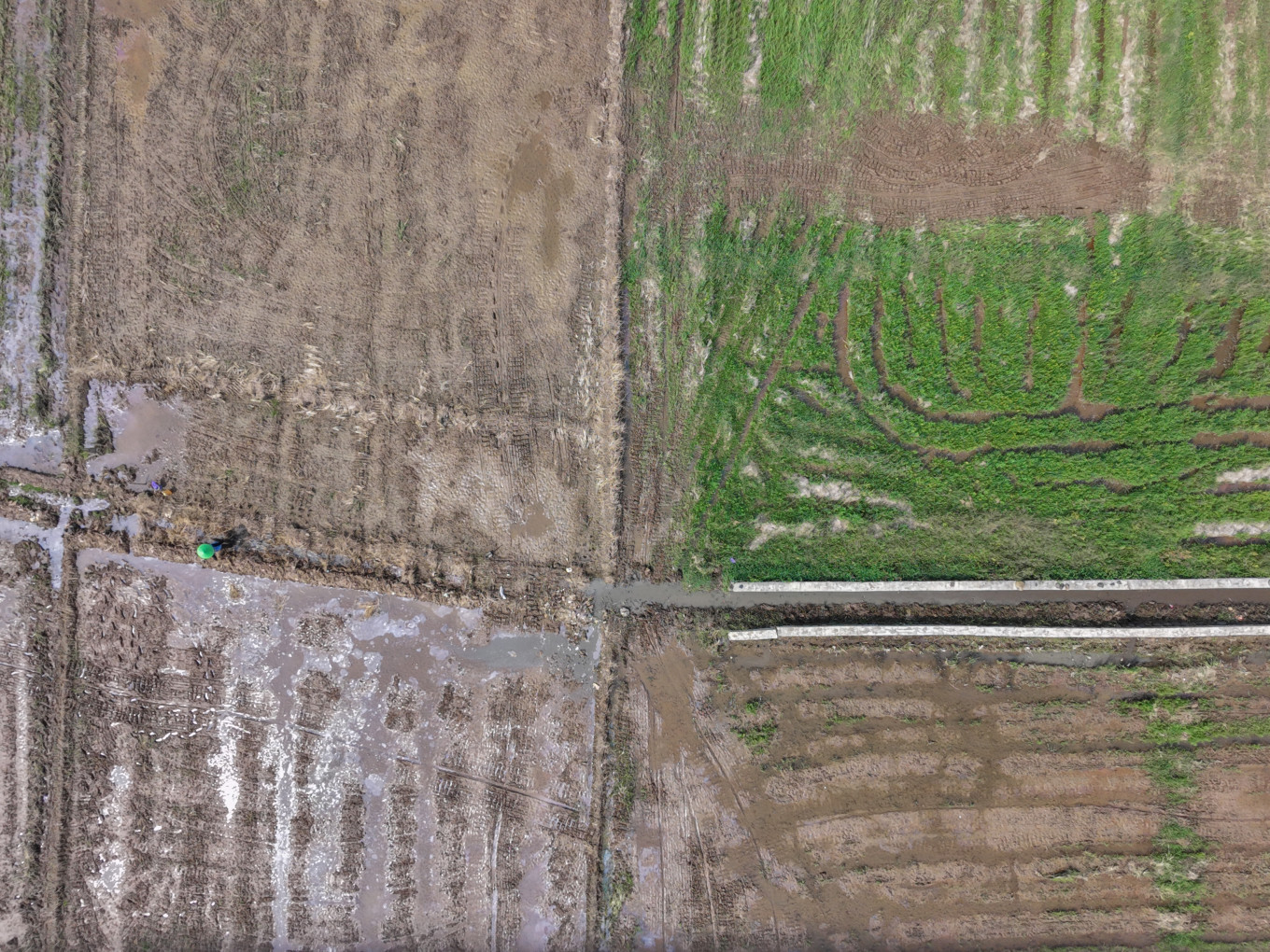 Farmers loosen soil using water flow from an irrigation canal in Batang regency, Central Java, in an aerial photo released on May 19, 2026. (Antara/Harviyan Perdana Putra)
I
ndosat Ooredoo Hutchison, together with Ooredoo Group, Nokia and NVIDIA, plans to develop Zankore, an artificial intelligence infrastructure platform aimed at serving the region.
The 1-gigawatt AI factory will be built in stages. Its first phase, with a capacity of about 200 megawatts, is scheduled to begin construction in Batang, Central Java, in the first half of 2027.
The project is being promoted as a step toward Indonesia’s ambition to become a regional AI hub. But advanced AI infrastructure requires not only enormous amounts of electricity. Its servers also need large volumes of water for cooling.
The difficult question is whether the government can guarantee enough water for both AI servers and local communities when Central Java is already facing water stress.
Every time we ask a chatbot a question, thousands of chips in data centers process the request and generate heat. Cooling systems must continuously remove that heat, often by evaporating water through cooling towers.
Water is also consumed indirectly along the data center supply chain, including in electricity generation.

A 2025 study by University of California researchers estimated potential water demand from AI factories using Microsoft’s projected approach. Indonesia recorded the highest projected cooling-water consumption among the countries examined, at about 1.9 liters for every kilowatt-hour of electricity used by servers.
Based on those projections, Zankore’s 200-MW first phase could evaporate between 4.8 million and 9.1 million liters of water per day, assuming continuous operation.
At that rate, Zankore could consume an amount equivalent to the 75.46 million liters of clean water prepared by the Central Java government during the 2026 drought crisis in just eight to 16 days. At the full 1-GW capacity, the same volume could be consumed in roughly two to three days.
The NVIDIA chips, the AI’s infrastructure used by Zankore, can use evaporative cooling towers, while alternatives such as seawater-based cooling could reduce freshwater consumption. Such systems, however, may create other environmental risks, including impacts on marine ecosystems.
As of this writing, Zankore has not disclosed which cooling system it will use.
Zankore represents an investment of about Rp 82 trillion (US$4.59 billion) more than the five-year investment target of $4.23 billion for the Batang Special Economic Zone (SEZ).
The government has also invested Rp 409.7 billion from the national budget to develop raw-water infrastructure for the Batang industrial zone, including Zankore’s. The system has a capacity of 285 liters per second, or about 24.5 million liters per day.
If Zankore relies on this source, its 200-MW first phase could consume more than 30 percent of the infrastructure’s daily capacity. At 1 GW, its estimated demand could exceed the entire capacity.
The economic benefits deserve closer scrutiny. Data centers are highly capital-intensive but relatively not labor-intensive. A 2026 study based on thousands of United States data centers found that such facilities typically employ fewer than 100 permanent workers.
The question is therefore not simply how much investment enters Batang, but how much value stays there, and who bears the environmental costs.
Zankore is 49 percent owned by Ooredoo, 37 percent by Indosat, 11 percent by NVIDIA and 3 percent by Nokia. This means 63 percent of its shares are held by companies from Qatar, the United States and Finland. Much of its equipment and AI chips will also be imported.
In economic terms, this creates a risk of a negative externality: profits accrue to shareholders, while part of the environmental cost, particularly water consumption, could fall on the local community.
Batang residents should not be expected to absorb that cost without transparency or safeguards.
The urgency is greater because Central Java declared a drought alert between June 5 and Sept. 28, affecting 2.34 million people in 784 villages, including areas of Batang. The provincial government subsequently prepared 75.46 million liters of clean water for residents.
Meanwhile, the northern coast of Central Java is already struggling with land subsidence. Indonesia’s Geological Agency and researchers at the Bandung Institute of Technology (ITB) have recorded subsidence of around 6–20 centimeters per year in the Pekalongan-Batang area.
As the ground sinks, soil becomes less able to store water, while seawater can move farther inland and worsen tidal flooding. These changes are difficult to reverse and could eventually force communities to relocate.
An AI factory is designed to operate continuously. Its servers cannot simply shut down because water becomes scarce. That is precisely why the government must understand its resource demands before the facility becomes fully operational.
At minimum, Zankore should be required to publicly disclose its projected water consumption, water sources, cooling technology and contingency plans during droughts. Authorities should also establish clear rules for allocating water between industrial users and local communities.
The same scrutiny should apply to other large data center projects, including the proposed AI data center in Jatiluhur, West Java.
Indonesia’s ambition to become an AI hub should not come at the expense of communities already struggling with water insecurity and sinking land.
If the water runs out, everyone loses. If it is managed and protected fairly, everyone has a better chance to benefit from the country’s digital future.
---
 Usman Arief is a lecturer and a researcher at Gadjah Mada University. Imam Salehudin is an associate professor at University of Indonesia. This article is republished under a Creative Commons license.