The Jakarta Post
Please Update your browser
Your browser is out of date, and may not be compatible with our website. A list of the most popular web browsers can be found below.
Just click on the icons to get to the download page.


Popular Reads
Top Results
No results found. Please check your search term and try again
Can't find what you're looking for?
View all search results
Popular Reads
Top Results
No results found. Please check your search term and try again
Can't find what you're looking for?
View all search resultsAnalysis: Same uniform, new master: The limits of police reform
Change text size
Gift Premium Articles
to Anyone
Share the best of The Jakarta Post with friends, family, or colleagues. As a subscriber, you can gift 3 to 5 articles each month that anyone can read—no subscription needed!
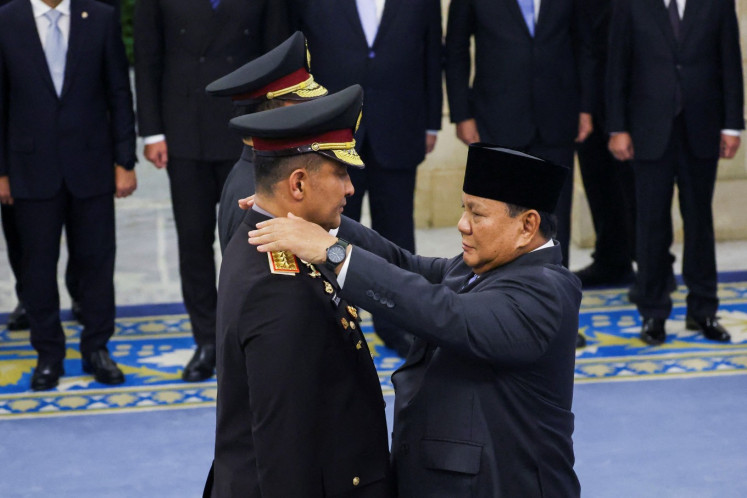
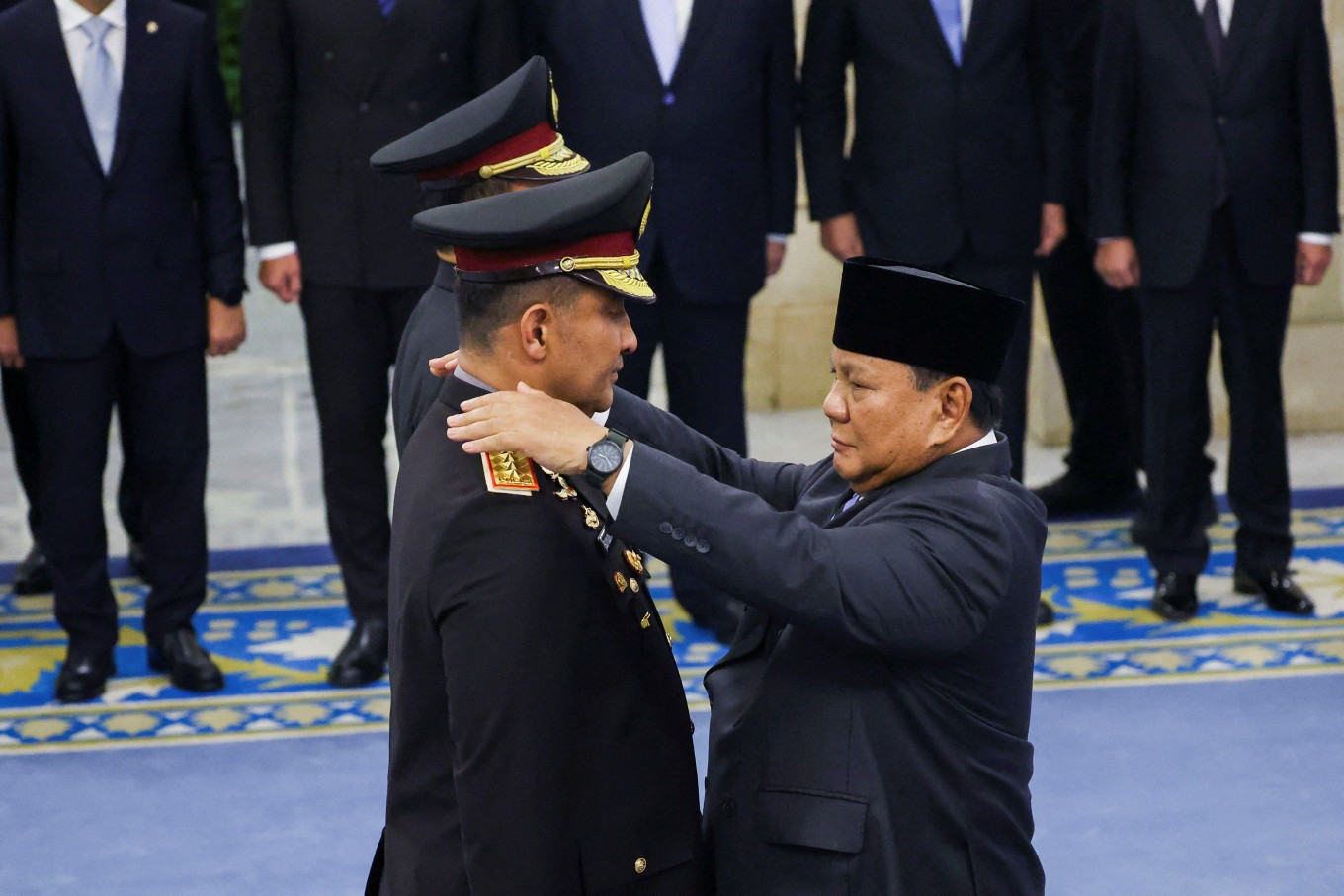 President Prabowo Subianto (right) attaches rank insignia on Oct. 1, 2026, to the uniform of newly appointed National Police Chief Suyudi Ario Seto (left) during his inauguration at the State Palace in Central Jakarta. (Reuters/Ajeng Dinar Ulfiana)
T
he inauguration of Suyudi Ario Seto as the new National Police (Polri) chief should be a chance to ask whether Polri can become a truly professional force. The early signals suggest it will not.
The new chief reshuffled senior appointments a day after his inauguration, but a reshuffle shows who holds power, not what the institution will do with it. Gen. Suyudi also said he would continue the policies of Gen. Listyo Sigit Prabowo whom he replaced, which is a clear statement that the institution's direction will stay the same. That pledge matters because the old direction is the problem.
Under Listyo, Polri was repeatedly criticized for heavy-handed policing of protests, impunity for abusive officers, and perceived political alignment. Reform was always promised as a project. In September 2025, Listyo formed an internal Police Reform Transformation Team on the president's direction, made up of 52 high- and mid-ranking officers. A body of serving officers reforming their own institution is an exercise in self-assessment, and self-assessment rarely produces structural change. A chief who promises continuity inherits that approach and will probably keep it.
The new Police Law enacted early this year reinforces the doubt. A reform law should have done at least three things: strengthened independent external oversight, narrowed Polri's sprawling mandate and tightened civilian control over appointments and budgets. A law that leaves these untouched may carry the label of reform but does not deliver it. The gap between the reform spirit of the public and the text of the statute shows how much influence Polri has over its own regulation.
The change of guard is better read as a transfer of loyalty than a change of course. Listyo rose under then President Joko “Jokowi” Widodo, and was seen as loyal to him. The new appointments mostly shift that allegiance to the sitting president, Prabowo Subianto. This is a real change in the chain of loyalty, but it does not make Polri more accountable to the public. It only changes which patron the force answers to. In a system where the police chief serves at the president's pleasure and the legislature approves nominees almost automatically, professionalism depends on the goodwill of whoever occupies the palace.
The most telling indicator is the growing number of active and retired police officers in Prabowo's administration. The same pattern applies to the military. Officers placed in ministries, agencies and state-owned enterprises extend the institution's reach into civilian governance. Some of this practice is being challenged. The presidential palace has said it will comply with a Constitutional Court ruling that requires police members to resign or retire before taking positions in civilian institutions.

That ruling is welcome, but compliance will be revealing. Officers can retire and keep their networks and loyalties, and a rule about formal status does not address the habit of treating the bureaucracy as a career extension for the security services. This points to the structural problem. Polri, like the TNI, has become one of the most powerful special interest groups in Indonesian democracy, arguably stronger than political parties, business associations or Islamic organizations.