The Jakarta Post
Please Update your browser
Your browser is out of date, and may not be compatible with our website. A list of the most popular web browsers can be found below.
Just click on the icons to get to the download page.


Popular Reads
Top Results
No results found. Please check your search term and try again
Can't find what you're looking for?
View all search results
Popular Reads
Top Results
No results found. Please check your search term and try again
Can't find what you're looking for?
View all search resultsA letter to Mayor Mamdani and Senator-elect El-Sayed
Drawing on stories of Jesus, Moses and the Prophet Muhammad, New York Mayor Zohran Mamdani and Senator-elect Abdul El-Sayed can teach about three candid reminders: guard the public trust, welcome scrutiny and govern for the marginalized.
Change text size
Gift Premium Articles
to Anyone
Share the best of The Jakarta Post with friends, family, or colleagues. As a subscriber, you can gift 3 to 5 articles each month that anyone can read—no subscription needed!
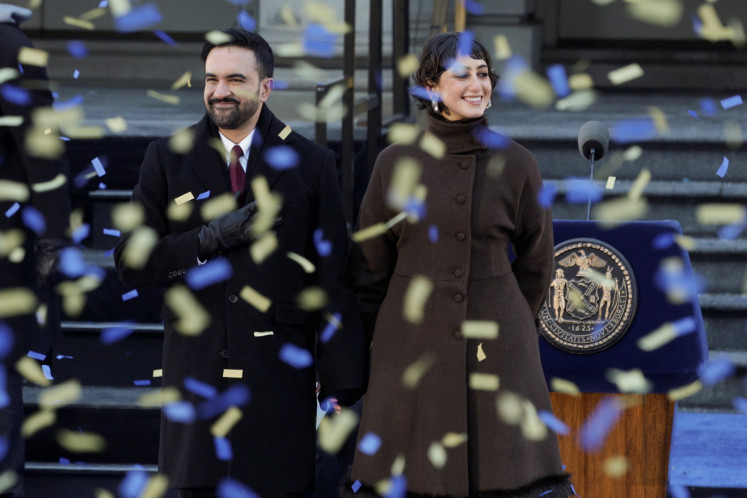
 New York City Mayor Zohran Mamdani (left) and his wife Rama Duwaji react as confetti falls during his inauguration ceremony on Jan. 1 in New York City, the United States. (Reuters/Jeenah Moon)
G
reetings from Indonesia, the world’s largest Muslim-majority democracy, where many of us have been cheering you on from across the ocean. Zohran Mamdani is nearly through his first year running New York City, and Abdul El-Sayed is about to walk into the United States Senate as its first elected Muslim member.
Many Indonesians have followed your journeys closely. Not only because you’re Muslims who won in America, but because your public lives may show the world what Islam looks like when it carries public responsibility.
Allow me, as an elder brother in faith and an admirer from afar, to live up to that reputation and share four hopes.
First, be leaders for everyone. Many people voted for you, and many did not. Your office now belongs to all of them. And “everyone” means more than people of different religions. It also includes the poor and the homeless, the migrant, the disabled, the elderly who live alone and those whose identities and ways of life are mocked or pushed aside by society, even when their lives are different from your own.
Here, Jesus, whom we honor as a great prophet, is the best teacher. He was often criticized for the company he kept. He sat at the table with people that respectable society had cast out, and he touched the sick whom others would not go near.
He did not first ask whether they deserved his kindness. He simply gave it. A leader’s heart is measured by how he treats those who can do nothing for him in return.

Second, guard the trust of power. Here I think of Moses. Before he led a nation, he worked for many years as a shepherd, taking care of his father-in-law’s sheep.
An old story, told for centuries in the Jewish tradition, gives us a beautiful detail. One day a small lamb ran away from the other sheep. Moses followed it for a long way, until he found it drinking from a stream.
He was not angry with it. He said gently, “I did not know you ran away because you were thirsty. You must be very tired.” Then he carried it home on his shoulders.
It is said that God chose him to lead His people for exactly this reason that a man who would carry one tired lamb could be trusted with a whole nation. Notice two things. First, Moses cared most for the one who was lost, the weakest of all. Second, the sheep were never his own. They belonged to someone else, and he looked after them as a trust.
Public office is the same. Power is an amanah (trust), not a reward. The public’s money belongs to the public, not to the leader. My own country knows that religious words mean nothing when public money is used dishonestly. So be open about how public money is spent, explain your decisions and let people check your work.
As someone who now serves the press in my country, I can tell you that a free and critical press is an honest leader’s best friend, even when its stories are uncomfortable to read.
Third, listen with sincerity. One day a woman named Khawlah came to the Prophet Muhammad, peace be upon him, with a painful family problem. She had no title and no influence, only a difficult situation at home and children to care for. She pleaded with him and explained her case, and he did not send her away.
He listened patiently until she had said everything she needed to say. The Quran then honored that conversation in a chapter named after her, Al-Mujadilah, “The Woman Who Pleads,” which begins with the words: “God has heard the words of the woman who pleads with you.”
Imagine that. God Himself paid attention to a conversation between a leader and an ordinary woman who would not stop speaking until she was heard.
If God listens to such voices, surely a mayor and a senator can too. Listen especially to those who did not vote for you, and to those who are afraid of you. Ikhlas (sincerity) is hard to fake for long. People can always tell the difference between a leader who truly serves them and one who is only acting.
Fourth, show the world the Islam you believe in. The Quran describes the Prophet as a mercy to all the worlds, rahmatan lil ‘alamin: a mercy for everyone, not only for Muslims.
I know this is an unfair burden. No two people can speak for nearly two billion believers, and you were elected to make rent, buses and healthcare work for ordinary people, not to defend a religion. But public life will hand you this weight anyway.
So carry it lightly and cheerfully. Be fair to your opponents, kind to the weak, faithful to your promises and humble in success. Then perhaps people will say, “If this is what a Muslim public servant looks like, then Islam is a blessing”.
Of course, I do not know the daily pressures of leading New York or serving in the Senate, and you will know far better than I how to use any of this. Take what is useful and forgive what is not. That is what younger brothers do with advice from older brothers anyway.
May God grant you wisdom, strength, good health and a good sense of humor for the long road ahead.
***
The writer is the rector of Indonesian International Islamic University (UIII), Depok, West Java, and chairman of the Press Council. The views expressed are personal.