The Jakarta Post
Please Update your browser
Your browser is out of date, and may not be compatible with our website. A list of the most popular web browsers can be found below.
Just click on the icons to get to the download page.


Popular Reads
Top Results
No results found. Please check your search term and try again
Can't find what you're looking for?
View all search results
Popular Reads
Top Results
No results found. Please check your search term and try again
Can't find what you're looking for?
View all search resultsDestroying the KPK, consolidating oligarchic power
It’s safe to say that the oligarchs are the main players behind attempts to defang the KPK.
Change text size
Gift Premium Articles
to Anyone
Share the best of The Jakarta Post with friends, family, or colleagues. As a subscriber, you can gift 3 to 5 articles each month that anyone can read—no subscription needed!
 Set as preferred source
T
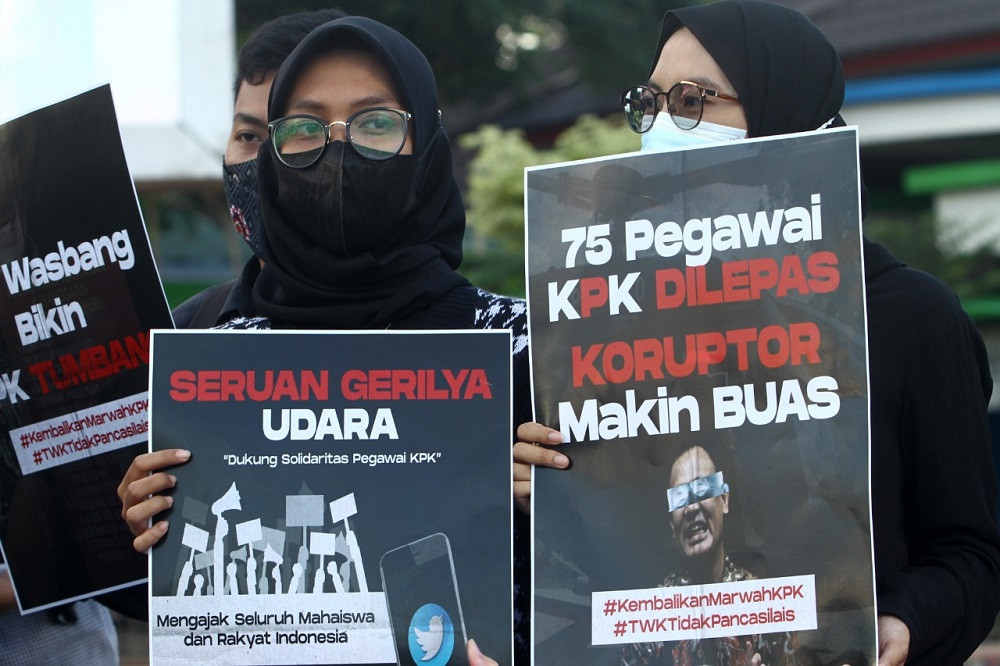
he weakening of the Corruption Eradication Commission (KPK) has entered a new phase. After the revision of the KPK Law, we are now witnessing the rising polemic surrounding the civic knowledge test (TWK), which many believe is a mechanism to remove certain “troublemakers” within the antigraft body.
The endless attempts to undermine the KPK evince that instead of facilitating democracy consolidation, the Reform Era actually resulted in the consolidation of oligarchies.
Early last month, the Constitutional Court (MK) turned down a judicial review filed against the revised KPK Law. We all remember that the revision of Law No. 30/2002 on the KPK went through a flawed process due to the absence of transparency and public consultancy.
The new Law No. 19/2019 strips the KPK of its authorities and independence. The systemic attempt to weaken the KPK coincided with the appointment of KPK leaders with questionable track records.
Data from Indonesia Corruption Watch (ICW) shows that maneuverings to undermine the KPK have been attempted many times. The weakening through the legislative process has been carried out since 2011, but to no avail due to strong public pressures.
Shortly after the Constitutional Court rejected the judicial review motion, controversy arose anew over the dismissal of 75 KPK employees who had not passed the TWK, as required by the KPK Law for them to gain civil service servant (ASN) status. Those who passed the test were installed on June 1, coinciding with the commemoration of Pancasila Day.
Corruption eradication was at the top of the reform agenda when the country embraced democracy in 1998. A number of legal products that support the corruption eradication agenda were issued, such as People’s Consultative Assembly (MPR) Decree No. XI/1998, Law No. 31/1999 on the eradication of corruption and Law No. 30/2002, which became the founding basis for the KPK. This is also the reason why the history of the KPK cannot be separated from the mandate of the reform movement.