TheJakartaPost
Please Update your browser
Your browser is out of date, and may not be compatible with our website. A list of the most popular web browsers can be found below.
Just click on the icons to get to the download page.


Popular Reads
Top Results
No results found. Please check your search term and try again
Can't find what you're looking for?
View all search results
Popular Reads
Top Results
No results found. Please check your search term and try again
Can't find what you're looking for?
View all search resultsOne year after the coup, Myanmar children face learning, life loss
The Myanmar junta has fired over 125,000 teachers, as well as more than 13,000 professors and university staff, accounting for 45 percent of all teaching and administration staff at universities.
Change text size
Gift Premium Articles
to Anyone
Share the best of The Jakarta Post with friends, family, or colleagues. As a subscriber, you can gift 3 to 5 articles each month that anyone can read—no subscription needed!
G
lobally, the unprecedented COVID-19 pandemic has disrupted traditional classroom education. However, hybrid or online learning has been industrialized in many parts of the world, allowing professors and teachers to move away from traditional classroom teaching to this new arrangement.
Moreover, many studies have been conducted on the experiences and challenges of educators in adopting such new technology and approaches, whereas some studies have been conducted on students who follow online learning as part of efforts to improve the quality of education.
In Myanmar, more than 12 million children have lost access to education since early 2020, after all schools and universities were closed to curb the surge in COVID-19 cases. But the country, unlike neighboring countries, lacks knowledge and infrastructure to implement online learning,
Even before the pandemic, Myanmar was one of the countries with the highest rates of child marriage, with 16 percent of girls marrying before the age of 18 in 2013. In the same year, one in 11 children were trapped in child labor and deprived of childhood, health and education due to poverty and conflict, and more than 2 million children were out of school.
Amid a year of battling with COVID-19 and its destructive impact on education, health, economy and people’s well-being across the country, the military illegitimately took over the state power on Feb. 1, 2021. Subsequently, the civilian government's plan to vaccinate educators as the priority group and reopen schools has crumbled.
Children and teachers have been exposed to a higher risk of life insecurity since military personnel seized more than 60 university and school campuses, and attacked more than 103 schools and other facilities, causing damage four months after the coup.
Furthermore, the military ordered that schools be reopened without imposing strict health protocols, just to show the regime had stabilized the country following the coup amid a surge in COVID-19 cases. The international community therefore called for the removal of military personnel from school and university campuses to protect the well-being of students and teachers.
Nevertheless, many students and educators refused to return to school and joined the Civil Disobedient Movement (CDM) as a non-violent demonstration against the coup. Consequently, the junta-formed State Administration Council fired over 125,000 teachers, as well as more than 13,000 professors and university staff, accounting for 45 percent of all teaching and administration staff at universities by May 2021, instead of withdrawing the military troops. Also, the military have arbitrarily detained over 770 university student protesters and issued arrest warrants of many students, prompting them to flee their homes for safety.
Many students have undergone interrogation; some were tortured to death overnight, such as Ko Lin Paing Soe, Ko Zin Ko Tun and Aung Bhone Kyaw. Some students were sentenced to 10 years of imprisonment, such as Min Thukha Kyaw.
Moreover, the military continued to shut down all wireless broadband services and deliberately block off mobile internet access across the country. The internet blackout remains in place today in several cities where armed conflicts continue to take place, simply to cover up the war crimes and brutal human rights violations the military troops commit.
Furthermore, the military has threatened anybody detected using VPN software with a prison sentence of up to three years and a fine of up to 5 million kyats (US$2,800).
Thus, students in Myanmar cannot access online learning due to internet restrictions, lack of computers, mobile phones and electricity. Moreover, community social workers and non-formal volunteer education providers come under a threat from the military, and they cannot perform education services in community places.
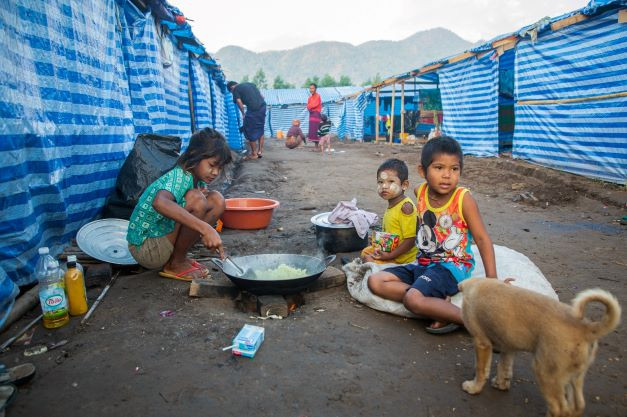
Over 236,000 people have been displaced from their homes after the coup due to the escalating armed conflicts. Among the displaced, almost 200,000 civilians in seven of Myanmar's 14 states and regions have been affected by military attacks.
The military have also deliberately blocked humanitarian aid to internally displaced persons (IDPs) camps. Humanitarian group workers have often become the target of airstrikes, making it challenging to operate non-formal education for the displaced students.
At least 75 children have been killed and over 1,000 others detained since the coup a year ago, regardless of the Child Rights Convention (CRC) Myanmar has ratified. However, the United Nations has only released condemnation statements and failed to act to halt the military's impunity and crimes against humanity.
As of Feb. 2, the military has continued to kill over 1,510 civilians, arrested 8,934 people, charged 1,972 people for a warrant and sentenced 666 people to prison, according to Assistance Association for Political Prisoners (AAPP).
The country has become a failed state within a year. The public health system has collapsed and people are not getting COVID-19 vaccines as the military raided and detained public health workers for participating in CDM. According to a UNICEF report, nearly 1 million children in Myanmar are not yet vaccinated against infectious diseases, 3 million lack access to clean drinking water and an estimated 14.4 million people need humanitarian assistance, including 5 million children.
The country's economy has collapsed, and the UN has appealed for $826 million for an immediate humanitarian response.
At this current humanitarian crisis, Myanmar people urgently need the international community and the UN humanitarian response. However, this man-made disaster will continue unless the military's crimes against humanity are halted and those responsible are held accountable.
In particular, the education of more than 12 million children in Myanmar is at stake under this brutal military regime. Therefore, if the world leaders and the international community are firmly committed to achieving the 17 Sustainable Development Goals, they cannot leave Myanmar people behind.
***
The writer is a PhD candidate in sociology and social policy at the School of Graduate Studies, Hong Kong.