TheJakartaPost
Please Update your browser
Your browser is out of date, and may not be compatible with our website. A list of the most popular web browsers can be found below.
Just click on the icons to get to the download page.


Popular Reads
Top Results
No results found. Please check your search term and try again
Can't find what you're looking for?
View all search results
Popular Reads
Top Results
No results found. Please check your search term and try again
Can't find what you're looking for?
View all search resultsGovt still cautious on case spike, maintains curbs
Coordinating Maritime Affairs and Investment Minister Luhut Binsar Pandjaitan, who is in charge of the government’s COVID-19 response in Java and Bali, said on Monday that it would take time before restrictions could be eased.
Change text size
Gift Premium Articles
to Anyone
Share the best of The Jakarta Post with friends, family, or colleagues. As a subscriber, you can gift 3 to 5 articles each month that anyone can read—no subscription needed!
W
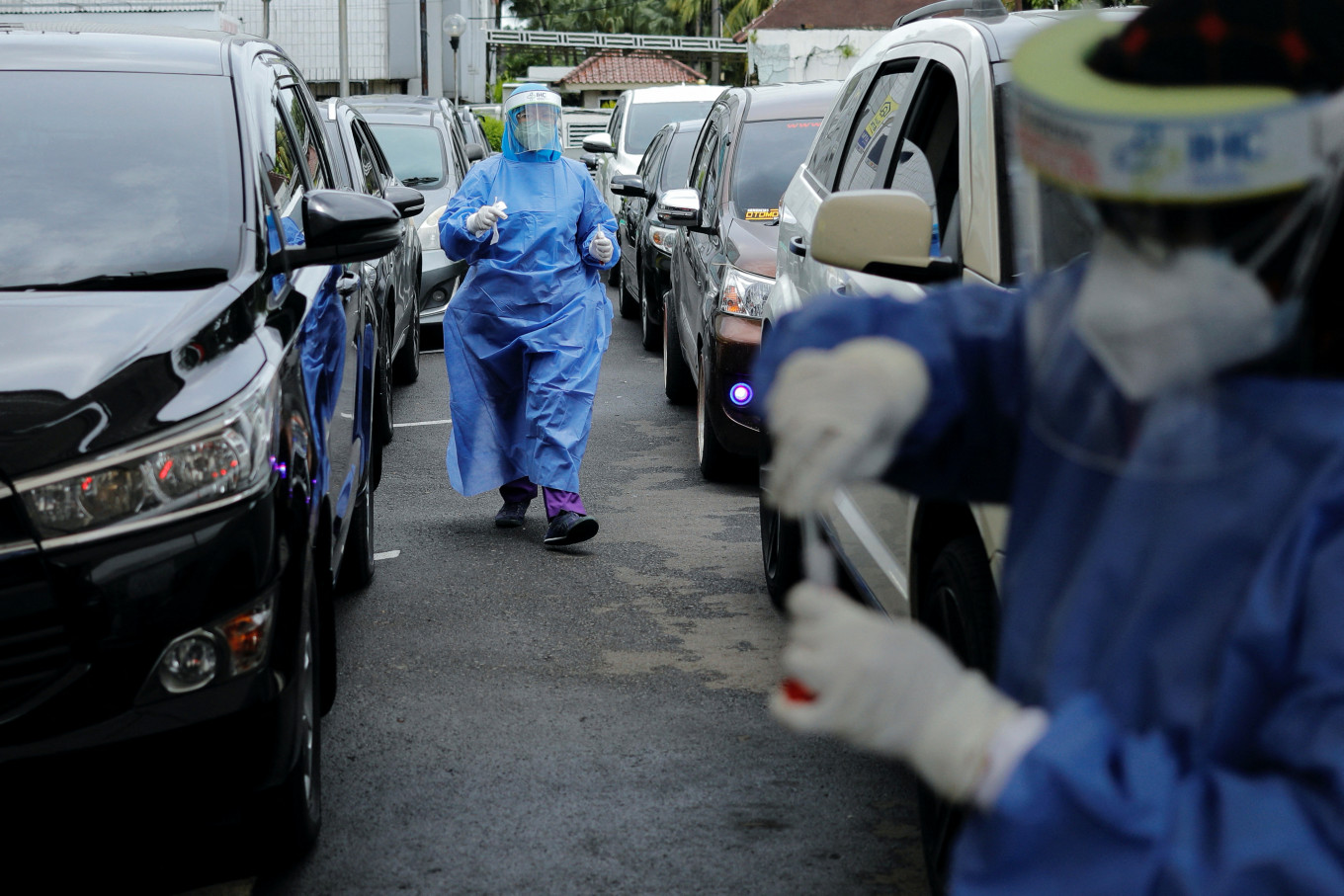
hile recent epidemiological data suggest that COVID-19 transmission has begun to slow down in some areas of the country, the government has decided to maintain stringent curbs, as experts contend that the jury is still out on whether or not the Omicron-fueled third wave of infections has passed its peak.
Monday saw some 34,000 new COVID-19 cases -- the lowest daily figure for the past two weeks and almost half the record-breaking 64,000 cases reported on Feb. 16. On Tuesday, nearly 57,500 new cases were reported.
Despite this, Coordinating Maritime Affairs and Investment Minister Luhut Binsar Pandjaitan, who is in charge of the government’s COVID-19 response in Java and Bali, said on Monday that it would take time before restrictions could be eased.
The government extended on Monday level 3 public activity restrictions (PPKM), the second-strictest curbs in the four-tiered system, in the densely populated urban agglomerations of Greater Jakarta, Greater Bandung in West Java, Greater Surabaya and Greater Malang in East Java, and across the provinces of Bali and Yogyakarta for another week.
Greater Semarang and Greater Surakarta in Central Java are now also included on the list.
“The increase in the level [of curbs] in each of these areas was due to increasing hospitalizations,” Luhut told a press briefing on Monday.
He said the pandemic situation was under control and the public should not panic.
Hospital bed occupancy for coronavirus patients in Jakarta, the country's capital and COVID-19 epicenter, has been trending downward in the past week, from 55 percent on Feb. 12 to 48 percent on Sunday. Rates in East Java, West Java and Central Java, however, have been rising.
Read also: Government expects case surge in Jakarta to ease soon
Although nationwide transmission is generally showing signs of easing, Health Minister Budi Gunadi Sadikin warned that COVID-19 deaths might continue to rise in the coming weeks.
Indonesia reported 176 deaths on Monday – 39 of which were in East Java and 24 in Jakarta – and 257 on Tuesday.
With Indonesia’s COVID-19 deaths having largely been among those not fully vaccinated, the elderly and those with comorbidities, Budi urged regional administrations to accelerate the rollout of primary and booster vaccination.
"Please immediately get vaccinated, at least two doses, especially [if you are a member of] the elderly population,” Budi said, also during Monday's press briefing.
Of the country’s 146,000 deaths, 48 percent were people aged above 60, according to ministry records. Despite this, only 52 percent of the total elderly population has been fully vaccinated.
“Not to mention that only a few provinces have managed to vaccinate 70 percent of their [general] population," Budi said.
Not out of the woods yet
Some countries, such as the United Kingdom, Denmark and Singapore, have now begun to accept the virus as endemic.
But Luhut said Indonesia would not be following these countries anytime soon because it still needed to increase rates of primary vaccination and boosters, reduce the number of infections and increase the capacity of health facilities and coronavirus surveillance.
“We will carry out this transition gradually and in stages,” Luhut said.
Read also: Daily COVID-19 fatalities reach 100 as cases soar
Epidemiologists generally welcomed the government’s cautious approach, with Masdalina Pane of the Indonesian Epidemiologists Association saying that Indonesia would need to wait for at least two more weeks to ascertain whether or not the Omicron peak had passed.
While he said that level 4 curbs might not be necessary, epidemiologist Dicky Budiman suggested that the government should maintain level 3 curbs for the time being and continue observing the pandemic situation in the coming weeks.
"We are on track [to recover] from the pandemic. We must not be distracted [by other countries] that have started easing restrictions, which will be detrimental for Indonesia,” Dicky said. “We have the best policy: slowly, but surely.”
Public are pleased
As the country continues battling the third wave, President Joko “Jokowi” Widodo has enjoyed widespread job approval, a recent survey released on Sunday by Indikator Politik Indonesia showed.
In the survey, which polled over 600 respondents nationwide from mid-January to mid-February, when coronavirus cases began increasing following the discovery of the first known Omicron case in the country, 70.9 percent of respondents approved of the work Jokowi was doing as President, while just 24.9 percent disapproved. The remaining 4 percent either did not answer or were neutral.
But his approval rating did not change much from the 71.4 percent in the previous in-person survey in December last year, when daily cases were below 200.
Read also: Jakartans cautiously optimistic about Omicron surge
The latest survey also found that more Indonesians supported the third dose rollout to protect people better against the virus. Some 61 percent of respondents said they welcomed the program that started on Jan. 12, increasing from 54 percent of respondents in the December 2021 survey.
With 67 percent of respondents being concerned about the threat posed by the Omicron variant, the survey also found high compliance with mask-wearing and social distancing in public spaces among the respondents.