Can't find what you're looking for?
View all search resultsCan't find what you're looking for?

View all search resultsIn today’s context, empowering bilateral diplomacy also represents the desire of domestic constituents to see more tangible outcomes or concrete projects from diplomatic missions overseas.

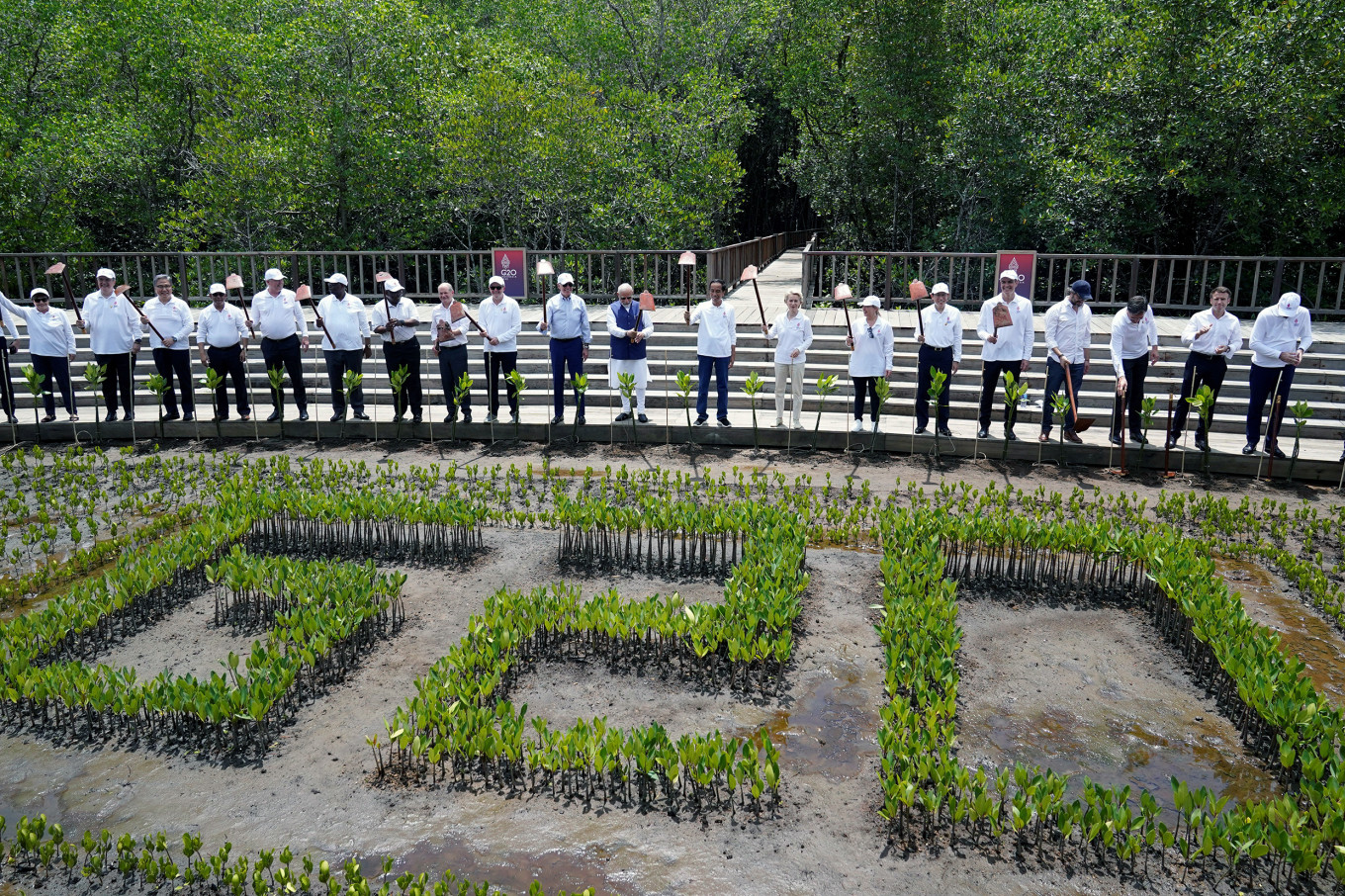
Heavy rain started pouring in Nusa Dua, Bali, not long after President Joko “Jokowi” Widodo announced the Group of 20 had reached a consensus to issue a Leaders’ Declaration during their summit on Nov. 16. The rain created a sense of respite after the island of gods had endured extreme heat and humidity for several days.
A similar atmosphere of relief prevailed when officials who were part of the Foreign Ministry G20 task force had dinner that day. It was as if a big stone had been removed from their chest. There was much joy that evening.
Co-sherpa of the G20 Dian Djani shared many behind the scenes stories of diplomatic efforts, ranging from the drafting of some contentious paragraphs in the declaration to securing support from G20 members. He also described the important role of Foreign Minister Retno Marsudi, who intervened in critical junctures in an effort to assuage concern among some countries on those paragraphs.
As the monologue went on, I looked around the table and was struck to see many unfamiliar faces of young diplomats whom I reckon only recently joined the Foreign Ministry.
To my big surprise, in all this year, they were entrusted with huge responsibilities to ensure the success of the G20 process.
Their roles ranged from preparing briefing notes, liaising and partnering with line ministries on many technical meetings, stock taking concrete deliverables to simply acting as junior assistants to Indonesia’s co-sherpa and sous sherpa.
Their extensive exposure into multilateral diplomacy in action convinced me that they would be ready to take up the mantle and oversee Indonesia’s next chairmanship in the G20, some years from now.
The success in chairing the G20—the most prominent global economic forum—has prompted some of Indonesia’s foreign policy enthusiasts to engage in lengthy discussions on two big issues.
First, on institutional building in the Foreign Ministry and the strength of the diplomatic machinery. And second, on Indonesia’s place within the ever-floating constellation of power and influence in global politics.
With regard to the first issue, the general perception is that there is already an equilibrium between diplomats championing bilateral and multilateral diplomacy.
Over the last two decades, there was a strong drive to upscale the bilateral branch in the Foreign Ministry. The intention is to balance the sense of entitlement on the works of diplomacy among those serving in multilateral posts vis-a-vis those who develop a career in bilateral posts.
In today’s context, empowering bilateral diplomacy also represents the desire of domestic constituents to see more tangible outcomes or concrete projects from diplomatic missions overseas. In the economic realm for instance, many stakeholders wish to see an increase in exports and inbound investment as well as more foreign tourist arrival.
Hence, the ministry for quite some time has directed more resources, including human capital, toward bilateral posts.
In the case of multilateral diplomacy, they are more concerned with norm setting at the global level and therefore are often seen as abstract and not always able to provide immediate answers to various global challenges. Generally speaking, the public is less keen to follow multilateral processes which may take decades to settle on particular issues, such as the decades-long negotiation on the United Nations Convention on the Law of the Sea.
Indeed, there are success stories, such as the works of the World Health Organization (WHO) through the COVAX Advance Market Commitment (AMC) and Access to COVID-19 Tools Accelerator to distribute vaccines for the global poor during the COVID-19 pandemic.
All in all, for many developing nations like Indonesia that have faith in global collaboration to solve global problems, support for multilateralism is essential. Therefore, by way of assigning dedicated multilateralists to the United Nations (UN), the Foreign Ministry hopes to see those protégés sharpen their negotiation skills and fight for Indonesia’s principle positions.
If we look more closely at the outcomes of the G20 Summit, we can see the two facets of Indonesian diplomacy intertwined.
On the one hand, they managed to secure consensus on various global issues of common concern as reflected in the Leaders’ Declaration. On the other hand, they managed to curate many concrete projects or deliverables.
One example of the concrete projects within the G20 is an agreement between Indonesia and Fiji to set up a regional agriculture training in Fiji for the promotion of food security, particularly among small island countries in the Pacific.
Promoting the interest of the Global South while chairing the G20 is a manifestation of the constitution that is entrusted upon the government to participate actively toward the establishment of a world order based on freedom, perpetual peace and social justice.
On the issue of Indonesia’s place within the ever-floating constellation of power or on the issue of international prominence, it would be politically incorrect to make self-assertions. Then again, minister Retno always impresses upon her team that chest-thumping has no place in Indonesia’s diplomatic tradition.
Perhaps, in the interest of getting some sense on where we are post-G20 presidency, it would be fitting to look into some comments made by third parties.
Bloomberg wrote that “Indonesia has long punched below its weight on international affairs. That changed at this year’s Group of 20 summit.” The Economist in its Nov. 19-25, 2022 edition wrote “a quarter of a century on [Indonesia was hit hard by multiple crises in 1998] Indonesia matters once again.”
The two quotes present encouraging observations of Indonesia’s foreign policy and diplomacy’s state of affairs. Moreover, it also entails greater expectations from domestic constituents and the global community for more ingenuity in Indonesian diplomacy in the face of a more complex global politics.
As we speak, the Foreign Ministry is gearing up for Indonesia’s ASEAN chairmanship for 2023.
Indonesia’s diplomacy has succeeded in ensuring the G20 remains intact and able to respond to multidimensional crises, from addressing the pandemic and economic downturn to geopolitical tensions.
All of this, as minister Retno puts it, can be attained because Indonesian foreign policy and diplomacy has for a long time invested in trust building.
***
The writer is a former Indonesian ambassador to Canada. The views expressed are his own.
Share your experiences, suggestions, and any issues you've encountered on The Jakarta Post. We're here to listen.
Thank you for sharing your thoughts. We appreciate your feedback.
Quickly share this news with your network—keep everyone informed with just a single click!
Share the best of The Jakarta Post with friends, family, or colleagues. As a subscriber, you can gift 3 to 5 articles each month that anyone can read—no subscription needed!
Get the best experience—faster access, exclusive features, and a seamless way to stay updated.