TheJakartaPost
Please Update your browser
Your browser is out of date, and may not be compatible with our website. A list of the most popular web browsers can be found below.
Just click on the icons to get to the download page.


Popular Reads
Top Results
No results found. Please check your search term and try again
Can't find what you're looking for?
View all search results
Popular Reads
Top Results
No results found. Please check your search term and try again
Can't find what you're looking for?
View all search resultsCash and non-cash gifts: Tradition to welcome Idul Fitri
Although experts say that non-cash gifts will potentially erode emotional bonds, the essence of the tradition remains unchanged, which is to spread happiness.
Change text size
Gift Premium Articles
to Anyone
Share the best of The Jakarta Post with friends, family, or colleagues. As a subscriber, you can gift 3 to 5 articles each month that anyone can read—no subscription needed!
S
haring happiness by giving angpao or red envelopes to relatives, generally those who are younger, during Chinese New Year seems to have become a cultural tradition not only among the Chinese community but also among other ethnicities and religious groups. Bagong (2023) says that angpao is a form of generosity that later developed into part of a tradition.
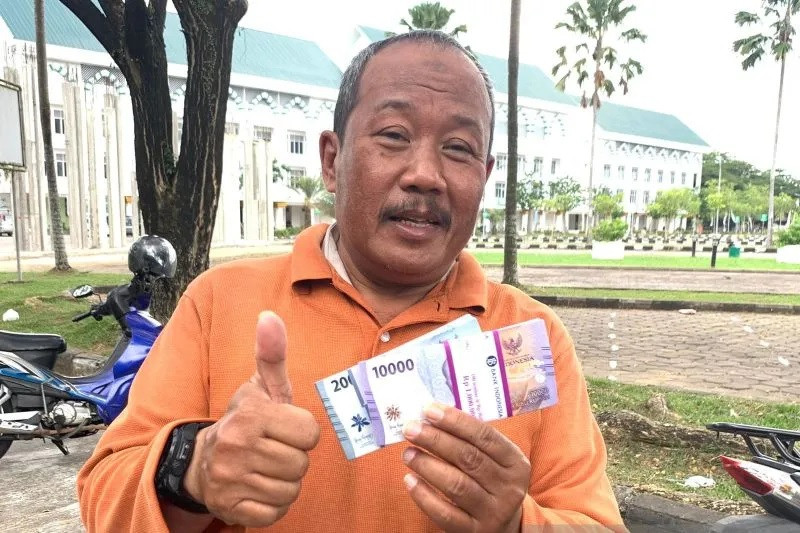
There is a similarity between the angpao tradition and fitrah during Idul Fitri, which takes the form of a small envelope containing various denominations of banknotes. Here, money becomes a universal language as a manifestation of social, emotional and interpersonal closeness. Happiness arises especially when people receive envelopes containing usually new, neatly lined up, colorful rupiah banknotes, with their distinctive smell.
Behind the tradition, the important role of Bank Indonesia (BI) as the regulatory authority of monetary management for both cash and non-cash is undeniable.
For this year's Ramadan and Idul Fitri festival, BI has prepared Rp 195 trillion (US$13 billion) in cash, up by 8.2 percent from last year’s Rp 180 trillion. The increase took into account several reasons, primarily the lifting of COVID-19 restrictions at the end of last year.
The second factor is the predicted rise in the number of people who will travel to their hometowns for a family reunion to celebrate the Islamic holiday. The Idul Fitri mudik (exodus) is expected to involve 123.8 million people or half of Indonesia's population.
The third factor is improvement in economic growth, which reached 5.31 percent by the end of last year and is predicted to expand further this year.
Those factors have prompted the central bank to prepare strategic steps to meet the public's need for cash during the holiday season. First, providing a sufficient amount of banknotes of various denominations, which are in good condition and fit for circulation.
Second, specifically for its distribution strategy, BI, apart from providing regular cash services, also cooperates with banks and other strategic partners. There are 5,066 offices or banking service points throughout Indonesia that are ready to serve as money exchanges. The public is also expected to take advantage of the Pintar.bi.go.id page to speed up the exchange process before availing of the cash service.
BI also facilitates money exchange by being present at public gathering points such as bus terminals, markets and train stations. BI is also present on several routes that Idul Fitri revelers normally take, including rest areas along the Java, Lampung and Palembang toll roads. Straits crossings such as Merak, Bakauheni, Ketapang and Gilimanuk ports, which are expected to be crowded, are equipped with BI money exchanges for travelers’ convenience.
People who rely on river transportation for their economic activities, such as those in South Sumatra, South Kalimantan and Central Kalimantan, will be facilitated by BI too through its mobile cash service along the rivers.
The rising demand for new denomination notes is the right moment for the central bank to educate the public about love, pride and understanding of the rupiah. Love is manifested in recognizing, caring for and safeguarding our money. Furthermore, we are proud of the rupiah as a national identity, symbol, sovereignty and unifying element. Finally, understanding the function of the rupiah in the economy is manifested in its use for transactions, shopping and savings.
For this year's Ramadan and Idul Fitri, as part of the love, pride and understanding the rupiah movement, the central bank encourages people to spend money wisely by shopping according to their needs, buying domestically produced products, and allocating some of their income for savings.
Since the pandemic, the tradition of giving cash during Idul Fitri or Chinese New Year has shifted due to the government’s social-distancing policy. Although experts say that non-cash gifts will potentially erode emotional bonds, the essence of the tradition remains unchanged, which is to spread happiness.
The use of non-cash money, non-cash payments and non-cash transactions is of great concern for the central bank ahead of Idul Fitri. BI has continued to encourage the use of non-cash through Quick Response Code Indonesian Standard (QRIS) payments and remittances through BI-FAST.
To anticipate the increase in transaction volume, BI, together with the payment system industry and associations, has made sure of the readiness and reliability of the system to sustain the non-cash payment system operations.
Of course, it is very unfortunate that there have been cases of abuse of QRIS payments recently. However, consumers should have no hesitation in using QRIS as a payment that is known to be fast, easy, cheap, safe and reliable.
BI has synergized with the industry including payment service providers, payment system associations, payment system infrastructure providers, National Electronic Transaction Settlement (PTEN) providers and other related parties to improve education and literacy regarding QRIS transactions.
In addition, BI continues to strengthen supervision of the implementation of QRIS, especially promoting Know Your Merchant aspects and monitoring transactions, as well as strengthening supporting infrastructure for the QRIS ecosystem to mitigate the risk of QRIS misuse or fraud. Consumers are advised to always pay attention to the information in the application when scanning QRIS, follow the payment instructions provided by the merchant, and avoid transactions if there are irregularities or information that does not match the merchant's profile.
All in all, when the crisp new banknotes neatly line up in our wallets and the QRIS and BI-FAST non-cash services have been installed on our smartphones, it is time for us to join the mudik tradition. Happy mudik and stay safe.
***
The writer is an analyst at Bank Indonesia. The views expressed are his own.