TheJakartaPost
Please Update your browser
Your browser is out of date, and may not be compatible with our website. A list of the most popular web browsers can be found below.
Just click on the icons to get to the download page.


Popular Reads
Top Results
No results found. Please check your search term and try again
Can't find what you're looking for?
View all search results
Popular Reads
Top Results
No results found. Please check your search term and try again
Can't find what you're looking for?
View all search resultsJapan's Takaichi aims for blizzard of votes in rare winter election
If the coalition of Takaichi's Liberal Democratic Party with the Japan Innovation Party, known as Ishin, wins 310 seats, it would be able to override the upper chamber, where it does not have a majority.
Change text size
Gift Premium Articles
to Anyone
Share the best of The Jakarta Post with friends, family, or colleagues. As a subscriber, you can gift 3 to 5 articles each month that anyone can read—no subscription needed!
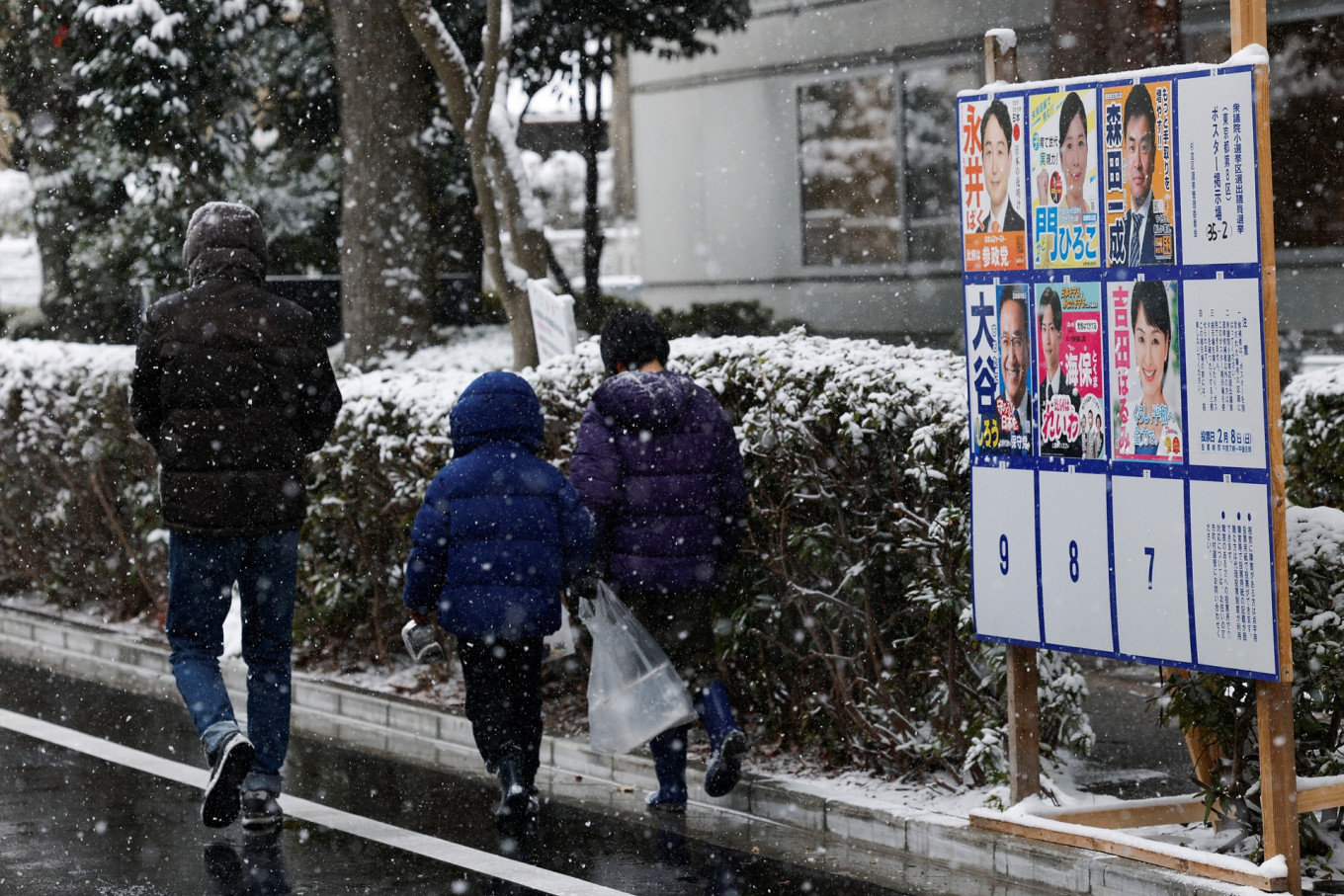 A family walks past election posters displayed near a polling station on the day of a general election in Tokyo, Japan, on Feb. 8, 2026. (Reuters/Kim Kyung-Hoon)
J
apanese voters were casting ballots on Sunday in an election expected to hand Prime Minister Sanae Takaichi a resounding win, although record snowfall blanketing parts of the country could keep some voters at home.
The conservative coalition of Takaichi, the nation's first female leader, is predicted to win around 300 of the 465 seats in the lower house of parliament, according to multiple opinion polls, a large gain from the 233 it is defending.
If the coalition of Takaichi's Liberal Democratic Party (LDP) with the Japan Innovation Party, known as Ishin, wins 310 seats, it would be able to override the upper chamber, where it does not have a majority.
She has vowed to step down if the coalition loses its majority.
'Sankatsu' wave
Takaichi, 64, who became prime minister in October after being selected LDP leader, sought a mandate from voters in a rare winter election as she rides a wave of popularity.
With a straight-talking style and an image as a hard worker that have won her support, especially with younger voters, Takaichi has accelerated military spending to counter China and pushed for a sales-tax cut that has rattled financial markets.
"If Takaichi wins big, she will have more political room to follow through on key commitments, including on consumption-tax cuts," said Seiji Inada, managing director at FGS Global, a consultancy. "Markets could react in the following days, and the yen could come under renewed pressure."
She has promised to suspend the 8 percent sales tax on food for two years to help households cope with rising prices, partly driven by the yen's sharp fall.
Takaichi has generated a social media-led wave, mostly among younger voters, of a Sanae-mania called "sanakatsu" for products she uses, such as her handbag and the pink pen she scribbles notes with in parliament.
A recent opinion poll found voters under 30 favoring her by more than 90 percent. That young cohort, however, is less likely to vote than the older generations that have long been the bedrock of LDP support.
On Thursday, Takaichi received the endorsement of US President Donald Trump, a signal that may appeal to right-leaning voters but could also put off some moderates.
Whiteout boost
With up to 70 centimeters of snow forecast in northern and eastern regions on Sunday, some voters will have to battle blizzards to pass their verdict on her administration. It is only the third postwar election held in February, with elections typically called during milder months.
Even the capital Tokyo was given a rare dusting of snow, causing some minor traffic disruptions. Nationwide, 37 train lines and 58 ferry routes were halted and 54 flights cancelled as of Sunday morning, according to the transport ministry.
In Nagaoka in the rural northern prefecture of Niigata, where snow was piled more than 1 meter high along the roadsides on Saturday, campaigners urged people to vote early to avoid expected snow storms.
"It's bad enough here in the towns, but in the mountains there's twice as much snow. It's hard just to leave the house," said Takehiko Igarashi, a volunteer for the Japanese Communist Party, which he said was calling up supporters and offering to drive them to polling stations.
Turnout in recent lower house elections has hovered around the mid-50 percent range. Any slump on Sunday could amplify the influence of organised voting blocs.
One of those is Komeito, which last year quit its coalition with the LDP and has merged into a centrist group with the main opposition Constitutional Democratic Party of Japan. Komeito has close ties to the lay-Buddhist Soka Gakkai group, which claims at least 8 million members nationwide.
Voters will pick lawmakers in 289 single-seat constituencies, with the rest decided by proportional-representation votes for parties. Polls close at 8 p.m. local time, when broadcasters are expected to issue projections based on their exit polls.