The Jakarta Post
Please Update your browser
Your browser is out of date, and may not be compatible with our website. A list of the most popular web browsers can be found below.
Just click on the icons to get to the download page.


Popular Reads
Top Results
No results found. Please check your search term and try again
Can't find what you're looking for?
View all search results
Popular Reads
Top Results
No results found. Please check your search term and try again
Can't find what you're looking for?
View all search resultsIndonesia decries double standards in nuclear weapons control
Disarmament is not merely a legal obligation, but a moral and strategic imperative for true international peace and security, said Foreign Minister Sugiono.
Change text size
Gift Premium Articles
to Anyone
Share the best of The Jakarta Post with friends, family, or colleagues. As a subscriber, you can gift 3 to 5 articles each month that anyone can read—no subscription needed!
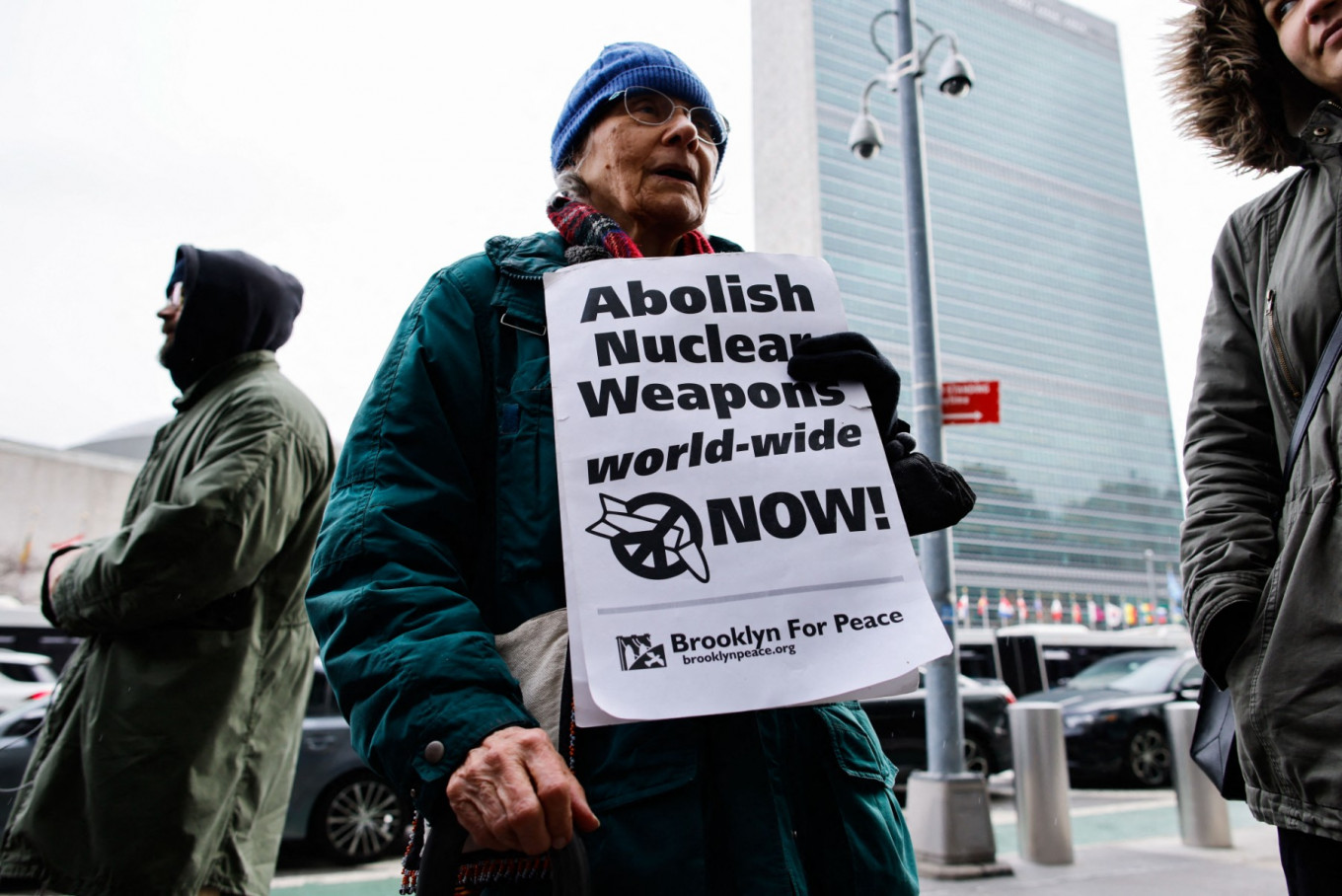 Antinuclear activists rally outside the United States Mission in front of the United Nations to mark the second anniversary of the entry into force of the Treaty on the Prohibition of Nuclear Weapons (TPNW) in New York, the US, on Jan. 20, 2023. The TPNW, the first legally binding international agreement to prohibit nuclear weapons, entered into force on Jan. 22, 2021. (AFP/Kena Betancur)
I
ndonesia has urged all countries to uphold their commitments to global nuclear non-proliferation and disarmament, calling for renewed negotiations and a more equitable application of international norms amid the growing risk of catastrophic escalation.
Speaking at the Conference on Disarmament in Geneva, Switzerland, on Monday, Foreign Minister Sugiono described the current global geopolitical landscape as “fragile” and “polarized”, as countries abandon long-standing international legal norms in a shift toward “survival mode”.
Amid the increasingly volatile environment, he reiterated Jakarta’s position of setting multilateral disarmament as a key pillar of international peace and security, calling for a renewed commitment to fostering dialogue and cooperation over nuclear-based security posturing.
“True security cannot be built through deterrence alone, but through trust, restraint and dialogue,” Sugiono said in his speech. “Disarmament is not merely a legal obligation. It is a moral and strategic imperative.”
The minister also urged the revival of negotiations on several issues, including a comprehensive nuclear weapons convention, legally binding negative security assurances and a fissile material treaty that “strengthens, not dilutes” disarmament objectives.
Following decades of steady reductions in nuclear arsenals, the global security landscape has in recent years entered a troubling phase of rearmament, with countries expanding their stockpiles amid intensifying great power competition and deepening geopolitical fragmentation.
The recent expiration of the nuclear arms reduction treaty between the United States and Russia, formally known as the New Strategic Arms Reduction Treaty (New START), has sparked renewed global concerns. The pact had long limited the number of deployed strategic warheads and delivery systems held by Washington and Moscow, the world’s two largest nuclear arsenals.