TheJakartaPost
Please Update your browser
Your browser is out of date, and may not be compatible with our website. A list of the most popular web browsers can be found below.
Just click on the icons to get to the download page.


Popular Reads
Top Results
No results found. Please check your search term and try again
Can't find what you're looking for?
View all search results
Popular Reads
Top Results
No results found. Please check your search term and try again
Can't find what you're looking for?
View all search resultsEngage Myanmar but suspend from ASEAN
As Brunei, Indonesia, and Malaysia scramble to round up support for a summit on Myanmar soon, suspension should be a consideration particularly if the military remains intransigent.
Change text size
Gift Premium Articles
to Anyone
Share the best of The Jakarta Post with friends, family, or colleagues. As a subscriber, you can gift 3 to 5 articles each month that anyone can read—no subscription needed!
M
ore than two months ago, Myanmar’s Tatmadaw usurped power alleging electoral fraud that could undermine stable democracy, national security, and solidarity in the country.
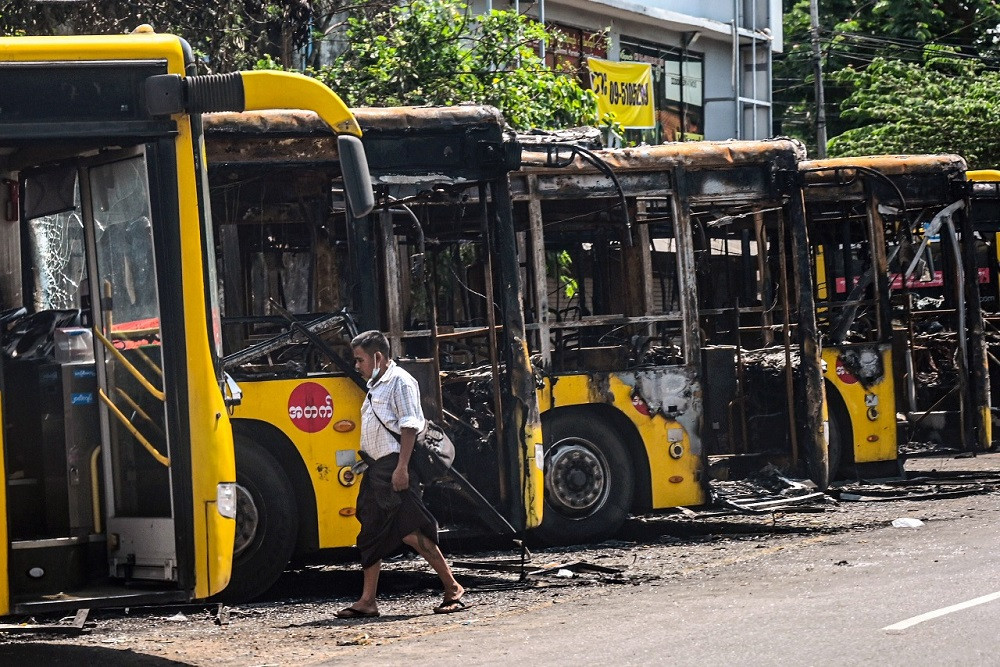
Since then, the military has itself directly set in motion all those scenarios it purportedly tried to head off. Hundreds have been killed, including children. With ethnic armed organizations clashing against the military and the junta and protesters digging in for the long haul, concerns are rife that the already deeply fractured nation seems headed towards a civil war.
Outside Myanmar, reactions to the coup have been mixed. Within ASEAN, responses have ranged from alarm and various degrees of concern to indifference and silence. In contrast to Western sanctions, the region’s leaders have opted to maintain open channels of communication to the Tatmadaw even though the junta has so far rebuffed any efforts at substantive negotiations for a solution to the crisis.
In the hopes of influencing or quietly pressuring the junta through sustained engagement, ASEAN leaders have had to walk the tightrope of not appearing to legitimize the takeover. This has led to awkward encounters such as last month’s ASEAN chiefs of defense forces meeting in which Sen. Gen. Min Aung Hlaing spoke of unconventional threats while other military chiefs expressed concern about the situation in Myanmar.
There are good reasons to preserve outreach to disagreeing or even disagreeable parties. In 2006, as a result of pressure from other ASEAN states, Myanmar skipped its chairmanship of the grouping to focus on the country’s “national reconciliation and democratization process.” Two years later, in the aftermath of Cyclone Nargis, ASEAN and the secretary-general, himself, successfully urged Myanmar to open up space for international humanitarian assistance through an ASEAN-led mechanism.
Now, in order to realistically address the security and stability of Myanmar, ASEAN must deal with the de facto party in power. In general, engagement rather than isolation both ensures and assures ASEAN of being a key and trusted partner to member-states, even in challenging times. It also affirms ASEAN centrality and staves off external meddling. Contrary to the argument of non-interference being outdated, the principle remains critical in current times as major powers once again jostle for spheres of influence in the region under the guises of ideology or fraternity.
There is, however, a need to rethink ASEAN credibility and efficacy; specifically, to its citizens. ASEAN may have been established as an inter-governmental organization but the Community that it has deliberately sought to evolve into in the decades since articulates a more inclusive vision: one that prioritizes the nearly 700 million people in the region. Even ASEAN’s most intuitively state-centric political and security pillar is premised upon “a rules-based, people-oriented, people-centered community” where “our peoples enjoy human rights, fundamental freedoms and social justice.” In laboring to engage with Myanmar’s military regime, has ASEAN disregarded its own pledges of people-centrism and overlooked the people of Myanmar? Is ASEAN’s focus misplaced?