The Jakarta Post
Please Update your browser
Your browser is out of date, and may not be compatible with our website. A list of the most popular web browsers can be found below.
Just click on the icons to get to the download page.


Popular Reads
Top Results
No results found. Please check your search term and try again
Can't find what you're looking for?
View all search results
Popular Reads
Top Results
No results found. Please check your search term and try again
Can't find what you're looking for?
View all search resultsM4CR, local communities agree to rehabilitate 1,042 hectares of North Kalimantan mangroves
Change text size
Gift Premium Articles
to Anyone
Share the best of The Jakarta Post with friends, family, or colleagues. As a subscriber, you can gift 3 to 5 articles each month that anyone can read—no subscription needed!
 Set as preferred source
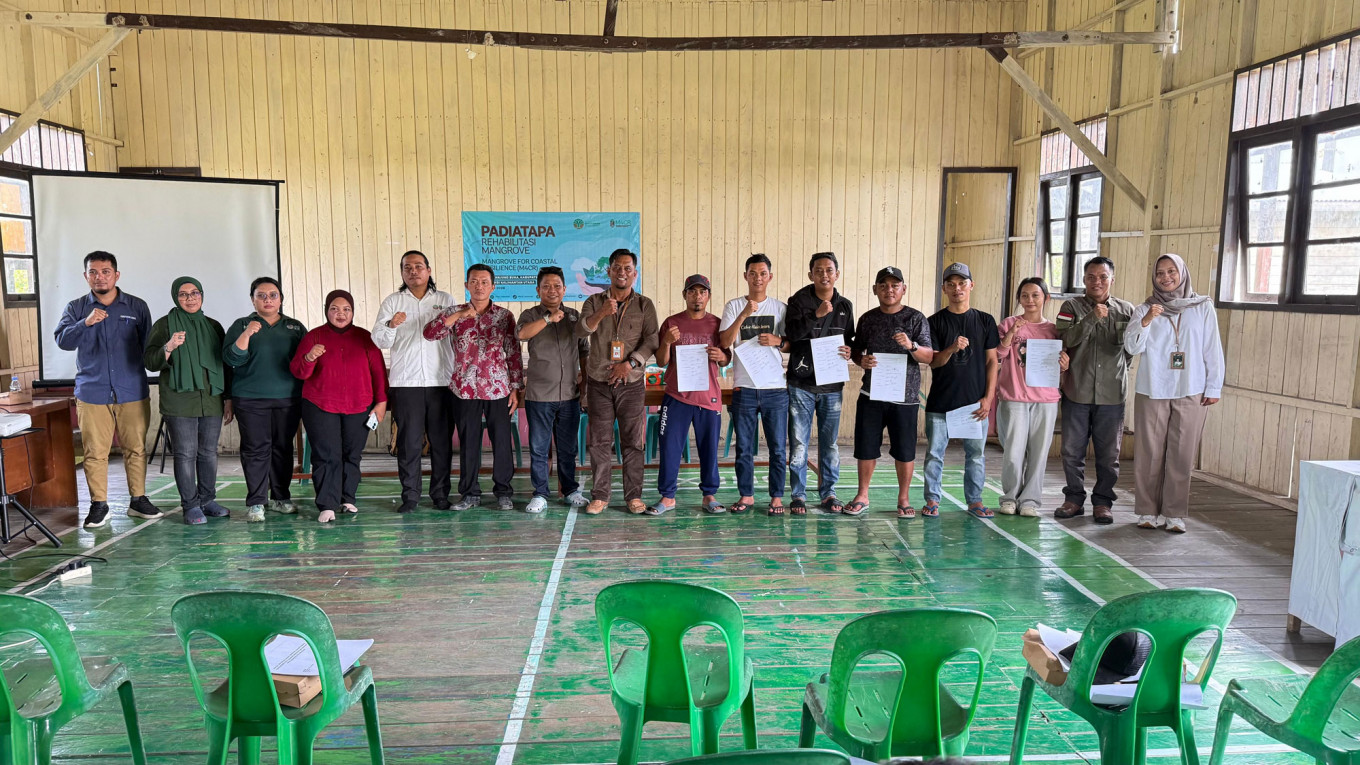 Representatives of community groups give a thumbs-up in Tanjung Buka village, Bulungan regency, North Kalimantan after agreeing on the area of a mangrove rehabilitation project in the province. (Image Courtesy of The M4CR Project)
F
or coastal communities in North Kalimantan, mangroves are more than natural ecosystems. They are an integral part of the environment and a source of livelihoods. According to the 2025 National Mangrove Map, North Kalimantan is home to 187,530 hectares out of a total 3.44 million ha of mangrove ecosystems across Indonesia.
As part of its commitment to ha restoration, the government has set a target of rehabilitating 600,000 ha by 2029 under the country’s Enhanced Nationally Determined Contribution (NDC).
One of the strategic initiatives supporting this target is Mangroves for Coastal Resilience (M4CR), a project that aims to rehabilitate 32,634 ha across four priority provinces, Riau, North Sumatra, East Kalimantan and North Kalimantan, through 2027.
Managed by the Forestry Ministry through the Directorate General of Watershed Management and Forest Rehabilitation (PDASRH), M4CR is supported by the Environment Ministry, the Maritime Affairs and Fisheries Ministry, the Office of the Coordinating Food Minister and the Environmental Fund Management Agency (BPDLH) as well as local administrations. The project is funded through a World Bank scheme.
A key element of M4CR is ensuring that local communities are involved from the outset through free, prior and informed consent (FPIC).
In Bulungan regency, the FPIC process was conducted in three villages: Sekatak Buji, Salimbatu and Tanjung Buka.
As the area is dominated by aquaculture ponds, mangrove rehabilitation intersects directly with local livelihoods. Through a series of community meetings and discussions, local communities agreed to jointly manage 1,042 ha involving 18 community groups.
Although FPIC may sound formal, the process essentially provides a space for two-way dialogue. Communities are informed about what will be done, how areas will be managed and what roles they can play. This approach enables local residents to help shape the rehabilitation process and fosters a stronger sense of ownership.
“We hope this project doesn’t stop at planting. Once activities are underway, the community will retain a sense of ownership, jointly protect the agreed-upon areas and gain both ecological and economic benefits from their ponds,” said Akhmad Ashar Sarif, PPIU manager for M4CR North Kalimantan.
In areas with aquaculture ponds, M4CR is promoting the sustainable silvofishery approach using an open canal embankment system with a planting density of 800 trees per hectare.
The approach integrates mangrove rehabilitation with aquaculture, allowing ecological and economic functions to coexist. An open canal system enables water to circulate through the area, maintaining connectivity between mangrove habitats and pond waters.
The mangroves are expected to help maintain ecological balance, improve water quality, filter sediment and provide habitat for marine organisms.
By combining ecosystem restoration with sustainable aquaculture, M4CR seeks to ensure that mangrove rehabilitation not only restores degraded landscapes but also remains relevant to the livelihoods of the communities that depend on them.