The Jakarta Post
Please Update your browser
Your browser is out of date, and may not be compatible with our website. A list of the most popular web browsers can be found below.
Just click on the icons to get to the download page.


Popular Reads
Top Results
No results found. Please check your search term and try again
Can't find what you're looking for?
View all search results
Popular Reads
Top Results
No results found. Please check your search term and try again
Can't find what you're looking for?
View all search resultsConsumer spending: Reviving the rhythm
By early November, average weekly spending growth in the fourth quarter reached 1.9 percent week-on-week, a marked improvement from 0.8 percent in September and almost flat readings during July and August.
Change text size
Gift Premium Articles
to Anyone
Share the best of The Jakarta Post with friends, family, or colleagues. As a subscriber, you can gift 3 to 5 articles each month that anyone can read—no subscription needed!
 Set as preferred source
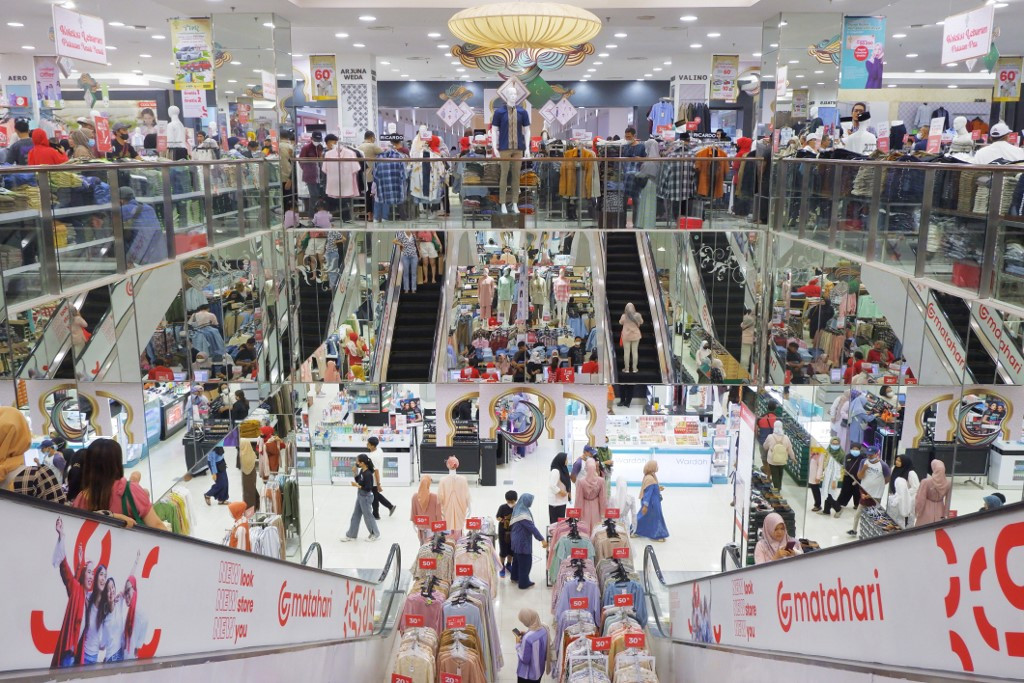 People shop at a mall in Serang, Banten, on April 9, 2023. (AFP/Dziki Oktomauliyadi)
A
s the calendar edges deeper into November, the latest indicators point to a gradual strengthening of household consumption in Indonesia. After moderating during the third quarter, spending momentum appears to be improving in the early weeks of the fourth quarter of 2025.
Data from the Mandiri Spending Index (MSI), indicator that tracks millions of real-time consumer transactions in a week, show that spending activity continues to rise as the year draws to a close. By early November, average weekly spending growth in the fourth quarter reached 1.9 percent week-on-week, a marked improvement from 0.8 percent in September and almost flat readings during July and August. The index has also posted consecutive weekly gains since early October, suggesting a consistent upward trend in household expenditure.
This improvement aligns with a notable rise in consumer sentiment. The Consumer Confidence Index (CCI) in October 2025 reached 121.2, the highest in the last six months, reflecting stronger public optimism regarding current and future economic conditions. Taken together, the MSI and CCI data indicate that households are entering the year-end period with more confidence and greater spending intent.
The rebound in consumer spending appears broad-based across regions, although the pace varies. Kalimantan remains the most dynamic region, with spending up 1.5 percent week-on-week, followed by Sulawesi at 1.4 percent. Java and Sumatra, which together account for the bulk of national consumption, recorded moderate increases of 0.7 and 1 percent, respectively, while Bali, Nusa Tenggara and Papua displayed seasonal normalization.
These patterns suggest that the composition of national consumer spending is becoming more geographically balanced, reflecting broader regional participation in domestic demand.
From a sectoral perspective, spending composition continues to evolve. After several months of prioritizing essential goods, households are gradually increasing expenditures on durable goods, particularly electronics and household equipment.

Mobile phone purchases, a behavioral proxy for consumer confidence among younger cohorts, rose 9.3 percent week-on-week in late October, marking the strongest increase since early in the third quarter. Meanwhile, lifestyle-related categories such as fashion and hobbies remain relatively muted, indicating that households are still exercising selective caution in discretionary spending.
This pattern illustrates what behavioral economics defines as “selective splurging”, a phase where consumers, while still cautious, begin to reallocate spending toward categories that deliver functional value and long-term benefit. The trend is especially pronounced among Gen-Z and Millennials, suggesting that the recovery in spending is being led by younger, digitally connected consumers who combine optimism with prudent financial behavior.
On the other hand, spending related to mobility and travel continues to accelerate as households plan for year-end holidays. Purchases of train tickets and airline tickets increased 3.3 and 4.3 percent week-on-week, respectively, in early November. Historically, this rise in transportation spending precedes broader consumption in leisure, dining and retail sectors during December.
For now, households appear to be rebalancing their budgets, reducing some non-essential categories such as beauty or hobbies to accommodate travel and family-related spending.
However, the rebound is not uniform. Middle- and upper-income groups remain the backbone of Indonesia’s consumption, with savings indices of 100.8 and 93.5 in October, showing that they have both the means and the confidence to spend.
But lower-income groups continue to face tight constraints. Their savings index has slipped to 73.1, down sharply from 81.9 a year earlier, suggesting they are relying more heavily on existing reserves to cover basic needs.
This divergence is a reminder that the recovery, while encouraging, is not yet inclusive. It underscores the importance of maintaining price stability and targeted policy support to safeguard purchasing power among lower-income consumers.
Even so, the overall picture looks brighter than it did just a few months ago. Year-on-year weekly spending growth in early November reached 35 percent, compared with 29 percent in the third quarter. That acceleration hints that the fourth quarter could finish stronger, supported by holiday travel, government incentives and a wave of end-of-year promotions.
If this momentum holds, Indonesia could close 2025 with consumer spending once again acting as the steady engine of growth.
To sustain it, policy and business actions will play a critical role. For the government, the focus should be on preserving purchasing power, keeping essentials like food and transportation prices stable, and managing the ripple effects of exchange rate movements on imports. For the medium term, targeted fiscal incentives, such as energy subsidies and income tax relief, could help strengthen household purchasing power, especially for lower-income groups.
For businesses, the opportunity lies in capturing this renewed sentiment through creative year-end campaigns, bundled travel offers and experiential spending that taps into consumers’ growing appetite for leisure.
All things considered, the tone of the economy heading into December feels quietly upbeat. Growth remains steady above 5 percent, confidence is climbing and the MSI paints a picture of recovery that is gradual but genuine. People are spending again, not recklessly, but with intent.
The pattern is cautious, the optimism measured, yet both point in the right direction. If these trends continue, the final weeks of 2025 could see Indonesia end the year with a soft but steady glow of confidence, powered, as always, by the quiet resilience of its households.
*****
The writer is an analyst at Mandiri Institute