The Jakarta Post
Please Update your browser
Your browser is out of date, and may not be compatible with our website. A list of the most popular web browsers can be found below.
Just click on the icons to get to the download page.


Popular Reads
Top Results
No results found. Please check your search term and try again
Can't find what you're looking for?
View all search results
Popular Reads
Top Results
No results found. Please check your search term and try again
Can't find what you're looking for?
View all search resultsChina signals tolerance for slower growth with 4.5%-5% target for 2026
Change text size
Gift Premium Articles
to Anyone
Share the best of The Jakarta Post with friends, family, or colleagues. As a subscriber, you can gift 3 to 5 articles each month that anyone can read—no subscription needed!
 Set as preferred source
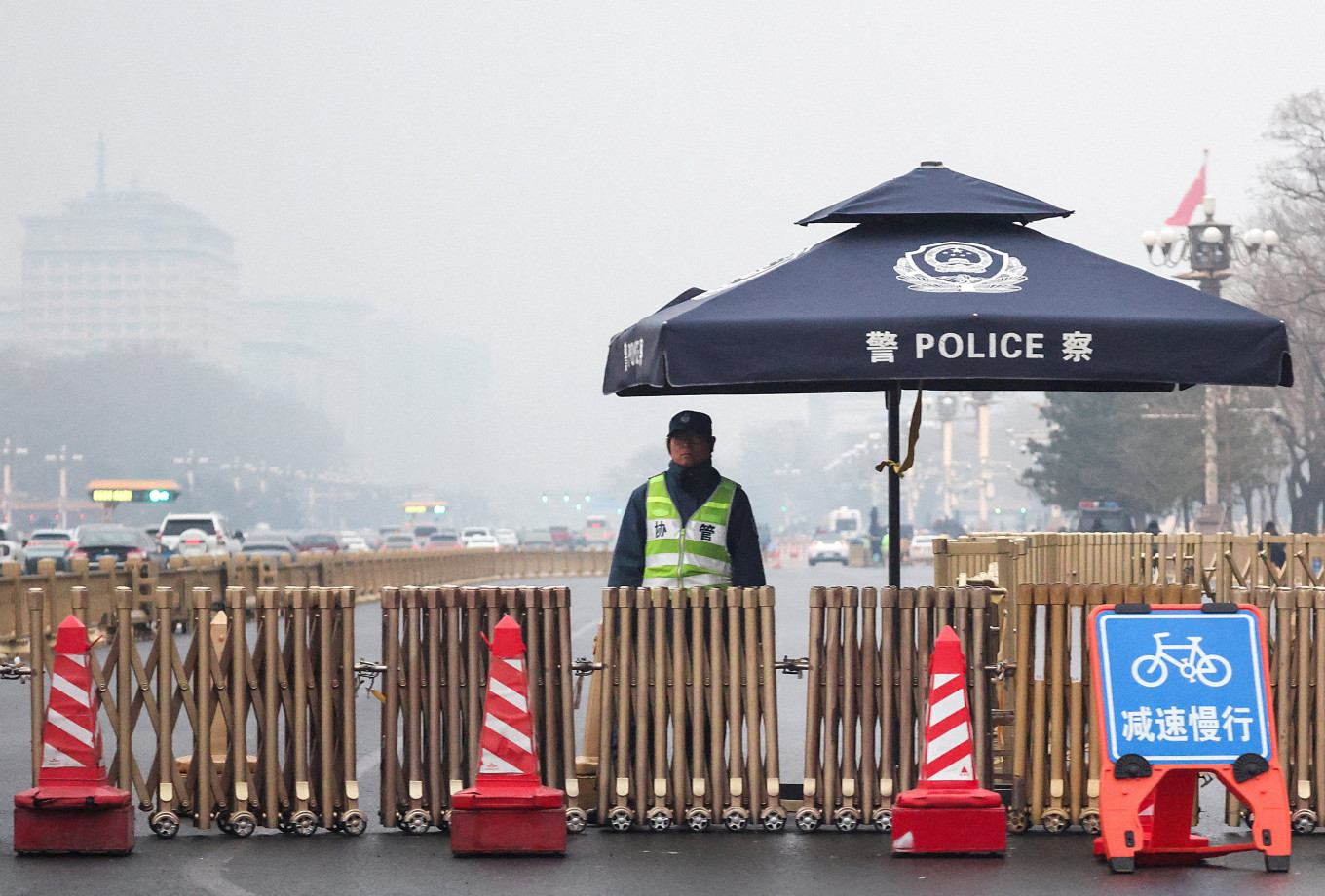 A police officer stands guard at a checkpoint at Changan Avenue on a foggy day ahead of the annual meeting of the National People's Congress in Beijing on March 2, 2026. (Reuters/Maxim Shemetov)
C
hina set its economic growth target for 2026 at 4.5%-5%, a slight downgrade from the 5% pace achieved last year, which leaves room for greater, albeit not decisive, efforts to curb industrial overcapacity and rebalance the economy.
China also released its 15th five-year plan, and as widely expected, pledged investments in innovation, high-tech industries, scientific research and a "notable" - but unspecified - increase in household consumption as a share of economic output.
The pledges show that Beijing is concerned weak domestic demand makes the world's second-largest economy too reliant on exports for growth, but that it also does not want to abandon efforts to upgrade its vast industrial complex, which gives it supply chain leverage over Washington and its allies at a time when the rivalry is intensifying.
The growth target appeared in an official government report seen by Reuters and due to be presented in parliament, which opens its annual session on Thursday with a speech by Premier Li Qiang.
Economists have said a lower target gives Beijing more flexibility to implement reforms, such as reducing industrial overcapacity, but cautioned that this shift does not mean a departure from its production-focused growth model.
Analysts at the Mercator Institute for China Studies describe promises to consumers as "hollow," saying that the leadership believes expansive support to key industries serves national interests best at a time of great power competition.

"Precariously balanced as it is, China’s economic policy will continue to systematically favor companies over households," MERICS analysts wrote in a note before the parliament meeting.
"Beijing will persist in slow-rolling measures to expand social welfare, while using generous subsidies and tax incentives to drive industrial growth and upgrading."
Steady stimulus plans
In terms of stimulus, China plans a budget deficit of 4.0 percent of gross domestic product, similar to last year. It set unchanged special debt issuance quotas for the central government of 1.3 trillion yuan (US$188.49 billion) and for local governments at 4.4 trillion yuan.
China pledged to raise minimum monthly pensions by 20 yuan per person and basic medical insurance subsidies for rural, non-working people by 24 yuan. It said it wants to increase education spending, subsidize childcare and reform public hospitals.
Larry Hu, chief China economist at Macquarie, expects fiscal levers to be adjusted flexibly, based on how the economy performs in coming months.
"If exports remain strong, they may tolerate weak domestic consumption. Conversely, if exports falter, they will step up domestic stimulus to defend the GDP target," said Hu.
Former central bank adviser Liu Shinjin warned at a financial forum in January that China's record $1.2 trillion trade surplus last year - a key factor behind reaching the 2025 economic growth target - reflects not only rising manufacturing competitiveness but also weak domestic consumption.
He said China must shift from its long-standing reliance on investment and exports towards a model primarily driven by innovation and consumption, adding that while manufacturing could be further upgraded, this doesn't mean its share in the economy shouldn't fall.
"China’s current insufficient consumption is deeply tied to a series of institutional and structural factors, making it unrealistic to fully resolve these issues in the short term," Liu said.
"However, leaving them unaddressed is not an option either."
The reaction to a key ruling by China's top court last year that made avoiding social insurance payments illegal - a step which theoretically fosters a long-term transfer of funds from businesses to workers via the welfare system - provides a cautionary tale of just how difficult reform implementation is.
Many businesses, pressured by low domestic demand, tariffs, high debts and price wars triggered by industrial overcapacity, have responded to the ruling mostly in ways that minimize their own payments, in some cases even by lowering wages.
The patchy implementation of the ruling left many economists pessimistic over China's determination to rebalance the economy.
"This highlights a core tension in Beijing's structural reforms," said Alicia Garcia-Herrero, chief Asia-Pacific economist at Natixis.