The Jakarta Post
Please Update your browser
Your browser is out of date, and may not be compatible with our website. A list of the most popular web browsers can be found below.
Just click on the icons to get to the download page.


Popular Reads
Top Results
No results found. Please check your search term and try again
Can't find what you're looking for?
View all search results
Popular Reads
Top Results
No results found. Please check your search term and try again
Can't find what you're looking for?
View all search resultsAsia stocks adrift as Middle East worries meet rate-hike bets
Change text size
Gift Premium Articles
to Anyone
Share the best of The Jakarta Post with friends, family, or colleagues. As a subscriber, you can gift 3 to 5 articles each month that anyone can read—no subscription needed!
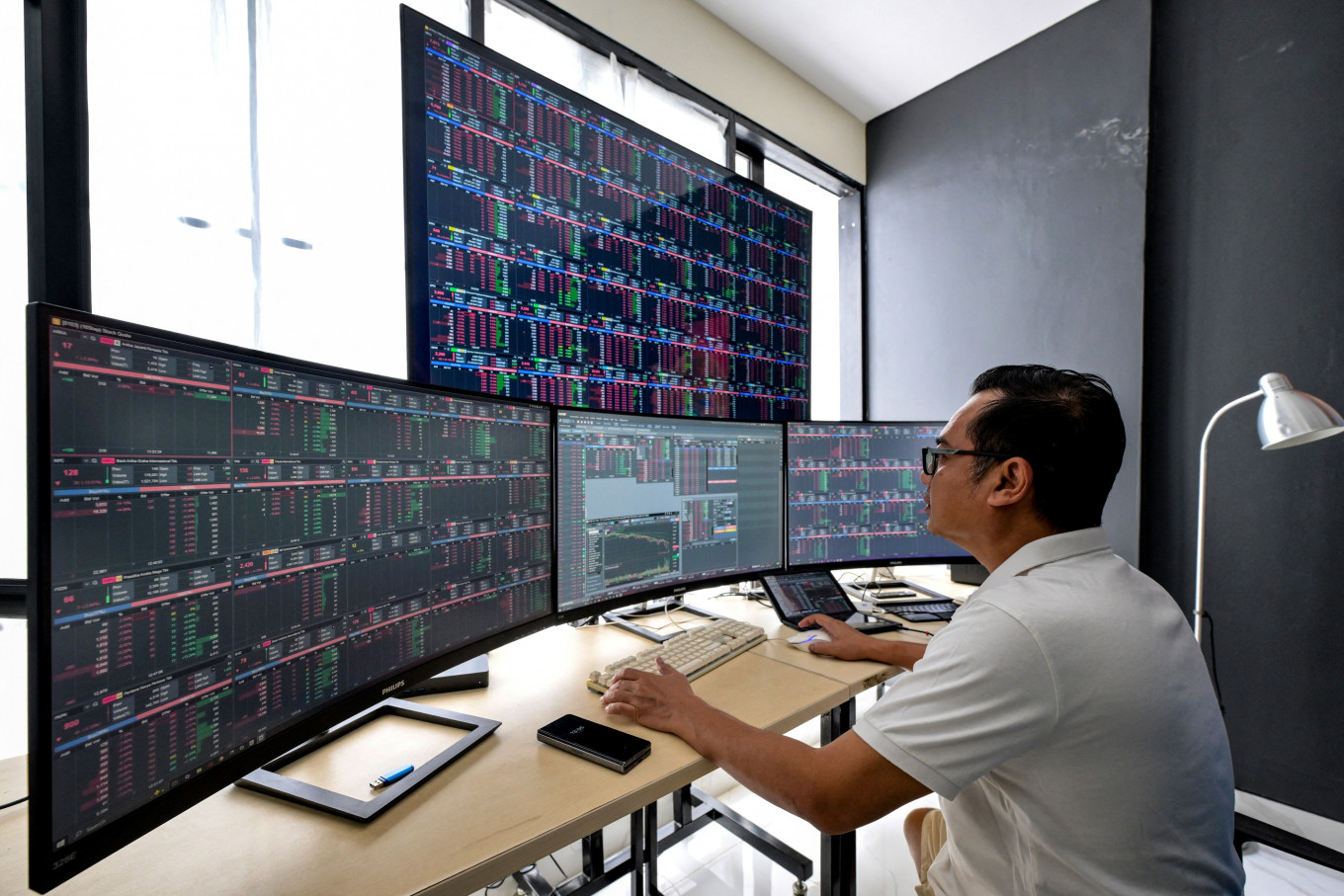 A stock trader monitors the Jakarta Composite Index (JCI) in South Tangerang, Banten, on April 8, 2025. (AFP/Bay Ismoyo)
A
sian stocks wobbled on Monday after Iran and the United States agreed to halt renewed hostilities that had cast a shadow over an interim peace deal and kept oil prices supported, while the dollar stood tall near a one-year high on rate-hike bets.
A return to diplomacy in the Middle East would follow several days of tit-for-tat strikes since an Iranian projectile hit a cargo vessel in the Strait of Hormuz last week, with both sides accusing each other of breaking an interim ceasefire.
Futures for S&P 500 and Nasdaq gained 0.4 percent while European futures rose 0.2 percent. South Korea's KOSPI fell nearly 2 percent, while Japan's Nikkei slipped 1 percent, leaving MSCI's broadest index of Asia-Pacific shares down 0.4 percent.
"It feels like we are lacking a bit of direction," said Nick Twidale, chief market strategist at ATFX Global in Sydney.
"We may get a shot in the arm later today from more positive news out of the Middle East [...] but at the moment I think it's going to be a bit of a flow-driven day without major moves to either side," Twidale said.
Worries over the future of the peace deal lifted oil prices, which have given up almost all of their war-driven gains as markets quickly reprice the prospect of easing supply.

On Monday, Brent crude futures climbed 0.85 percent to $72.6 a barrel while US West Texas Intermediate crude rose over 1 percent to $70.01 a barrel.
The 14-point interim peace accord agreed on June 17 was meant to halt the fighting, which the US and Israel started on Feb. 28, and reopen the critical strait while talks proceeded on issues such as Iran's nuclear program.
"Markets enter July with a ceasefire that nobody quite trusts," said Marc Chandler, chief market strategist at Bannockburn Capital Markets.
Tech worries linger
Investors have also been battling concerns that valuations for AI-related firms have become stretched following years of gains, with Micron's strong earnings forecast and Apple's price hikes last week underscoring the contrasting challenges.
Markets are undergoing a tactical rotation away from mega-cap AI into smaller, more cyclical segments, marking early signs of broadening after extreme concentration, strategists at BofA Global Research said in a note.
The Bank for International Settlements cautioned over the durability of the current AI investment surge, noting supply bottlenecks and intense competition could spur the kind of overinvestment seen in previous boom-and-bust cycles.
Jose Torres, senior economist at Interactive Brokers, said the rising costs tied to modern infrastructure have firms scrambling for cash on their balance sheets and adding to risks if those investments fail to deliver.
"For this reason, traders have gravitated toward the defensive and cyclically oriented areas of the equity space in recent weeks," Torres said.
Rising rate hike wagers
Easing oil prices may help reduce some inflation pressure but elevated prices are likely to keep the US Federal Reserve under pressure to raise rates. Investors are pricing in at least one hike this year, a sharp reversal from expectations of two rate cuts before the conflict began.
BofA strategists anticipate three hikes, a more hawkish view that reflects a firmer labor backdrop, the new Fed Chair Kevin Warsh and a persistent inflation problem.
Rising odds of a rate hike have lifted the dollar. The dollar index, which measures the US currency against six other units, was at 101.33, just below the one-year high it touched last week.
The Japanese yen was languishing at 161.77 per US dollar as fears of another bout of intervention from Tokyo kept the fragile currency from breaking through its lowest in 40 years.
The rising dollar has weighed on gold, which was down 0.4 percent at $4,072 per ounce. The yellow metal is set for a 13 percent decline in the second quarter, its biggest quarterly drop since 2013.