The Jakarta Post
Please Update your browser
Your browser is out of date, and may not be compatible with our website. A list of the most popular web browsers can be found below.
Just click on the icons to get to the download page.


Popular Reads
Top Results
No results found. Please check your search term and try again
Can't find what you're looking for?
View all search results
Popular Reads
Top Results
No results found. Please check your search term and try again
Can't find what you're looking for?
View all search resultsB50 and the price of energy independence
The biggest challenge for the implementation of B50 is how to balance palm oil demand between biodiesel, food needs and exports.
Change text size
Gift Premium Articles
to Anyone
Share the best of The Jakarta Post with friends, family, or colleagues. As a subscriber, you can gift 3 to 5 articles each month that anyone can read—no subscription needed!
 Set as preferred source
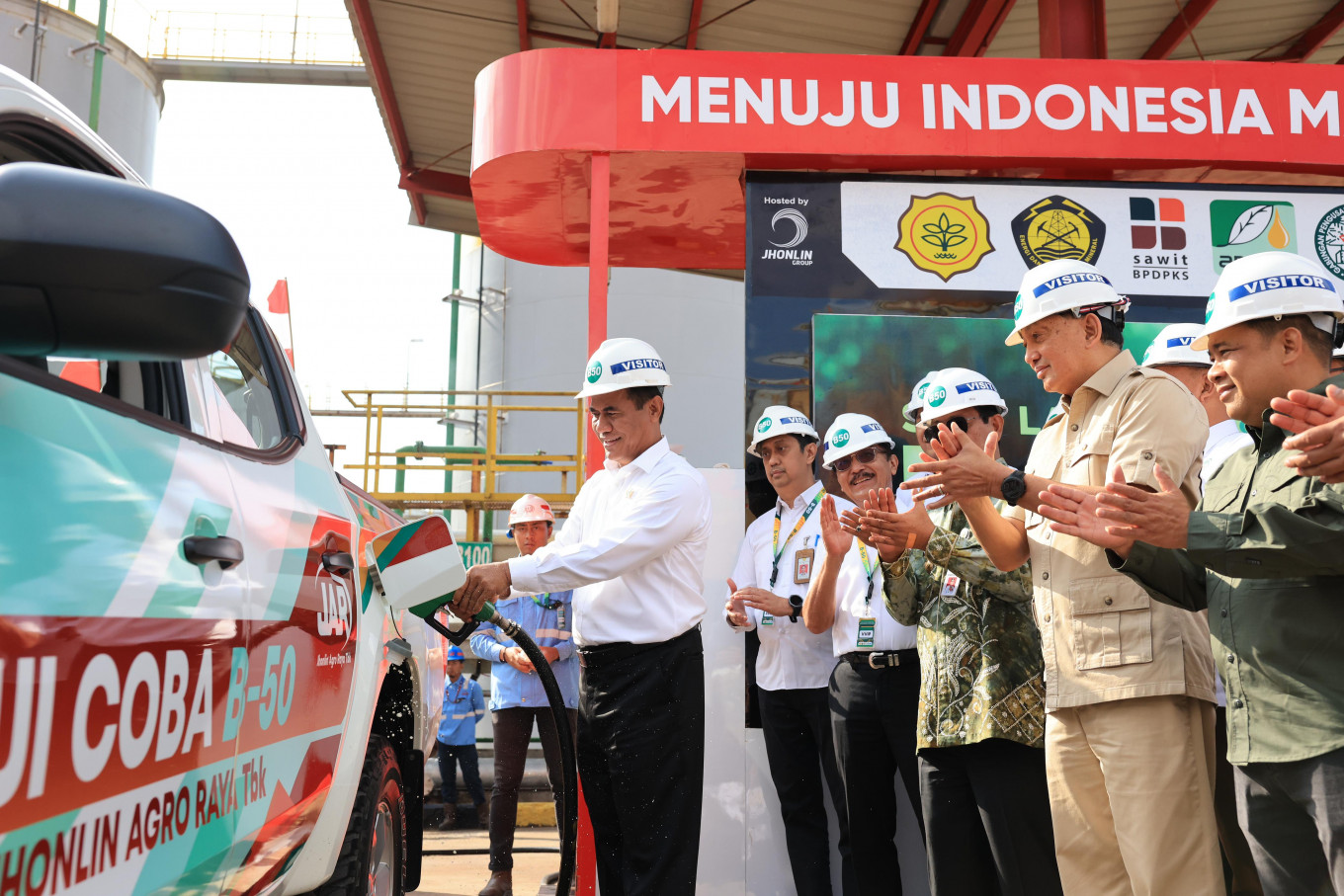 Agriculure Minister Andi Amran Sulaiman fills B50 biodiesel fuel into a road-test vehicle during a softlaunch ceremony marking the use of B50 at PT Jhonlin Agro Raya biodiesel factory in Batulicin, Tanah Bumbu regency, South Kalimantan, on Sunday, Aug. 18, 2024. (Courtesy of Agriculture Ministry/-)
O
n July 1, Indonesia started one of its most ambitious biofuel programs. The mandatory B50 program officially came into force, requiring diesel fuel to be blended with 50 percent palm oil-based biodiesel and 50 percent conventional diesel. This marks another major step in Indonesia’s biodiesel journey, after the country had only recently moved to B40.
The main reason behind B50 is energy security, and the timing is also important. With global energy supply chains facing pressure from the recent Iran war and rising risks around the Strait of Hormuz, the government is positioning B50 as a way to reduce Indonesia’s exposure to external energy shocks. Energy and Mineral Resources Minister Bahlil Lahadalia has said that B50 could replace around 300,000 barrels per day of imported diesel demand. The ministry also projects foreign exchange savings of around Rp 157 trillion (US$8.7 billion) this year.
For Indonesia, this is a strong policy narrative. The country has long been one of the world’s largest palm oil producers, but B50 gives palm oil a bigger role beyond exports and food products. It allows Indonesia to turn its palm oil strength into a source of energy resilience. In that sense, B50 is not only about fuel blending. It is also about reducing import dependence and improving the country’s energy position.
However, behind the positive story, B50 still comes with several trade-offs. Like B40 before it, this policy is not a free lunch. The biggest challenge is how to balance palm oil demand between biodiesel, food needs and exports.
B50 is expected to absorb an additional 3 million to 3.5 million tonnes of crude palm oil every year, on top of what B40 already uses. The problem is that Indonesia’s palm oil production has been relatively flat. If production does not increase, higher CPO use for biodiesel could reduce supply for cooking oil or exports. The government believes production growth can support the shift without hurting exports too much. However, industry players, including the Indonesian Palm Oil Association (GAPKI), have warned that higher domestic absorption could reduce export volumes. This is important because export volumes help fund the subsidy system that supports the biodiesel program.
The subsidy mechanism is the most important risk to watch. The government covers the price gap between biodiesel and fossil diesel through the Plantation Fund Management Agency (BPDP), which is funded by levies on palm oil exports. At the moment, the calculation looks more manageable because oil prices rose earlier this year during the Iran conflict. Higher oil prices narrowed the gap between fossil diesel and palm-based biodiesel.

This was also one of the reasons why the government restarted the B50 rollout after delaying it in January due to funding concerns. But the risk is that this condition may not last. The Iran conflict has eased, and oil prices have started to move lower again. At the same time, CPO prices remain high at above $1,100 per tonne, while crude oil is around $72 per barrel. This creates a wider price gap and means subsidies may again become necessary.
BPDP has said that the levy framework works more comfortably when oil prices are around $85 per barrel and CPO prices are around $1,000 per tonne. Current market conditions are no longer in that range. If oil prices continue to normalize while CPO prices stay high, the subsidy burden could increase. At the same time, lower palm oil export volumes could reduce levy revenue. This is the main financial risk behind B50.
Because of this, B50 should be implemented with flexibility. A fixed 50 percent blend may work well when oil prices are high and CPO prices are manageable. But it can become costly when oil prices fall and CPO prices remain elevated. A more flexible mandate would allow the blend level to adjust when the price gap becomes too wide.
Subsidy rules should also be linked more closely to actual market conditions. This would reduce the risk of putting too much pressure on BPDP when export levy revenue is lower. Without this flexibility, the government may face two difficult choices: allowing higher fuel prices to be passed on to consumers, or increasing levies on palm oil exports. Both options carry risks. Higher fuel prices could hurt consumers, while higher levies could reduce margins for plantation companies and smallholders.
The deeper solution is not only flexibility, but also productivity. Indonesia cannot keep relying on higher palm oil demand without improving supply. Expanding plantation areas is not the best answer, especially because sustainability remains a key issue for Indonesia’s palm oil sector. The more credible solution is replanting old and low-yielding trees with better varieties.
This is where BPDP’s replanting program becomes important. The program was designed to improve palm oil productivity, but it needs to move faster. Higher yields would allow Indonesia to support biodiesel demand without putting too much pressure on food supply, exports or land use. However, the productivity push must be done sustainably. It should not become an excuse for careless plantation expansion.
Indonesia’s palm oil sector is still working to improve its image in global markets, especially around deforestation concerns. Progress through RSPO and ISPO certification, better traceability and stronger sustainability standards needs to continue. Energy security should not come at the cost of sustainability credibility. If B50 increases pressure for land expansion, Indonesia risks losing the trust it has been trying to rebuild.
Overall, B50 can still become an important pillar of Indonesia’s energy resilience. It supports import reduction, strengthens domestic fuel supply and gives palm oil a bigger role in the national energy system. But its success will depend on execution over the next twelve months.
The key will be whether the mandate can adjust when market prices change, whether BPDP can manage the subsidy burden when oil prices normalize and whether palm oil productivity can improve without sacrificing sustainability. B50 has strong potential, but it needs to be managed carefully so that the cost does not fall too heavily on consumers, exporters, smallholders or the environment.
***
The writer is an industry and regional analyst at Bank Mandiri.