TheJakartaPost
Please Update your browser
Your browser is out of date, and may not be compatible with our website. A list of the most popular web browsers can be found below.
Just click on the icons to get to the download page.


Popular Reads
Top Results
No results found. Please check your search term and try again
Can't find what you're looking for?
View all search results
Popular Reads
Top Results
No results found. Please check your search term and try again
Can't find what you're looking for?
View all search resultsCorporate Japan's rare-earth warnings get louder as China keeps the spigot closed
Change text size
Gift Premium Articles
to Anyone
Share the best of The Jakarta Post with friends, family, or colleagues. As a subscriber, you can gift 3 to 5 articles each month that anyone can read—no subscription needed!
 Set as preferred source
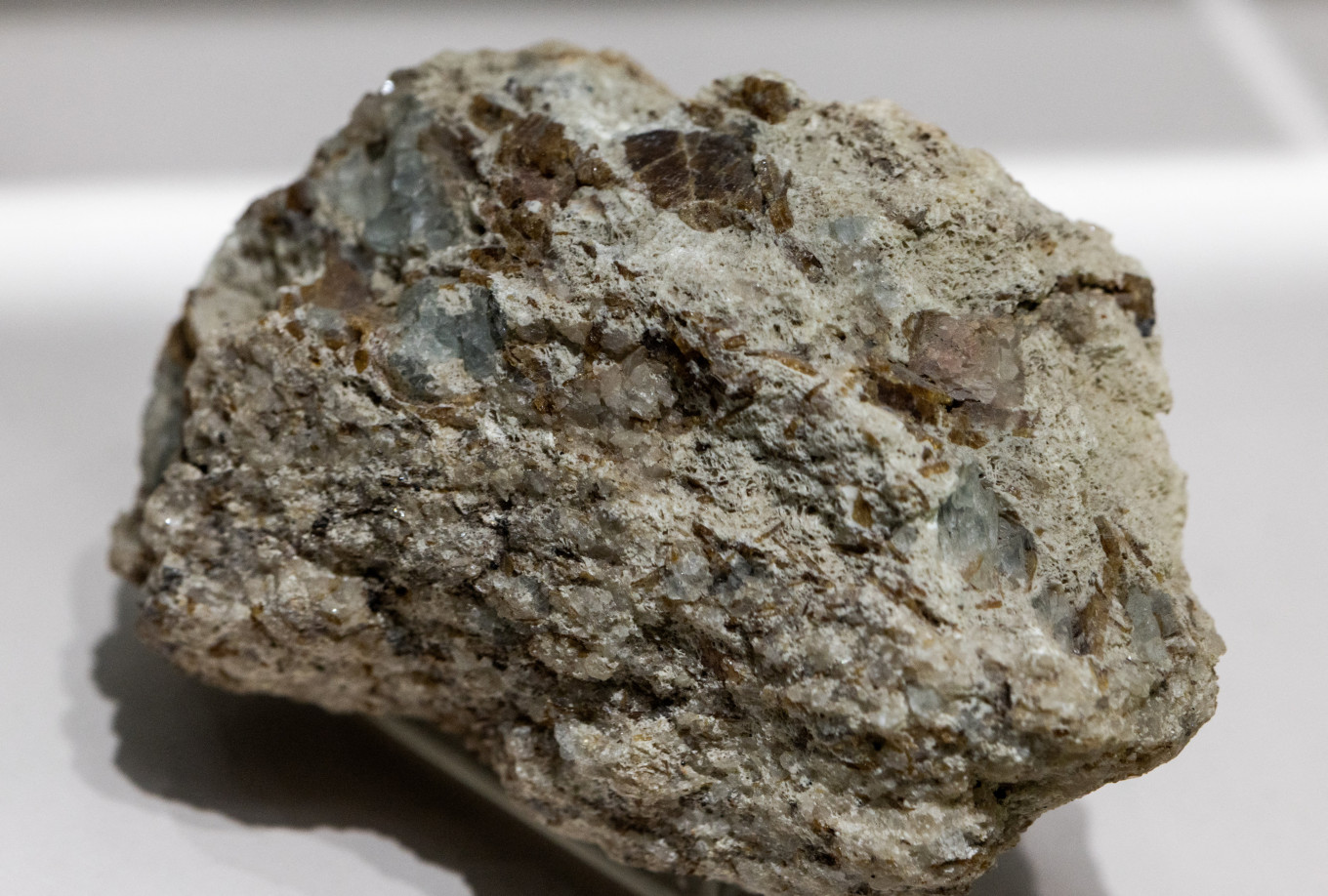 Unassuming appearance: A sample of bastnaesite ore, a mineral used in the rare earth industry to extract elements such as cerium, lanthanum, and neodymium, is displayed at the Geological Museum of China in Beijing on Oct. 14, 2025. (Reuters/Maxim Shemetov)
A
shortage of critical minerals is starting to affect the broader Japanese economy, adding a sense of urgency for Prime Minister Sanae Takaichi's government to find alternatives to exports that China has cut off, according to recent corporate filings.
China dominates the global market for rare earths – which are crucial in making items from electric cars to weapons – and it is using those supplies as a diplomatic cudgel.
Since Takaichi enraged Beijing with comments about defending Taiwan in November, Beijing has choked off shipments of certain key minerals to Japan.
Recent surges in the Nikkei stock index to successive records and buoyant corporate sentiment in the Bank of Japan's Tankan survey point to an economy on an upswing. But an unprecedented increase in corporate Japan's notices about critical minerals is flashing a warning signal for the quarters ahead.
Japan's economy took a hit to the tune of about 0.9 percent of GDP in 2010 during a bout of trade restrictions by China, but the effect could be worse this time around now that rare earths have grown in importance in a variety of supply chains, said Takeshi Higashifukasawa, chief economist at Mizuho Research Institute.
"With the development of AI, rare earths are being used across a broad range of goods and throughout supply chains," Higashifukasawa said, noting that electric vehicles have entered the fray since then. "Companies cannot afford to be optimistic."

Chinese customs data last month showed there were no exports to Japan of terbium or dysprosium oxide from November through May and minuscule shipments of yttrium oxide since December, cutting off supplies critical to making powerful magnets.
Regular filings to the Tokyo Stock Exchange over the past decade typically had fewer than 40 mentions of rare earths per month, with most concentrated in the materials and industrial sectors. But such notices have doubled since May and are now increasingly cited as risks by consumer and electronics firms.
More than two-thirds of nearly 200 filings in May and June that mentioned rare earths said export controls were affecting their business negatively or could do so in the future.
"Should restrictions on the export of rare earths or similar measures persist for an extended period, this could affect the group's production activities and financial performance," watchmaker Citizen Watch said in one such warning on June 23.
In response to Reuters questions, Citizen Watch said rare earths are mainly used in motors, but they had not affected production or earnings, adding it did not currently expect to revise earnings forecasts because of rare-earth-related supply risks or China's export controls.
Omron, a maker of medical devices, cited on June 22 China's export restrictions on rare earths as part of its broader assessment of geopolitical risks, alongside conflicts in Ukraine and the Middle East. However, the impact of China's export controls on production and earnings was not significant at present, the company said, adding it does not procure rare earths directly, though some purchased components contain materials that use them.
While the pain is not being evenly felt across industries, it is spreading, said Satoru Yoshida, a commodities analyst at Rakuten Securities, attributing the divergence to how much supply companies built up before Beijing tightened the screws.
"Supply is being restricted, but everyone is starting to use them – and that only makes them even rarer," Yoshida said, adding that China controlled roughly 70 percent of rare earth production and 60 percent of reserves as of 2025.
Supply search
Tokyo has been racing to line up alternatives. In a statement, Japan's industry ministry said it is using investments and subsidies to work with allies and companies to secure stable supplies of rare earths and other critical minerals.
Takaichi signed a framework with US President Donald Trump in October to coordinate on critical minerals and rare earths, including joint stockpiling and rapid-response supply arrangements. And the two governments have discussed joint development of deep-sea deposits; commercial-scale output, however, remains years away.
Takaichi is also banking on a plan agreed to by Group of Seven nations in June to step up coordination of stockpiles, and Japan has also begun some rare-earth recycling projects.
But when those efforts will come online and how much they can yield remain unclear, said Yuriy Humber, CEO of Tokyo-based Yuri Group, a consultancy.
"I assume that a year of export restrictions will create big problems and we're four to five months into that," Humber said. "Obviously, the government wants to keep the issue under wraps so as not to cause panic and give China the early win.