The Jakarta Post
Please Update your browser
Your browser is out of date, and may not be compatible with our website. A list of the most popular web browsers can be found below.
Just click on the icons to get to the download page.


Popular Reads
Top Results
No results found. Please check your search term and try again
Can't find what you're looking for?
View all search results
Popular Reads
Top Results
No results found. Please check your search term and try again
Can't find what you're looking for?
View all search resultsIndian, Pakistani siblings reunite 75 years after Partition
This year marks the 75th anniversary of Partition, during which sectarian bloodshed killed possibly more than one million people, families like Sika's were cleaved apart and two independent nations -- Pakistan and India -- were created.
Change text size
Gift Premium Articles
to Anyone
Share the best of The Jakarta Post with friends, family, or colleagues. As a subscriber, you can gift 3 to 5 articles each month that anyone can read—no subscription needed!
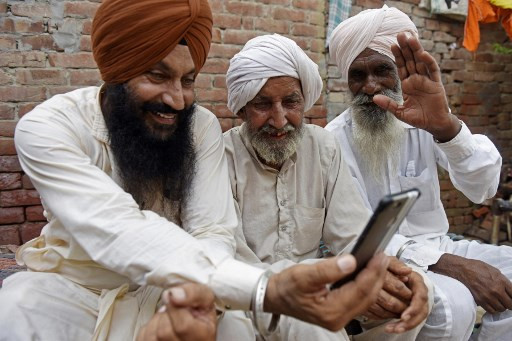 In this picture taken on August 2, 2022, Indian Sikh labourer Sika Khan (C) talks to his elder brother Sadiq Khan in Pakistan, via a mobile video call at a village in Bathinda. Tears of joy rolled down his wizened cheeks when Indian Sika Khan met his Pakistani brother for the first time since being separated by Partition in 1947. Sika was just six months old when he and his elder brother Sadiq Khan were torn apart as Britain split the subcontinent at the end of colonial rule.
(AFP /Narinder Nanu)
In this picture taken on August 2, 2022, Indian Sikh labourer Sika Khan (C) talks to his elder brother Sadiq Khan in Pakistan, via a mobile video call at a village in Bathinda. Tears of joy rolled down his wizened cheeks when Indian Sika Khan met his Pakistani brother for the first time since being separated by Partition in 1947. Sika was just six months old when he and his elder brother Sadiq Khan were torn apart as Britain split the subcontinent at the end of colonial rule.
(AFP /Narinder Nanu)
T
ears of joy rolled down his wizened cheeks when Indian Sika Khan met his Pakistani brother for the first time since being separated by Partition in 1947.
Sikh laborer Sika was just six months old when he and his elder brother Sadiq Khan were torn apart as Britain split the subcontinent at the end of colonial rule.
This year marks the 75th anniversary of Partition, during which sectarian bloodshed killed possibly more than one million people, families like Sika's were cleaved apart and two independent nations -- Pakistan and India -- were created.
Sika's father and sister were killed in communal massacres, but Sadiq, just 10 years old, managed to flee to Pakistan.
"My mother could not bear the trauma and jumped into the river and killed herself," Sika said at his simple brick house in Bhatinda, a district in the western Indian state of Punjab, which bore the brunt of Partition violence.
"I was left at the mercy of villagers and some relatives who brought me up."
Ever since he was a child, Sika yearned to find out about his brother, the only surviving member of his family. But he failed to make headway until a doctor in the neighborhood offered to help three years ago.

More from The Weekender

The weight of time
Richard Mille’s newest ultralight timepiece pares down haute horlogerie to its mechanical necessities, proving that sophistication often comes from knowing what to leave out.

At this wellness retreat, your poo is everybody’s business
Ayurvedagram promises balance through ancient Ayurvedic practices. For four days, I surrendered my schedule, my modesty and, almost, my digestive tract.

All aboard: The case for staying grounded
An eight-hour train ride from Jakarta to Surabaya shows that getting there can be half the fun.