The Jakarta Post
Please Update your browser
Your browser is out of date, and may not be compatible with our website. A list of the most popular web browsers can be found below.
Just click on the icons to get to the download page.


Popular Reads
Top Results
No results found. Please check your search term and try again
Can't find what you're looking for?
View all search results
Popular Reads
Top Results
No results found. Please check your search term and try again
Can't find what you're looking for?
View all search resultsEddy Susanto’s ‘Lalitavistara Wallacea’ explores nature through sacred texts
At ArtSociates Jakarta, the Indonesian artist uses Old Javanese script and Buddhist philosophy to depict 10 Wallacean animal portraits, linking wildlife, cultural heritage and the cosmos.
Change text size
Gift Premium Articles
to Anyone
Share the best of The Jakarta Post with friends, family, or colleagues. As a subscriber, you can gift 3 to 5 articles each month that anyone can read—no subscription needed!
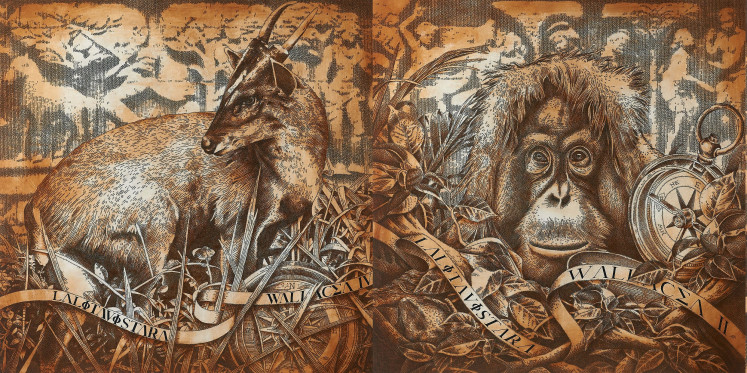
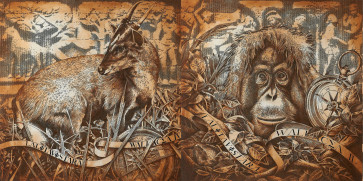
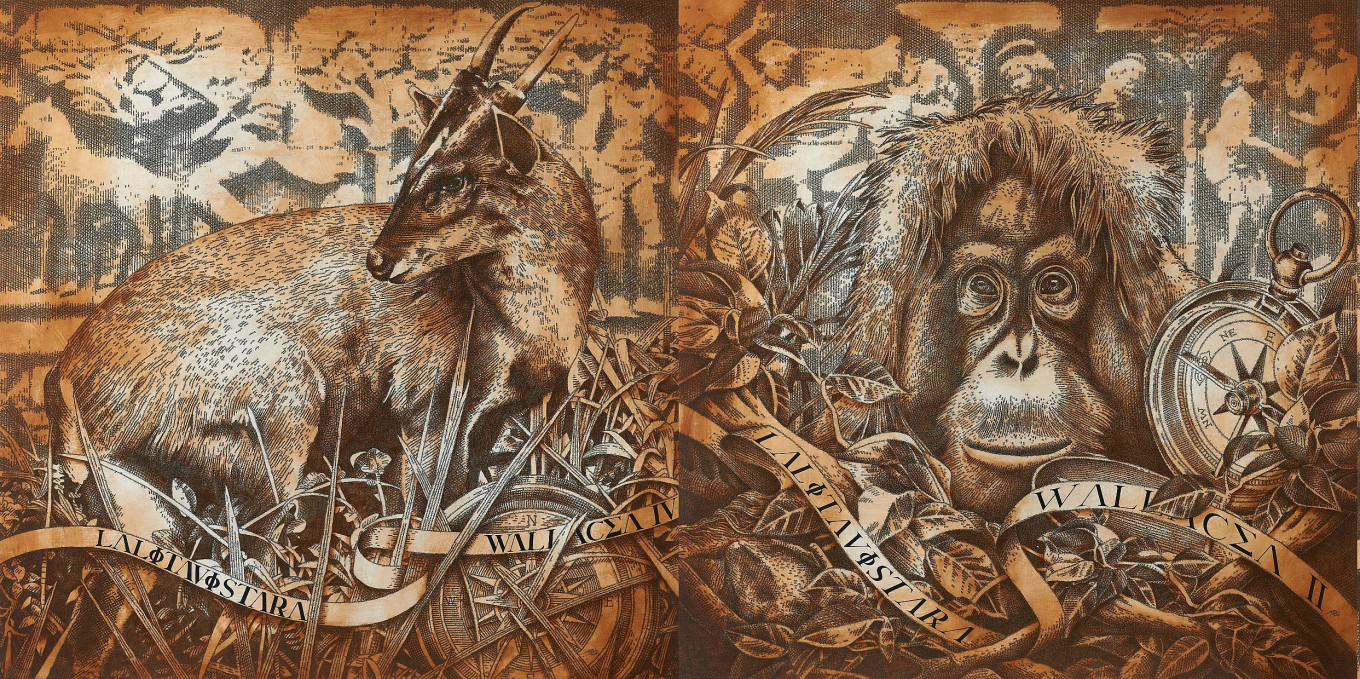 Wildlife in focus: A combination of two photographs of artworks by Indonesian artist Eddy Susanto, featured in his first solo exhibition, Lalitavistara Wallacea, at ArtSociates Jakarta in Central Jakarta through Oct. 25. The works depict endemic fauna, including (from left) the Javan muntjac (Muntiacus muntjak) and orangutan (Pongo pygmaeus). (Courtesy of Eddy Susanto/-)
A
t a time when wildlife is increasingly threatened by fires in Kalimantan, Eddy Susanto’s solo exhibition Lalitavistara Wallacea, currently on show at ArtSociates Jakarta, serves as a timely reminder of the need to recognize and preserve the natural world.
The exhibition presents 10 images of endemic Wallacean fauna, each meticulously shaped by microscopic text that forms the lines, shading and contours of the animals. Composed entirely of passages from the Sang Hyang Kamahayanikan, a foundational 10th-century Javanese Mahayana Buddhist text, the images initially appear naturalistic. Only upon closer inspection does it become clear that their forms are made up of sacred passages written in Hanacaraka, the traditional Javanese script.
The title brings together two distinct references. Wallacea evokes Alfred Russel Wallace, the English naturalist who independently developed the theory of evolution by natural selection. Lalitavistara, meanwhile, refers to an ancient Sanskrit Mahayana Buddhist scripture, or sutra, composed around the third and fourth centuries. The text recounts the life of the Buddha and is depicted in the reliefs of Borobudur Temple, presenting a cosmos shaped by karma, spiritual progression and ultimate openness.
The exhibition’s 10 images draw inspiration from the fauna of Wallacea, a transitional biogeographic zone where Asian and Australian wildlife meet. The region’s distinctive distribution of species was mapped by Wallace in the 19th century. Yet its fauna had been depicted long before the naturalist arrived in Java, including in the stone reliefs of Borobudur, which date to the eighth and ninth centuries.
By embedding sacred scripture into the bodies of endemic animals, Eddy reinterprets them as physical manifestations of a broader spiritual and philosophical universe.
In his signature style, the artist shapes each animal using passages of Old Javanese scripture that form its visual contours. Known for juxtaposing Javanese narratives with Western iconography, Eddy brings the sacred cosmology represented at Borobudur into dialogue with the biogeographic realities associated with the Wallace Line.
Proposed by Wallace in the 19th century, the Wallace Line is a faunal boundary that runs through the Indonesian archipelago, separating predominantly Asian fauna to the west from more Australasian species to the east. It passes between Bali and Lombok in the south and between the islands of Borneo and Sulawesi farther north, extending toward the Philippines.

More from The Weekender
A passport to the kingdom of the sick
A breast cancer diagnosis, a journey to the kingdom of the sick and a determination to describe what lies there without metaphor, euphemism or the word “fight.”

The weight of time
Richard Mille’s newest ultralight timepiece pares down haute horlogerie to its mechanical necessities, proving that sophistication often comes from knowing what to leave out.
At this wellness retreat, your poo is everybody’s business
Ayurvedagram promises balance through ancient Ayurvedic practices. For four days, I surrendered my schedule, my modesty and, almost, my digestive tract.