TheJakartaPost
Please Update your browser
Your browser is out of date, and may not be compatible with our website. A list of the most popular web browsers can be found below.
Just click on the icons to get to the download page.


Popular Reads
Top Results
No results found. Please check your search term and try again
Can't find what you're looking for?
View all search results
Popular Reads
Top Results
No results found. Please check your search term and try again
Can't find what you're looking for?
View all search resultsLow demand for gas puts off retailers from building pumps
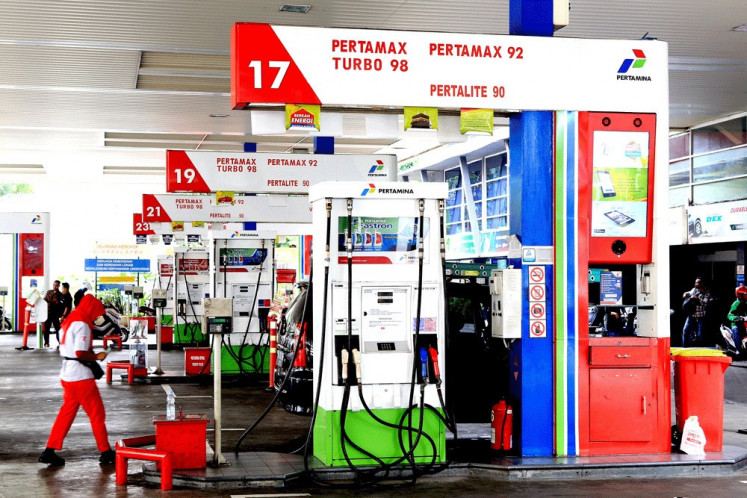
Fuel stations across Jakarta have been slow to install pumps for natural gas and liquefied gas, saying the low demand did not warrant the high investment involved
Change text size
Gift Premium Articles
to Anyone
Share the best of The Jakarta Post with friends, family, or colleagues. As a subscriber, you can gift 3 to 5 articles each month that anyone can read—no subscription needed!

Fuel stations across Jakarta have been slow to install pumps for natural gas and liquefied gas, saying the low demand did not warrant the high investment involved.
Ratna Suratni, head of the Jakarta mining agency's gas, electricity and energy division, said the stations were obliged to install the pumps, but had yet to do so because of the cost.
"It's the egg-chicken problem all over again. Businesses are still waiting for a high demand for gas, such as CNG (compressed natural gas) or Vigas (the trade name for liquefied gas for vehicles, or LGV)," she told The Jakarta Post over the weekend.
"On the other hand, consumers can't be persuaded to switch from gasoline to gas because of the limited number of stations providing gas."
A memorandum of understanding was signed last September by the city administration, state oil and gas firm PT Pertamina, PT Shell Indonesia and Malaysia-based oil and gas firm Petroliam Nasional Berhad (Petronas), requiring the companies to install gas pumps at their fuel stations.
The program is part of the administration's effort to reduce carbon emissions and promote wider use of gas.
The MoU also applies to the city's 66 petroleum retailing business license holders.
Currently, there are eight stations that provide CNG and three that provide LGV, with another four under construction.
Pertamina spokesman Wisnuntoro said it was hard to implement the MoU because of the huge investment required.
"The installation of a single gas pump, including the underground gas tank, nozzle and compressor, can cost more than Rp 500 million (US$54,788)," he told the Post.
The Jakarta transportation agency's 2007 records show about 3,079 of the city's 50,388 public transportation vehicles, including big and small buses, TransJakarta buses, minivans, taxis and three-wheeled cabs, run on gas.
Herwan Gozali, operations director of taxi firm PT Express Transindo Utama, said higher fuel prices and the need to maintain fares had forced the company to modify its cars to use LGV.
"Vigas sold for Rp 3,600 per liter when it was first introduced in March, and gasoline for Rp 4,500 per liter," he said.
"But although Vigas now costs Rp 5,000 per liter, it'll always be cheaper than gasoline, which now costs Rp 6,000 per liter."
Herwan added the process to modify the company's 3,000 cars would be complete by early next year.
Kurtubi, director of the Center for Petroleum and Energy Studies, said the switch from gasoline to gas was a wise policy move.
"But the administration can not force the stations to act first. It must first convince them the demand is already there and the gas supply is secure," he told the Post.
Kurtubi also said the government and the city administration should lead by example.
"The administration can start by using gas for its operational vehicles," he said.