The Jakarta Post
Please Update your browser
Your browser is out of date, and may not be compatible with our website. A list of the most popular web browsers can be found below.
Just click on the icons to get to the download page.


Popular Reads
Top Results
No results found. Please check your search term and try again
Can't find what you're looking for?
View all search results
Popular Reads
Top Results
No results found. Please check your search term and try again
Can't find what you're looking for?
View all search resultsThe death of police reform
The newly amended Police Law betrays the spirit of the Reform era, turning the force into a political counterweight rather than a professional protector.
Change text size
Gift Premium Articles
to Anyone
Share the best of The Jakarta Post with friends, family, or colleagues. As a subscriber, you can gift 3 to 5 articles each month that anyone can read—no subscription needed!
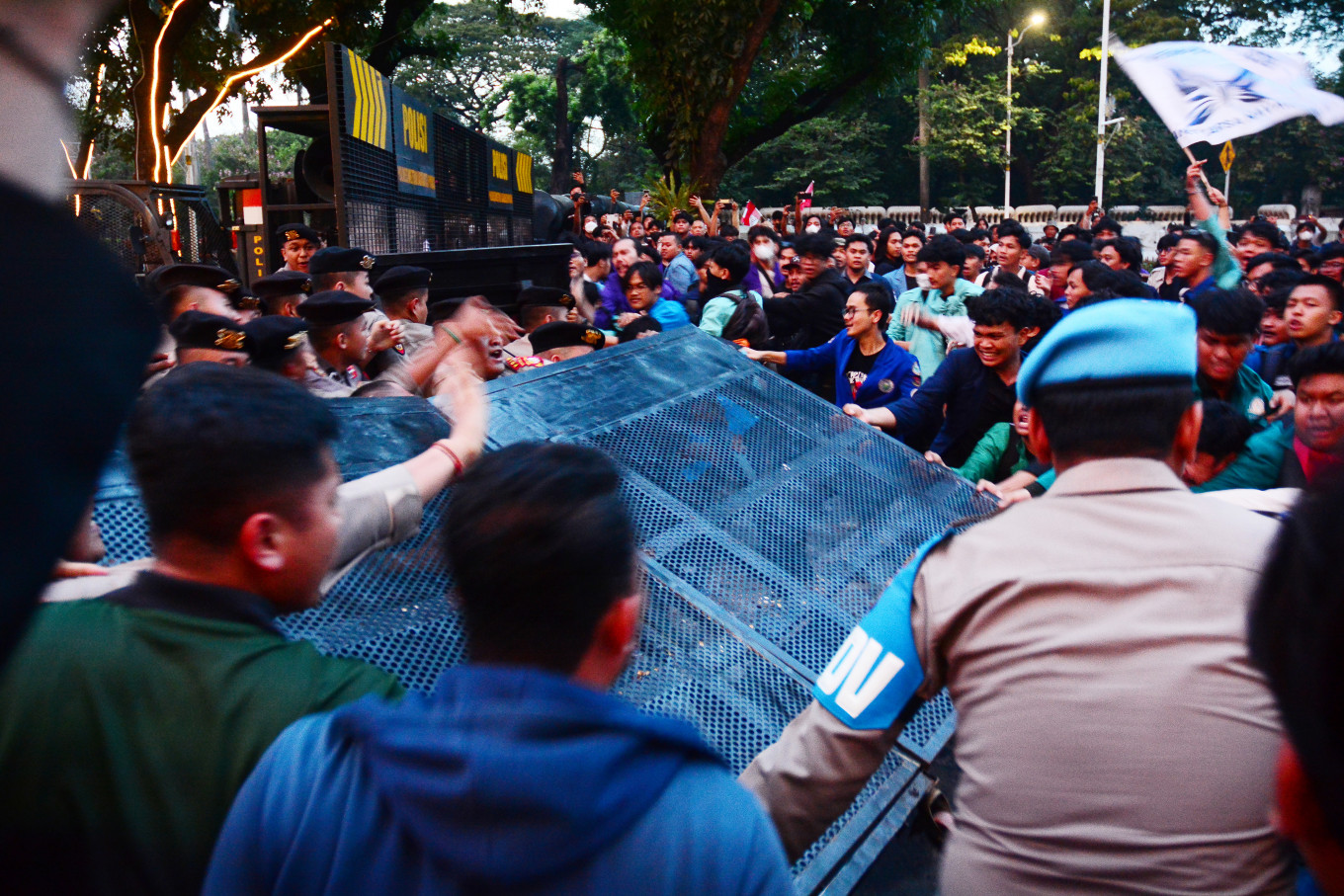 Police attempt to hold back protesters from the Aliansi Badan Eksekutif Mahasiswa Seluruh Indonesia (BEM SI) during a demonstration marking National Education Day on Jl. Medan Merdeka Selatan in Jakarta on May 2, 2026.
The demonstrators expressed their demand for reforms in education budget governance, including separating public education funding from official institutional budgets, ending excessive commercialization of education and ensuring equitable access to quality education. (JP/Iqro Rinaldi)
Police attempt to hold back protesters from the Aliansi Badan Eksekutif Mahasiswa Seluruh Indonesia (BEM SI) during a demonstration marking National Education Day on Jl. Medan Merdeka Selatan in Jakarta on May 2, 2026.
The demonstrators expressed their demand for reforms in education budget governance, including separating public education funding from official institutional budgets, ending excessive commercialization of education and ensuring equitable access to quality education. (JP/Iqro Rinaldi)
J
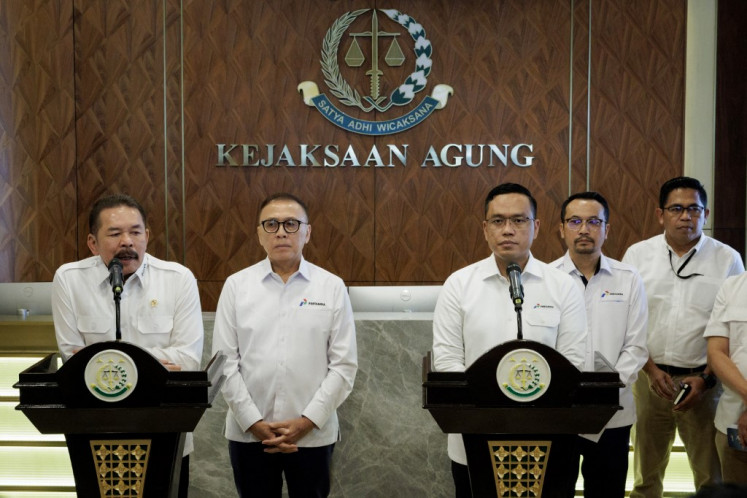
ust a few days ago, we expressed our eagerness to see the National Police follow a court order to investigate the parties behind the four Indonesian Military (TNI) personnel held responsible for the acid attack on human rights activist Andi Yunus and expose the true motives behind the criminal act.
However, that may now be a false hope after the House of Representatives unanimously passed on Tuesday the amendment to the 2002 Police Law, morphing the institution into a more powerful body without adequate checks and balances. The rushed deliberation of the revision at the House, going through only two hearings on June 4 and 8, not only violates the prudent legislative principle of meaningful public consultation, but also demonstrates a political process laden with narrow, elitist interests.
We have grown all too familiar with this pattern when we recall the rewriting of the Corruption Eradication Commission (KPK) Law, the Job Creation Law, the new Criminal Code (KUHP), the Criminal Law Procedure Code (KUHAP) and the TNI Law over the past few years.
Beyond the flawed process, the amended Police Law pushes the force further away from the very spirit of reform the nation embraced in 2000, which separated the police from the military to serve as a professional law enforcement agency with a strong mandate to maintain security and order. More recently, President Prabowo Subianto formed a committee to accelerate the police reform agenda, but it ultimately resulted in watered-down recommendations intended to maintain the status quo.
The amended Police Law is rife with provisions that could endanger our democracy. For example, Article 28A allows active police officers to hold government positions. While framed as relating to police duties, this kind of assignment breaches the Constitutional Court ruling that bans this practice and directly undermines the professional, non-partisan ethos of the police.
The revision also fails to live up to longstanding public demands for effective external oversight. Based on the new law, the National Police Commission (Kompolnas) will remain a toothless consultative body without any authority to punish errant officers. We cannot expect the police to uphold professionalism without independent supervision.

As in the case of the new TNI Law, the amended Police Law raises officers’ retirement age up to 60 years old. Four-star generals, most likely the police chiefs, are now allowed to serve until 61 at the president’s discretion. Not only does this provision lack solid reasoning, but it will also create an unnecessary career regeneration bottleneck.