TheJakartaPost
Please Update your browser
Your browser is out of date, and may not be compatible with our website. A list of the most popular web browsers can be found below.
Just click on the icons to get to the download page.


Popular Reads
Top Results
No results found. Please check your search term and try again
Can't find what you're looking for?
View all search results
Popular Reads
Top Results
No results found. Please check your search term and try again
Can't find what you're looking for?
View all search resultsAgency mulls using multiple subsidized fuel distributors
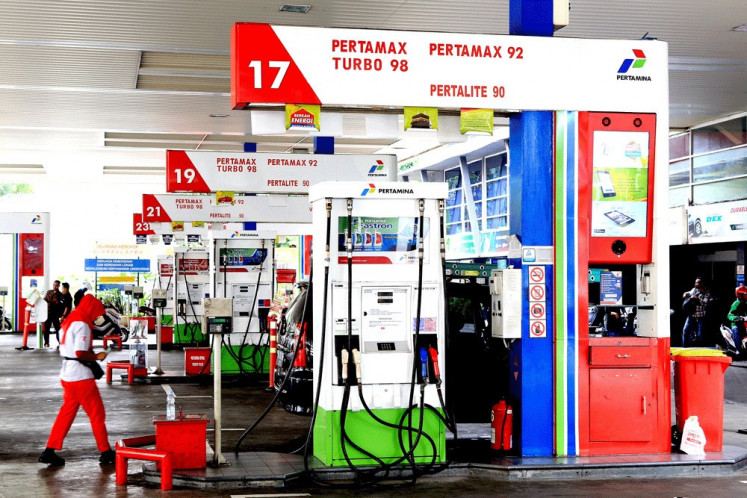
Downstream oil and gas regulator BPH Migas is considering adding more distributors of subsidized fuels to help the current sole provider, state-owned PT Pertamina, secure a nationwide supply
Change text size
Gift Premium Articles
to Anyone
Share the best of The Jakarta Post with friends, family, or colleagues. As a subscriber, you can gift 3 to 5 articles each month that anyone can read—no subscription needed!

D
ownstream oil and gas regulator BPH Migas is considering adding more distributors of subsidized fuels to help the current sole provider, state-owned PT Pertamina, secure a nationwide supply.
Under the oil and gas law, any company may participate in BPH Migas' annual tender to win the rights to distribute subsidized fuels. But Pertamina, with its superior network of gas stations, has been the sole distributor for four consecutive years.
For next year however, BPH Migas committee member Ibrahim Hasyim said Friday the agency was entertaining the idea of selecting multiple distributors, as shortages are still regular occurrences in many parts of the country.
"Some areas, due to reasons such as environmental conditions, still face shortages. It would be good if we could have two or more subsidized fuels distributors in these kind of areas," Ibrahim said during a presentation on his company's preparations for a new tender in 2009.
If a multidistributor mechanism were implemented, Shell, Petronas and other retailers may play a role in managing the country's subsidized fuels, he added.
"We will discuss this further, especially regarding whether such a mechanism is allowed under our regulations. We are scheduled to select subsidized fuel distributors for 2009 in December this year."
Hanggono T. Nugroho, another member of the committee, said a mechanism for allowing multiple distributors could be carried out in two ways. Retailers could be assigned to manage fuel for, first, different regions, or second, for different processes.
"If we used the second mechanism, a retailer may be responsible for storage only, with a separate retailer responsible for distribution," Hanggono said.
Pertamina spokesman Wisnuntoro said the company had no problem with the multiple distributors policy as long as all they were treated equally.
"The working area would have to be distributed fairly to all distributors. Each retailer would have to be assigned to all regions disregarding of their accessibility," he said.
Ibrahim said that although fuel distribution in the country had been liberalized since the law's introduction in 2001, the retailers' penetration was still unequal among the regions.
"Our liberalization in the oil and gas sector has not been that successful. Most retailers only operate in the Greater Jakarta area."