TheJakartaPost
Please Update your browser
Your browser is out of date, and may not be compatible with our website. A list of the most popular web browsers can be found below.
Just click on the icons to get to the download page.


Popular Reads
Top Results
No results found. Please check your search term and try again
Can't find what you're looking for?
View all search results
Popular Reads
Top Results
No results found. Please check your search term and try again
Can't find what you're looking for?
View all search resultsSIEM 2008 confronts challenge of change
It started with a relaxed chat among the few who cared about the state of Solo's culture -- and it has developed to become a community group with the idea of turning Solo into a city of culture
Change text size
Gift Premium Articles
to Anyone
Share the best of The Jakarta Post with friends, family, or colleagues. As a subscriber, you can gift 3 to 5 articles each month that anyone can read—no subscription needed!

It started with a relaxed chat among the few who cared about the state of Solo's culture -- and it has developed to become a community group with the idea of turning Solo into a city of culture.
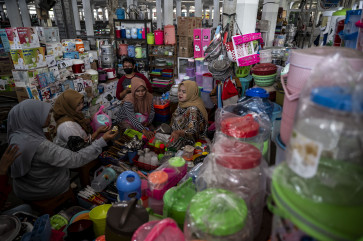
A visitor browses ethnic musical instruments and other hand-made items for sale at a stall at the SIEM 2008 ethnic art festival in Solo. (JP/Slamet Susanto)
This was how the Solo International Ethnic Music Community (SIEM) came into being.
Almost two years ago, in January 2007, Bambang Suteja, a businessman, and Putut H Pramono, a cultural observer, got together with some academics for a chat.
One of the main topics of conversation was their concern for the state of ethnic music, which was becoming more marginalized because it had not been able to adjust to changes forced by commercialism.
"At that time we were only five people (in the group). There was Bambang as a businessman, there was a cultural observer and some academics," said Putut H Pramono, the SIEM 2008 festival section head.
Putut told The Jakarta Post that the original idea was to hold a festival featuring ethnic art that could be enjoyed by a wide range of people.
"We didn't intend to get trapped by the event. After the event closed, that was to be the end of our involvement. So for this SIEM festival we created a learning space and interactivity to cope with the changes," Putut said.
If the number of visitors is any indicator of success, then the first SIEM, held in 2007, could be deemed a winner. From a target of 3,000 visitors, the first festival attracted about 50,000 visitors.
The second SIEM, which was held in Pamedan Pura Mangkunegaran Surakarta from Oct. 28 to Nov. 1 this year, featured 20 ethnic music groups from 20 regions.
Among the ethnic music delegates present were Kande from Aceh, Teratai Pasiana from Selayar, Bambang SP from Surabaya, Lumaras Budoyo from Magelang, Sound Of Kiser from Cirebon, Gangsadewa Yogyakarta and Kayu Bakar from Papua.
Four international groups -- from Singapore, Japan, Australia and Taiwan -- were also present. SIEM 2008 also presented jazz singers Syaharani and Innisisri, and guitarist Balawan.
Putut said that to ensure SIEM 2008 could be enjoyed by people from all walks of life, the committee chose organizers from two different genres: Rahayu Supanggah, an expert on ethnomusicology, musician and teacher at the Indonesian Art Institute Surakarta, came to represent the classical generation, while Gilang Ramadhan represented the contemporary generation.
The theme for the event was "Collective Awareness, Awareness of Difference and Awareness of Change", which emphasized the awareness of human beings and mutual respect.
"Although we are different, we have our own collective awareness ... to be united and respect the differences," said Bambang Suteja, the general manager of SIEM.
"Nowadays there is a need for ethnic music like this. Next year it may be different again because the times keep changing and ethnic music also has to change in order to exist in the midst of commercialization."
Apart from holding musical performances on stage, SIEM 2008 also held a workshop and explored issues with other delegates in the hope the event would be able to produce creative work and expand the network of ethnic musicians on an international scale.
Ethnicity from the perspective of the economy and industry was also discussed during a series of seminars at the festival.
Also part of the festival were a tree-planting project, in conjunction with Solo students, and an event with community members to clean up the city.
"The workshop venue was chosen as a place that has historical value. Last year, in 2007, the SIEM festival was held at Benteng Vastenburg Solo. This year it was held in the complex of Mangkunegaran," said Putut.
Bambang Suteja added that to reach all sections of society SIEM pursued the model of a fluid community. The festival, he said, was more or less a way of constructing an environment of interaction, and a place in which to connect artists and the community of a pluralist society.
"SIEM is also like a newborn baby. At the moment it is looking for shape. But the shape that is required will not depend on any one person," said Bambang.
During the 2008 SIEM festival, Bambang said, an exhibition was held that presented different products, such as food and merchandise that represented ethnic treasures from respective delegates.
Bambang added that the SIEM committee would undertake studies to ensure the festival would not be trapped by routine and become monotonous.
"Maybe (it should be held) every two years, or three years or five years. This matter is being looked into," he said.