The Jakarta Post
Please Update your browser
Your browser is out of date, and may not be compatible with our website. A list of the most popular web browsers can be found below.
Just click on the icons to get to the download page.


Popular Reads
Top Results
No results found. Please check your search term and try again
Can't find what you're looking for?
View all search results
Popular Reads
Top Results
No results found. Please check your search term and try again
Can't find what you're looking for?
View all search resultsBoediono, Mulyani knew of bailout total: Expert
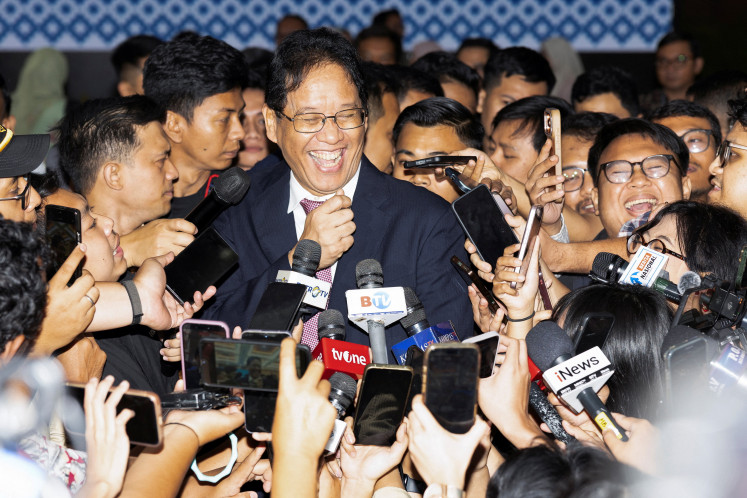
Vice President Boediono and Finance Minister Sri Mulyani Indrawati knew of higher total cost estimates for the Century bailout total when the decision was made, an economist claimed before the inquiry committee
Change text size
Gift Premium Articles
to Anyone
Share the best of The Jakarta Post with friends, family, or colleagues. As a subscriber, you can gift 3 to 5 articles each month that anyone can read—no subscription needed!
 Set as preferred source

V
ice President Boediono and Finance Minister Sri Mulyani Indrawati knew of higher total cost estimates for the Century bailout total when the decision was made, an economist claimed before the inquiry committee.
Speaking as an expert witness before the House of Representative’s special committee on Thursday, Dradjad Wibowo, also former legislator of the National Mandate Party (PAN) said that on Nov. 20, 2008, Boediono who was then Bank Indonesia (BI) governor, had submitted a letter with an estimated total bailout amount to Sri Mulyani, chairman of the Financial System Stability Committee (KSSK).
“In that letter, there was a calculation saying that the redemption amount needed for Bank Century’s customers who had savings that were less than Rp 2 billion stood at Rp 5.3 trillion,” he was quoted as saying by detik.com.
“In the last paragraph, there was an attachment with an analysis on the bank. The attachment clearly says that for Bank Century to meet its minimum Capital Adequacy Ration [CAR] of 8 percent, the bank would need Rp 632 billion. For liquidity purposes, the bank needed Rp 4.79 trillion. In total Rp 5.4 trillion was then needed.”
Dradjad also said that the attachment also put the point that in order for Bank Century to meet its capital requirements, the bank would need an extra Rp 1.7 trillion.
“So, Bank Indonesia had calculated Rp 1.7 trillion plus Rp 5.4 trilion, which equaled to around Rp 7 trillion. However, in December, there was a gap because there were foreign exchange disparities from the US treasury and therefore, the bailout amount amounted to Rp 6.7 trillion.”
Dradjad’ testimony contradicted Sri Mulyani’s testimony before the committee that she was only aware that the initial bailout amount was Rp 632 billion. The total cost of the bailout finally rose more than 10 times this initial estimate to Rp 6.76 trillion.
During another inquiry, previous vice president Jusuf Kalla said that Mulyani once told him that she felt as if she was misled by Bank Indonesia due to the surprising increase of the total cost of the bailout.
The special committee also heard conflicting opinions from many other economists and banking analysts including Kwik Kian Gie, Rizal Ramli, Chatib Basri, Faisal Basri, Hendri Saparini and Ichsanuddin Noorsy.
Kwik, Hendri, Dradjad, Rizal and Ichsanuddin questioned the central bank’s conclusion that Bank Century was a failed bank which posed a systemic threat. They said KSSK’s decision to bail out the bank was based on inaccurate microeconomic and macroeconomic data.
They said BI had fabricated microeconomic and macroeconomic data to support its conclusion that Bank Century was a failed bank posing a systemic threat to the banking system, unless it was bailed out.
“The determination that Bank Century was as a failed bank with a systemic impact is really a fabrication and the ailing bank would not have raised any systemic impacts if it was not bailed out,” Hendri told the inquiry committee.
However, other economists such as Chatib Basri and Faisal Basri hailed the government’s decision to bail out the bank in its bid to prevent its failure from causing a domino effect upon many other small banks which in the end could have caused a new economic crisis similar to that of 1997.
Chatib Basri and Faisal Basri, both of the University of Indonesia, said they saw nothing wrong with the government’s decision on the bailout. They said bailing out the bank was estimated to be cheaper than liquidating it.