The Jakarta Post
Please Update your browser
Your browser is out of date, and may not be compatible with our website. A list of the most popular web browsers can be found below.
Just click on the icons to get to the download page.


Popular Reads
Top Results
No results found. Please check your search term and try again
Can't find what you're looking for?
View all search results
Popular Reads
Top Results
No results found. Please check your search term and try again
Can't find what you're looking for?
View all search resultsResidents play important role in waste management
Local residents played an important role in efforts to improve waste management in the capital, an environmental expert has said
Change text size
Gift Premium Articles
to Anyone
Share the best of The Jakarta Post with friends, family, or colleagues. As a subscriber, you can gift 3 to 5 articles each month that anyone can read—no subscription needed!
 Set as preferred source

L
ocal residents played an important role in efforts to improve waste management in the capital, an environmental expert has said.
University of Indonesia environmental expert Gabriel Andari Kristanto reiterated that the key to improving waste management in big cities like Jakarta or the Greater Jakarta area, for that matter, was the involvement and the awareness of local residents of the importance of managing their household waste.
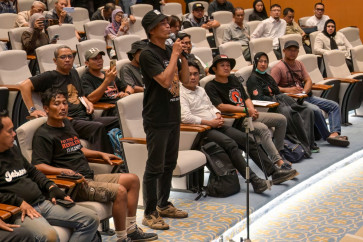
'The biggest challenge to improving waste management in Jakarta is how to boost the participation of residents from the basic level of separating organic waste from inorganic waste, or encouraging them not to throw garbage into the river, for example. Sorting garbage should be started at the individual level, not in the [landfill] and we can't rely on [the city administration] for that. That is our responsibility as residents. So, the issue is how to improve our participation,' Gabriel said on the sidelines of the symposium Future City Jakarta held at the University of Indonesia in Depok, West Java, recently.
Gabriel, who received her PhD in environmental toxicology from Texas Southern University, pointed out a change in mind-set on waste was a key factor in boosting people's awareness.
'If you mind checking out the KBBI [the Great Dictionary of the Indonesian Language] you'll find out that it gives an insignificant definition of waste. It basically says that waste is something valueless, something that has to be thrown away. That's it. We should start seeing waste as something that has value and business potential, [something] that will bring profit should it be managed in the right way,' she said.
As an example, she pointed out that a garbage collector at the Bantar Gebang landfill in Bekasi, West Java, can earn from Rp 200 million (US$16,436.56) to Rp 300 million per month from processing plastic waste and the like.
'People see scavengers as merely the poor. But if we went up and looked at the level of garbage collectors, we'd see that they can actually earn that much money from waste. We have to acknowledge the business potential in waste,' she said.
Furthermore, Gabriel encouraged residents to help scavengers boost their income simply by rearranging their household waste.
'We can start by separating plastic waste from organic waste and put them together in one container or plastic bag: It will help scavengers collect profitable waste. Otherwise it will take a long time and require too much effort to collect the garbage piece by piece. By collecting plastic waste or organic waste in one container, we have already helped a scavenger boost his income for that day.
'State-owned enterprises can also play a role by providing loans for scavengers or those who work on waste management,' she said.
On the regulator's side, Gabriel suggested that the government include waste management in the school curriculum.
'It has to be started from the education system. The government should also prepare and build waste infrastructure. If they want us to separate waste then they should also provide a proper dump truck and waste treatment facilities. If they forbid people from throwing garbage in the river then they should provide proper garbage trash cans or garbage centers in each neighborhood,' she said.
Jakarta produces more than 6,000 tons of garbage daily, most of which is treated in the Bantar Gebang landfill in Bekasi. The landfill, however, does not have proper waste treatment facilities.
The only new waste treatment facility is the intermediate treatment facility (ITF) in Cakung Cilincing, North Jakarta, which started operating in August 2011 using Mechanical Biological Treatment technology. At Cakung Cilincing, inorganic waste is recycled while organic waste is fermented to produce energy for electricity.
The city administration is now preparing two other ITF facilities in Sunter and Marunda, also in North Jakarta.