The Jakarta Post
Please Update your browser
Your browser is out of date, and may not be compatible with our website. A list of the most popular web browsers can be found below.
Just click on the icons to get to the download page.


Popular Reads
Top Results
No results found. Please check your search term and try again
Can't find what you're looking for?
View all search results
Popular Reads
Top Results
No results found. Please check your search term and try again
Can't find what you're looking for?
View all search results2015, year of the rise of app-based motorcycle taxi
In 2015, Jakarta saw rapid growth of app-based transportation, with ojek (motorcycle taxi) being the most notable one
Change text size
Gift Premium Articles
to Anyone
Share the best of The Jakarta Post with friends, family, or colleagues. As a subscriber, you can gift 3 to 5 articles each month that anyone can read—no subscription needed!
 Set as preferred source

I
n 2015, Jakarta saw rapid growth of app-based transportation, with ojek (motorcycle taxi) being the most notable one. The use of mobile phone apps to hitch a ride became a significant trend among Jakartans last year.
Ojek are a traditional form of transportation in Jakarta. Given the city's infamous congestion, ojek can be found on every street corner of the capital, although their existence has no legal basis.
For years, ojek have been considered an alternative type of public transportation for people who liked to reach their destination without spending hours stuck in traffic, but now the game has completely changed.
The rising popularity of the two biggest players in the app-based ojek business, Go-Jek and GrabBike, has made the two-wheeled taxi a favorite mode of public transportation among middle-class Jakartans. Their green-black jackets and helmets can be easily spotted every day across the city.
Established in 2011, Go-Jek's popularity soared in early 2015 when it launched Android and iOS apps. The company's founder, Nadiem Makarim, claimed in late December there were around 200,000 drivers throughout the country.
Malaysian-based GrabTaxi kicked off its operations in Indonesia last May, after years of building a strong presence in other Southeast Asian markets. The fame of both GrabBike and Go-Jek have attracted others to jump on the ojek bandwagon.
However, the rise of app-based ojek has its own backlash.
The drivers began to face violent threats from traditional ojek drivers, who felt the newcomers were encroaching on their turf and who claimed the application of 'extreme' promotional tariffs by Go-Jek and GrabBike left them unable to compete.
Taxi companies Blue Bird and Express also voiced their objection, as their drivers reported dropping income since the advent of the app-based ojek.
GrabBike offered a promotional fixed tariff of Rp 10,000 (72 US cents) and later Go-Jek offered a Rp 15,000 fare for trips up to 25 kilometers.
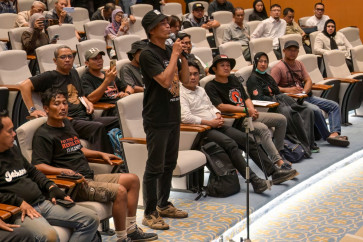
Adi, 35, a traditional ojek driver, said he and his friends put up 'anti Go-Jek and GrabBike' posters at the Kalibata City mall in South Jakarta as they felt their job was becoming tougher with the fierce competition brought by app-based ojek. 'There are 40 ojek drivers registered here. This means there are 40 families to feed every day, and those apps make it harder for us,' he told The Jakarta Post.
In addition to resistance from traditional drivers, the app-based ojek business also stands on very thin ice, as Law No. 22/2009 on traffic and land transportation does not mention ojek as a form of public transportation.
Transportation Minister Ignasius Jonan circulated a letter to the traffic police to enforce the law on app-based ojek. However, when the circular created public uproar ' and after President Joko 'Jokowi' Widodo expressed his concern, the minister canceled his recommendation.
'Ojek are needed by society. We should not issue regulations that make life difficult for people, it must be managed,' Jokowi said on his Twitter account.
The government's ambiguous standpoint on the app-based ojek and the dramatic public uproar show that, while ojek drivers actually violate the law and are not exactly a solution to the city's woeful traffic conditions, they have been providing some comfort to urbanites.








Your Opinion Matters
Share your experiences, suggestions, and any issues you've encountered on The Jakarta Post. We're here to listen.
Enter at least 30 characters
0
/ 30
Thank you
Thank you for sharing your thoughts. We appreciate your feedback.


