The Jakarta Post
Please Update your browser
Your browser is out of date, and may not be compatible with our website. A list of the most popular web browsers can be found below.
Just click on the icons to get to the download page.


Popular Reads
Top Results
No results found. Please check your search term and try again
Can't find what you're looking for?
View all search results
Popular Reads
Top Results
No results found. Please check your search term and try again
Can't find what you're looking for?
View all search resultsRI seeks support to counter EU biofuel criteria
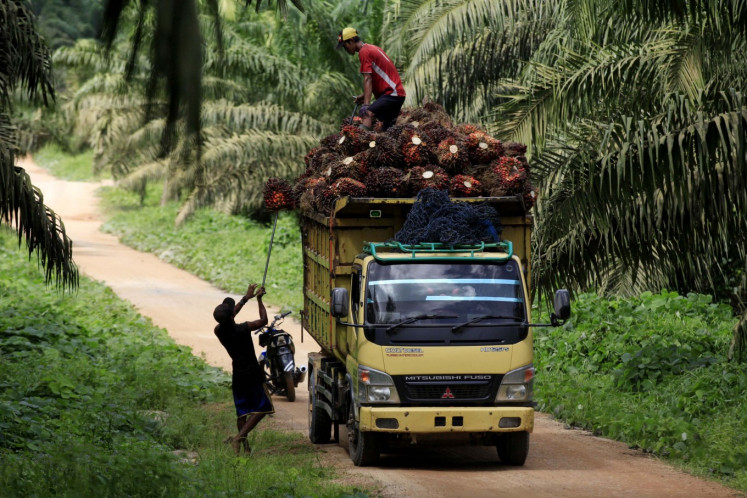
The government is collecting international support to counter the European Union’s plan to limit the entry of biofuels into the EU market by setting additional criteria for acceptable palm oil products
Change text size
Gift Premium Articles
to Anyone
Share the best of The Jakarta Post with friends, family, or colleagues. As a subscriber, you can gift 3 to 5 articles each month that anyone can read—no subscription needed!

T
he government is collecting international support to counter the European Union’s plan to limit the entry of biofuels into the EU market by setting additional criteria for acceptable palm oil products.
The EU has agreed to extend the deadline to phase out biofuel use from 2021 to 2030. At the same time, however, the union is planning to set extra criteria for biofuel accepted to the EU market.
Coordinating Maritime Affairs Minister Luhut Pandjaitan, who has been leading Indonesia’s diplomacy on palm oil matters, said the government considered the new deal to be still unfair.
Luhut argued that the criteria for acceptable crop-based biofuel, which will take effect in February 2019, was unjust for Indonesia, the world’s largest palm oil producer.
“We can’t be dictated to. It is our product and we are the ones who know it best. So how can they [EU] be the ones who regulate it?” Luhut said.
On June 14, the European Commission, the European Parliament and EU member states agreed to increase renewable energy use in Europe.
Basically, the new regulatory framework extends the deadline for palm oil used in transportation by nine years from the previous deadline of 2021.
However, the agreement also set criteria for the certification of two types of crop-based biofuels (CBB) in relation to indirect land-use change risk (ILUC risk) by distinguishing high-level risk fuel from low-level risk.
It is expected that in February 2019, the European Commission will report on the status of production expansion of relevant food and feed crops worldwide and set out in a delegate act the criteria for the certification of “acceptable” biofuels.
The Indonesian government, Luhut said, would hold two meetings with the primary goal of setting up counter criteria.
In August, Luhut said the government would hold a meeting with oil palm smallholders, the EU and the United Nations to discuss the potential acceptable criteria for palm oil by referring to the Sustainable Development Goals (SDGs).
“Meanwhile, in September, we will meet with the UN to discuss the future impacts of the EU’s phasing out of palm oil [in biofuel], especially on [increasing] poverty,” he added.
Other than meetings, Luhut said the government would also bring the matter to the upcoming UN climate conference (COP24) in December in Katowice, Poland.
“All of those are efforts to be credible as we will be offensive on this matter. Hence, we expect to collect the supporting data from reputable and international institutions,” he said.
Luhut also said he had asked the EU to include Indonesia in the discussion about the criteria.
The Council of Palm Oil Producer Countries (CPOPC), whose members include Indonesia and Malaysia and supply 80 percent of the world’s palm oil, concurred that the EU’s criteria for acceptable biofuel may only benefit the union.
CPOPC executive director Mahendra Siregar argued that the ILUC-risk criteria from the EU was controversial as it had various methodologies and seven calculation models.
“If the EU wants to stress out on environmental impacts, why only use one criteria that blindly sees the impact on other countries? Hence, for me, this has become a matter of intervention from a country to another,” he told The Jakarta Post on Friday.
Separately, Indonesian Biofuel Producers Association (APROBI) chairperson Paulus Tjakrawan said the government should team up with fellow major palm oil producers Malaysia and Thailand to discuss the criteria.
“It [criteria] has to be objective and fair as it will be used as an import requirement for palm-oil-based biofuel to Europe,” he said.
Exports of palm-oil-based biofuel to the EU dropped 54 percent to only 164,000 tons in 2017 year-on-year (yoy), according to data from the Indonesian Palm Oil Producers Association (GAPKI).