The Jakarta Post
Please Update your browser
Your browser is out of date, and may not be compatible with our website. A list of the most popular web browsers can be found below.
Just click on the icons to get to the download page.


Popular Reads
Top Results
No results found. Please check your search term and try again
Can't find what you're looking for?
View all search results
Popular Reads
Top Results
No results found. Please check your search term and try again
Can't find what you're looking for?
View all search resultsDiscourse: Chile aims to bounce back stronger after recent unrest
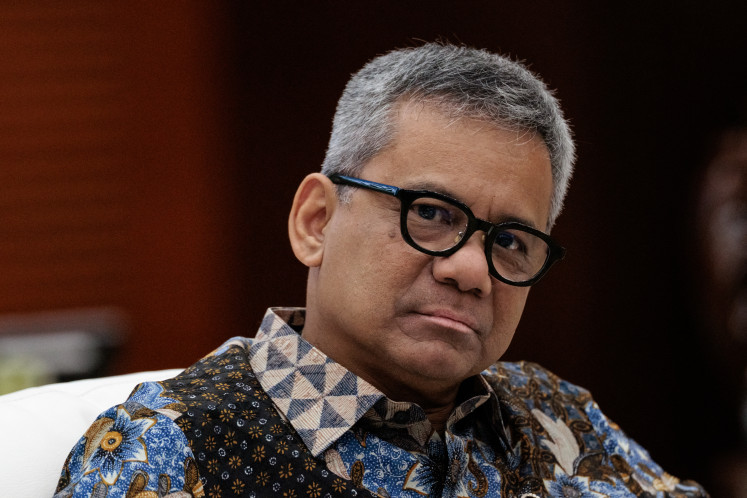
Rodrigo Yañez BenitezThe Chilean government recently canceled the Asia Pacific Economic Cooperation (APEC) Summit, which had been scheduled to be held in November in Santiago, due to unrest in the Latin American country
Change text size
Gift Premium Articles
to Anyone
Share the best of The Jakarta Post with friends, family, or colleagues. As a subscriber, you can gift 3 to 5 articles each month that anyone can read—no subscription needed!
 Set as preferred source

Rodrigo Yañez Benitez
The Chilean government recently canceled the Asia Pacific Economic Cooperation (APEC) Summit, which had been scheduled to be held in November in Santiago, due to unrest in the Latin American country.
The protests, which initially centered on public rejection of a hike in Metro fares, have evolved into a broader call to demand more equality in Chilean society.
The Jakarta Post’s Marchio Irfan Gorbiano recently talked with Chilean Vice Trade Minister Rodrigo Yañez Benitez to discuss the situation in the country after the cancellation of the APEC Summit and its development plan following the recent protests. The following are the excerpts of the interview, edited for length and clarity.
Question: The APEC Summit, which was supposed to be held in November in Chile, was canceled due to civil unrest in your country. What’s next after that?
Answer: What’s important to recall is that APEC is a process of meetings that started last December. Over 170 meetings were held in Santiago in different working groups, senior official meetings etc. So, […] we were able to approve several deliverables. So, this year was very fruitful in terms of that.
For instance, politically speaking, the agreement, the consensus for a statement that the ministers responsible for trade got in Vina del Mar last May, which happened to be the first since 2015, was a very important signal of what we were looking to achieve with APEC, which was bringing it back to its basics, to the consensus-based environment among the members. And with the sound statement around the role of international trade for growth, development and social development, also the support of APEC in strengthening WTO [World Trade Organization] agenda, its reform, among other issues related to trade.
But also, we were able to launch for the first time in APEC a roadmap for the inclusion of women in the economy and in trade, which was the first time an APEC priority to be set around gender issues and women’s inclusion. But also, [we devised] other roadmaps on illegal fishing, marine debris and integration processes, like launching for the first time the single window for trade in the context of APEC.
So, we’ll start the pilot [project] that will last three years and [other initiatives], like a strategic plan on global value chains in APEC. So bottom line, we were very happy with the results of our year. I think we were able to put back APEC in terms of its being a forum that delivers.
However, like you mentioned, the fact that the Leaders Week was canceled, left us with the political sort of closure for what has been a fruitful year of work. In that sense, the decision made by President [Sebastian] Pinera aimed to focus fully on the social reform agenda. So, not just APEC got canceled and affected by this decision but also the COP25 meetings that were supposed to take place in Santiago. So, going back to your question, the next step is to give formal closure to the process.
The trade deal between the US and China was previously supposed to be signed at the leaders’ meeting. Considering the recent development, do you think other multilateral platforms, such as APEC or the Group of 20, can provide the necessary push for the United States and China to sign a deal?
It’s true that the leaders’ summit was the de facto deadline for this agreement, and […] the traction or the momentum might have been affected because of the APEC Summit being canceled. But for us this was one of the side results that was paramount.
Seeing an agreement between the two largest economies within APEC on trade was paramount for us. Our economy has gotten hit by the trade tensions, by the uncertainty that it entails. We’ve seen our exports decreasing throughout this year by nearly 6.7 percent compared to last year.
That is explained [by] the level of uncertainty that the world economy faces. So, commodity prices are being affected, and for us it’s very important that this situation gets resolved to get trust and predictability back to the markets. So, we expect that China and the US are able to identify a venue where they can finish, give closure to this agreement, because it’s important for us.
The last time you were here you exchanged instruments of ratification (IoR) with our trade minister. Is there any update within the framework of the Indonesia-Chile Comprehensive Economic Partnership Agreement (IC-CEPA)?
Well, it’s been recently enacted and published in our official gazette a few weeks ago. And now we expect to discuss with trade authorities here in Indonesia the next step of CEPA. We have made an agreement to, in the short term, advance also in services and investment. So, we expect to discuss the next steps on those issues, because it’s relevant to have a more comprehensive economic integration with Indonesia as well.
We think that the CEPA will be a very good tool for increasing our trade in goods at this moment. Now we’re focusing on the implementation of it. For instance, to advance the halal certification program. For instance, also to give proper [information] on this instrument [to] our trade players and operators.
In terms of trade and investment, what are the Chileans looking for in Indonesia and what can Indonesian businesses contribute to Chile’s economy?
Well, at the stage of trade in goods, the opportunities that Chileans have here reside mainly in the agro-food sector, where we can also be a supplier that increases food safety for Indonesia and also provide additional alternatives for Indonesian consumers.
So, increasing, for instance, the trade in fresh foods like fish [with] our salmon, our seafood, our meat etc. is something we look at with a great deal of interest here. And in the context of Indonesia, we trade currently trucks […], shoes and other manufactured goods from Indonesia.
We could easily expand that, as Chile is the second-largest importer in the Latin American region, after only Brazil. So, that is something that for Indonesia is very good as an opportunity, and I think we’ll set a sound base to make the next step and increase our trade also in services and increase investment, because so far, we see no investment from our respective countries.