TheJakartaPost
Please Update your browser
Your browser is out of date, and may not be compatible with our website. A list of the most popular web browsers can be found below.
Just click on the icons to get to the download page.


Popular Reads
Top Results
No results found. Please check your search term and try again
Can't find what you're looking for?
View all search results
Popular Reads
Top Results
No results found. Please check your search term and try again
Can't find what you're looking for?
View all search resultsBeyond Bandung: The urgent task of decolonizing the mind
Seventy years after the historic Bandung Conference, the struggle for true independence has moved from the map to the mind. We must dismantle the "captive mind" and reconstruct a global knowledge system grounded in inherent human dignity.
Change text size
Gift Premium Articles
to Anyone
Share the best of The Jakarta Post with friends, family, or colleagues. As a subscriber, you can gift 3 to 5 articles each month that anyone can read—no subscription needed!
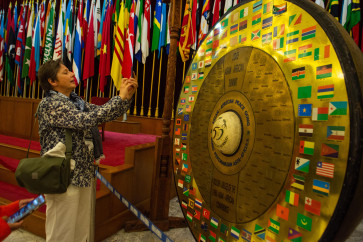
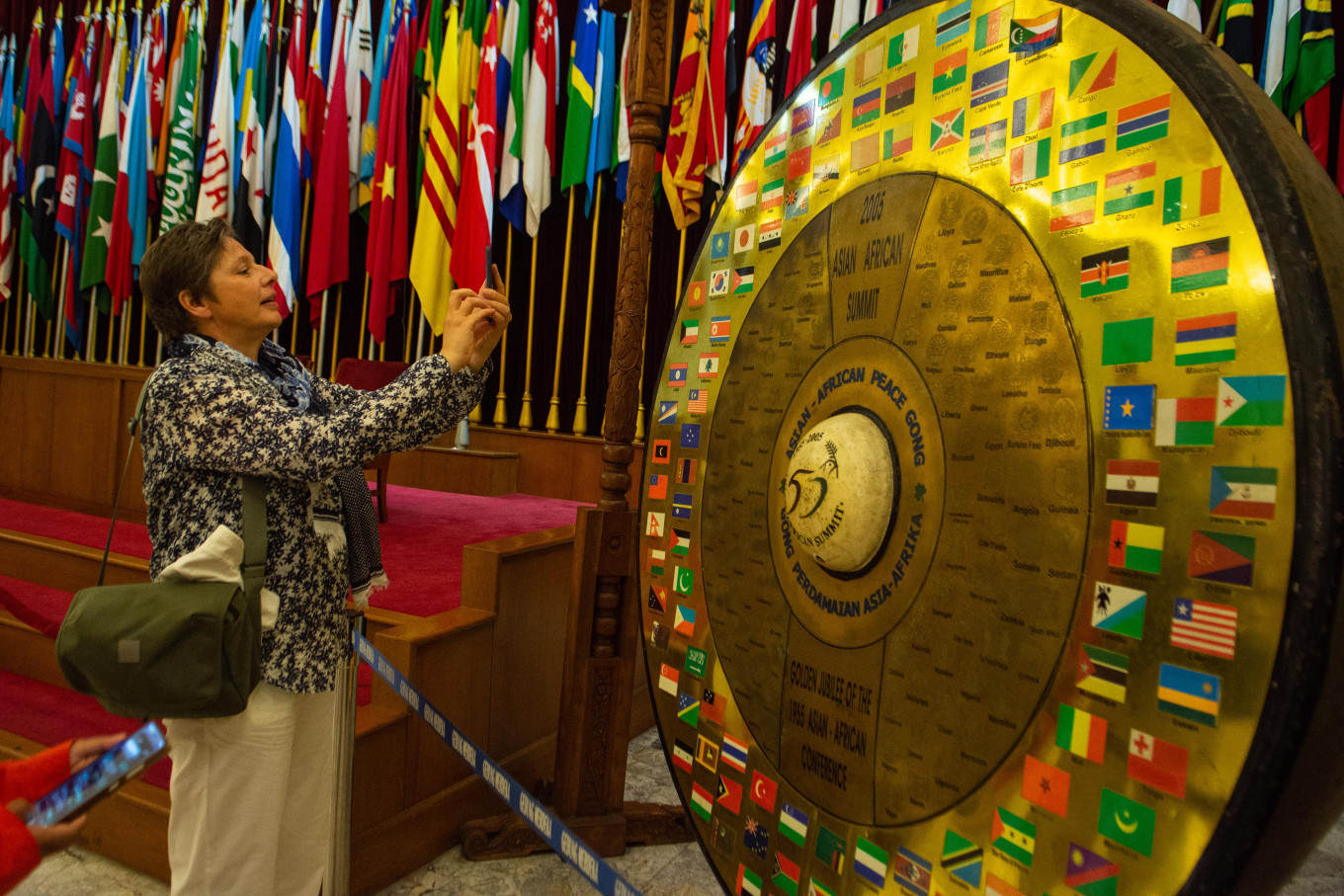 Bandung spirit: A foreign visitor takes a photo of the Asia-Africa Conference gong on April 15 at the Merdeka Building in Bandung, West Java. Inaugurated in 1980, the Asia-Africa Conference Museum receives 400-500 visitors per day and is expected to see an increase during the 71st anniversary of the Asia- Africa Conference from April 18 to 24. (Antara/Novrian Arbi)
I
n April 1955, representatives of 29 Asian and African nations gathered in Bandung, Indonesia. They convened not to respond to the agenda of others, but to set their own.
No Western power was invited - a deliberate act, not an oversight. In a world where gatherings without a Western presence were considered inconsequential, Bandung answered with a different proposition: they asserted that the majority of humanity could chart its own course. And it did. The Non-Aligned Movement that emerged was not merely a diplomatic posture; it was an assertion that the world was larger than the frameworks imposed upon it.
Seventy years later, that assertion remains unfinished business.
What Bandung’s generation confronted was not only political subordination, but something harder to name and therefore harder to dismantle: the subordination of ways of knowing. Sociologist Syed Hussein Alatas called it the "captive mind" - the intellectual who studies his own society exclusively through categories produced elsewhere, treating borrowed tools as universal truths.
The captive mind does not feel its captivity, and that is precisely what colonialism’s intellectual legacy was designed to achieve. While Bandung represented a turning point in the political struggle for independence, the deeper independence - of thought, knowledge, and imagination - remained elusive. In that sense, colonialism did not end in the 1960s; it was transformed.
Financial systems, educational models and legal frameworks were all reconfigured to present the colonial order as natural and inevitable. What we call the postcolonial world is coloniality operating under a new language while preserving a seamless continuity.

Our present moment is better understood as an era of re-coloniality. Yet this Western-centric order is no longer merely contested; it is visibly unraveling - nowhere more starkly than in Gaza. What Gaza has exposed is the collapse of the normative architecture that was supposed to govern the modern world.