TheJakartaPost
Please Update your browser
Your browser is out of date, and may not be compatible with our website. A list of the most popular web browsers can be found below.
Just click on the icons to get to the download page.


Popular Reads
Top Results
No results found. Please check your search term and try again
Can't find what you're looking for?
View all search results
Popular Reads
Top Results
No results found. Please check your search term and try again
Can't find what you're looking for?
View all search resultsThe silent challenge for women CSOs in eastern Indonesia
When rigid "one size fits all" accounting meets the complex realities of Eastern Indonesia, the very rules designed to ensure transparency risk silencing the marginalized voices they were meant to empower.
Change text size
Gift Premium Articles
to Anyone
Share the best of The Jakarta Post with friends, family, or colleagues. As a subscriber, you can gift 3 to 5 articles each month that anyone can read—no subscription needed!
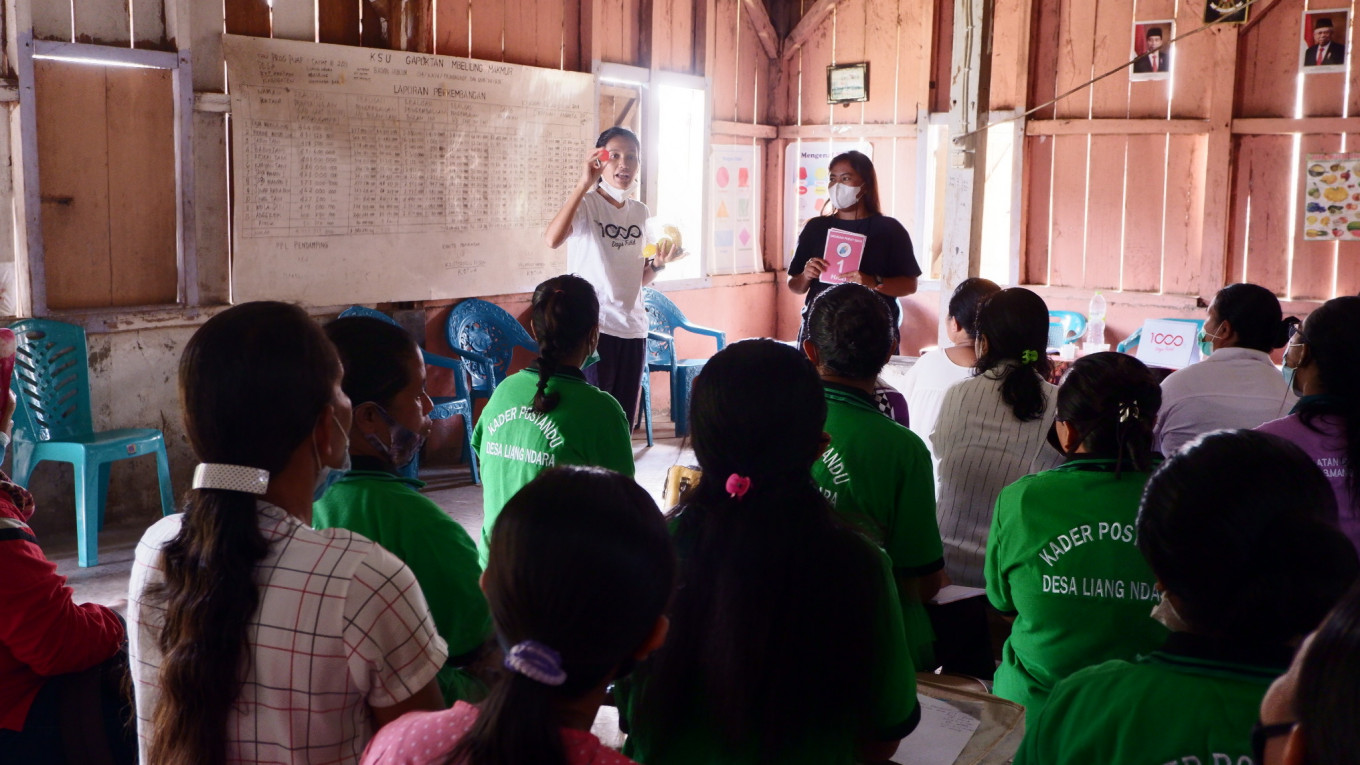 Continuous training: The 1000 Days Fund has been giving training for community health workers (kader) in Komodo Island and beyond with everything they need to know about stunting. (JP/Vania Evan)
I
nclusive development can only be realized if the most marginalized groups in society - such as women in Eastern Indonesia - receive serious, sustained support. In this context, women’s civil society organizations (CSOs) are crucial.
Amid the persistent imbalance in infrastructure and services, these CSOs are on the front lines, reaching those hardest for the government to serve. Their social proximity also means they are more sensitive to the invisible issues that are often overlooked by outsiders.
However, women’s CSOs in Eastern Indonesia face challenges from all directions. Beyond lagging development, they must navigate a dominant patriarchal culture and work practices imported from the western (Java) and central (Sulawesi, Kalimantan) regions of the country.
Paradoxically, they also experience serious difficulties from a source meant to support them: the financial management standards of funding institutions. This "silent challenge" threatens both the work and the very existence of women's CSOs in the region.
In September 2024, in the town of Merauke, South Papua, a dispute broke out between a local CSO and a development assistance institution. The CSO could not provide the required supporting documents - specifically vehicle registrations (STNK) and identity cards (KTP) - to account for their grant funds. The problem was not a lack of understanding of the rules; rather, the vehicles they leased in the town generally did not have legal documents. In Merauke, even basic documentation like ID cards or birth certificates is rare for many adults.
A similar story emerged from East Nusa Tenggara (NTT). During one activity, because many participants were illiterate, the CSO used thumbprints on the attendance list instead of signatures. This practical initiative later became a major obstacle during the financial reporting process.

These problems are not confined to the most remote regions. Even in Bogor, West Java, just 60 kilometers south of Jakarta, a CSO faced a similar impasse. A donor’s administrative staff demanded copies of members’ ID cards for transport reimbursement.