The Jakarta Post
Please Update your browser
Your browser is out of date, and may not be compatible with our website. A list of the most popular web browsers can be found below.
Just click on the icons to get to the download page.


Popular Reads
Top Results
No results found. Please check your search term and try again
Can't find what you're looking for?
View all search results
Popular Reads
Top Results
No results found. Please check your search term and try again
Can't find what you're looking for?
View all search resultsHormuz reopening could be OPEC’s undoing
Saudi Arabia and neighboring Gulf producers will cheer the eventual reopening of the Strait of Hormuz, but the ensuing flood of oil risks eroding OPEC’s already fragile grip on the market.
Change text size
Gift Premium Articles
to Anyone
Share the best of The Jakarta Post with friends, family, or colleagues. As a subscriber, you can gift 3 to 5 articles each month that anyone can read—no subscription needed!
 Set as preferred source
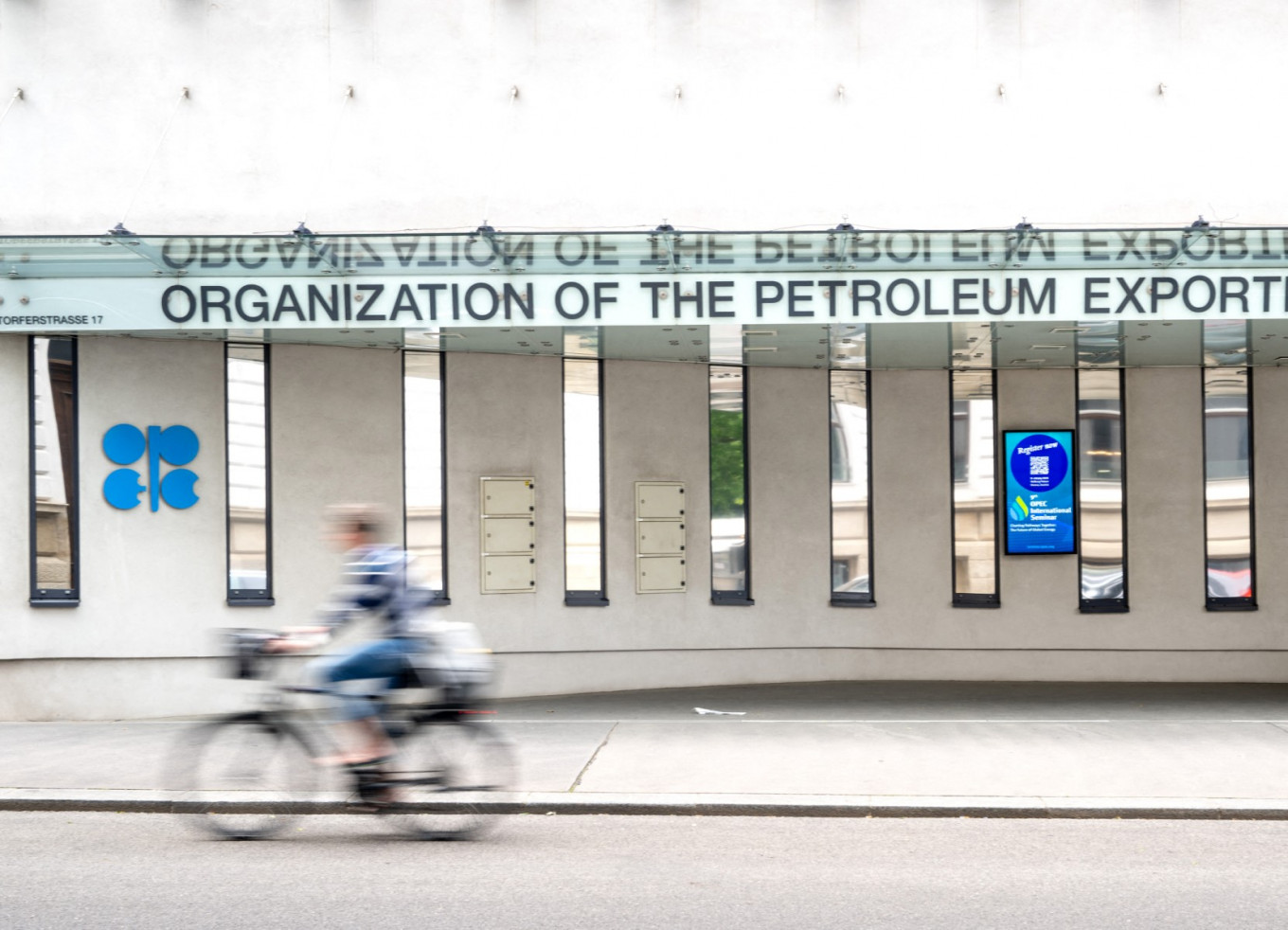 A cyclist rides past the building headquarters of OPEC (Organization of The Petroleum Exporting Countries) in Vienna, Austria on May 28, 2025. (AFP/Joe Klamar)
S
audi Arabia and neighboring Gulf producers will cheer the eventual reopening of the Strait of Hormuz, but the ensuing flood of oil risks eroding Organization of the Petroleum Exporting Countries (OPEC)’s already fragile grip on the market.
The Iran war and the closure of the vital waterway, through which nearly a fifth of the world’s oil and gas flowed before the conflict, have sharply diminished output from OPEC and moved the industry’s center of gravity away from the Middle East.
Riyadh’s options for countering these changes are limited.
It remains far from clear when the strait will reopen or what conditions will look like when it does. While United States President Donald Trump insists that traffic through the waterway should return to its pre-war norm, Iran is determined to retain some measure of control, suggesting any recovery will be cautious, contested and bumpy.
Yet amid the uncertainty, one outcome looks almost inevitable: Saudi Arabia, Bahrain, the United Arab Emirates, Qatar, Kuwait, Iraq and Iran will all seek to maximize oil exports to plug the vast fiscal holes created by the conflict.
The loss of roughly 13 million barrels per day of Middle East exports, around 13 percent of global supply, since the start of the war on Feb. 28 represents more than US$80 billion in lost revenue, according to ROI calculations.

Damage to energy infrastructure, including refineries, storage facilities, tankers and liquefied natural gas plants, runs into the tens of billions of dollars.
The incentives to move quickly will be huge given pent-up demand from major energy importers, particularly in Asia.
Asian governments and refineries have sharply curtailed consumption during the conflict and drawn down inventories. Many will likely be eager to rebuild stockpiles.
Supply and demand are unlikely to recover in sync, however.
For starters, it could take months for Middle East producers to restart much of the roughly 11 million bpd of shut-in output. It’s also unclear how much demand has been truly destroyed and how much has simply been postponed.
Add lingering geopolitical concerns, and the likely result is an uneven, stop-start rebound that strains supply chains and injects fresh volatility into oil prices.
Historically, such conditions would have played to OPEC's strengths. The group and its allies, including Russia, have repeatedly intervened to stabilize markets during past crises by adjusting output. A prime example is the COVID-19 pandemic, when coordinated cuts and subsequent increases helped steer prices through extreme swings.
This time, however, the cartel looks far less capable of playing that role.
The war has left OPEC weakened and fragmented. Its production collapsed to an average 20 million bpd in April from 31 million in February, according to US Energy Information Administration data. OPEC’s share of global production has dropped to an all-time low of around 22 percent.
More damaging still, the UAE’s decision in April to quit the group to pursue its own production growth strategy dealt a significant blow to both OPEC’s cohesion and Saudi authority.
Compounding the strain has been Russia’s inability to ramp up exports and act as a swing supplier within the wider OPEC+ alliance because of repeated Ukrainian drone strikes on its energy infrastructure, part of Kyiv's campaign to weaken Moscow's war economy.
Against this backdrop, the reopening of Hormuz could leave Riyadh in an awkward position. Revenue-starved OPEC members are likely to compete aggressively for market share, pushing more barrels onto the market and exerting heavy downward pressure on prices. Riyadh will struggle to convince them to rein in production to prop up prices.
Saudi Arabia’s own wartime actions may further undermine its leverage. By diverting more than 60 percent of its exports through the Red Sea, Riyadh was able to take advantage of the price surge during the conflict. That will make it harder for the kingdom to persuade producers such as Iraq and Kuwait, which had few or no alternative export routes, to restrain output once full access is restored.
OPEC’s recent policy signals reinforce the direction of travel. On Sunday, the group agreed to a fourth consecutive monthly output increase.
At the current pace, OPEC+ is on track to fully unwind, at least on paper, the 1.65 million bpd of cuts agreed in 2023 by September.
To be sure, any supply rebound will not be immediate. Still, the balance of risks points firmly towards oversupply.
Returning OPEC barrels alongside sustained high output from countries including the US, Brazil and Venezuela could leave the global market facing a surplus of around 5 million bpd in the months after a full reopening of Hormuz, according to Rystad Energy analyst Jorge Leon.
Crucially, producers outside the Gulf, including some OPEC members, have solidified their market positions during the crisis. That should make it harder for Gulf producers to reclaim lost share without aggressive pricing.
Over the decades, the producer group has shown a willingness to engage in painful price wars. But starting one now, after the most disruptive supply shock in decades, risks spinning out of control and further hastening the end of the OPEC era.
---
The writer is a columnist for Reuters. The views expressed are personal.